


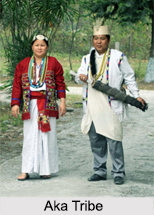
 Aka Tribes dwell in the state of Arunachal Pradesh. They are mostly concentrated on the south-eastern provinces of the state’s Kameng district division. As far as its name is concerned, the word Aka has an indigenous origin and it means ‘painted’, thus symbolizing their culture of applying paints on their face and that too vividly. This unique manner of painting has become a trademark of this Aka tribal community. Aka Tribes dwell in the state of Arunachal Pradesh. They are mostly concentrated on the south-eastern provinces of the state’s Kameng district division. As far as its name is concerned, the word Aka has an indigenous origin and it means ‘painted’, thus symbolizing their culture of applying paints on their face and that too vividly. This unique manner of painting has become a trademark of this Aka tribal community.
Origin of Aka Tribe The folklore of Aka Tribe claims that their ancestor was King Bhaluka, the grandson of King Bana who was defeated by Lord Krishna at Tezpur. The Aka language originated from Tibeto-Burman family. There are two dialects, namely Hrusso Aka and Kora Aka. They are a close-knit community, with eleven clans and sub clans. The independent Aka tribes are also known as ‘Hrusso’. Society of Aka Tribe The Aka people have a simple caste system and polygamy is practiced in their society. Their caste is divided in the commoner Kevatsum and aristocrat Kutsun. Even there is a system of cross cousin marriages in the Aka society. Their administration is carried out by the simple method of electing chief or the headman of the village. They built a special kind of house that has a raised platform, almost 6 feet above the ground with two rooms separated with a partition wall. The house also provides shelter for various animals like pigs and goats. Occupation of Aka Tribe Aka tribes practice ‘Jhum Cultivation’. They consider millet and maize as their staple food and pulses, plant leaves, rice and potato are generally cultivated in lands. Their popular drinks namely Aarah, Mingri and Lao pani are made of fermented millet and maize. Culture of Aka Tribe 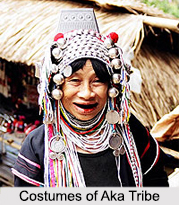 A close affinity with the Miji along with intermittent Tibetan and Vaishnava influences from the Sherdukpen group had been the reason behind shaping up the modern Aka culture. The culture of Aka tribe is enriched due to its treasures of folk art and crafts. The major art and crafts of Aka tribe include basket weaving, handiworks and wood sculpture. The most common Aka art is the beautiful drawings on wood that are mostly found in their house. A close affinity with the Miji along with intermittent Tibetan and Vaishnava influences from the Sherdukpen group had been the reason behind shaping up the modern Aka culture. The culture of Aka tribe is enriched due to its treasures of folk art and crafts. The major art and crafts of Aka tribe include basket weaving, handiworks and wood sculpture. The most common Aka art is the beautiful drawings on wood that are mostly found in their house.
Tattooing too is popular mainly amongst the women. Facial tattoos include an outline of a straight line running from below the forehead to the chin from where it again diverges into two directions. No other part of the body is tattooed. Akas have the practice of keeping weapon for self-defence from the attacks of wild animals and also for hunting. The most significant weapon is the bow and arrow, popularly known as the ‘Tkeri’ and ‘Moo’ respectively. Another significant weapon is a type of rough harpoon, one end of which is pointed with sharp iron nails embedded on it. Religion of Aka Tribe The Aka are religious minded, chiefly following ‘Donyi-Polo’ religion, who consider that their primitive ancestor was ‘Abo-Teni’. In the religious belief of the Aka people, the influence of Tibetans and the Buddhists are prevalent. Thus the religion of the Aka tribe is an amalgamation of the influence derived from Tibetan, Buddhist and Hindu concept of religion. The Aka people are the practitioners of magic and spell. Festivals of Aka Tribe Local festivals also are feted in great enthusiasm, performed mainly under the guidance of a village ‘shaman’. Amongst them, ‘Nechido’ festival is quite important usually held in November and continued for four days at a stretch. Costumes of Aka Tribe The costumes of Aka tribe have an indigenous style and difference is found among the dresses of men and women. There is a custom of wearing Tibetan knobbed hat and Assamese silk. On the other hand, long garment of dark-red colour is preferred by the women of this community. One of the most important parts of the Aka costume is the cane cap enclosed with two bird-feathers. Jewellery is an integral part of the Aka costumes, especially for the women of this community. One can find an Aka woman wearing quite a number of silver ornaments including bead necklaces. ‘Melu’ is a flat shaped ornament worn over the chest; ‘Rombin’ are the ear bulbs, ‘Gichlu’ are the earrings and ‘Gejjul’ are the wristlets. They wear a fillet of silver chain-work, popularly known as ‘Lenchhi’. Special jewellery called ‘Aescheri’ has been handed over to the people by their ancestors. The parents of bride mainly give it at the time of marriage. It is worn mostly by women; sometimes men also wear this jewellery. |
| |||



Home > Society > Indian Tribals > Indian Tribal People > North East Indian Tribes > Tribes of Arunachal Pradesh > Aka Tribes
Aka Tribes
| Aka Tribes of Arunachal Pradesh have artistic fervour widely flowered in artworks like silver jewelleries, wood crafts, etc. |
| ||||||||||||||||||||||||||||

