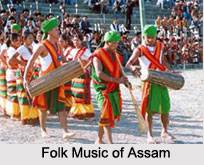
Folk Music of Assam is rich and encompasses different types of folk music. Some of the famous Folk Music of Assam is as follows:
Bihu Geet: The festival of Bihu is the heart and soul of Assamese culture and Bihugeet are the songs sung during this festival. The carnival of life is expressed through Bihu songs. These songs are performed by youth, which is characterized by, flinging and flipping of hands, brisk stepping and swaying of hips.
Kamrupiya Lokageet: Kamrupiya Lokageet is a popular form of folk music of Assam, which is basically sung in lower Assam. This music developed during the reign of Kamrupa Kingdom. These songs are based on various human emotions, especially of common people. It is known for its richness of musical style.
Goalporiya Lokageet: Goalporiya Lokgeet is a form of folk music of Assam, which is mainly sung in the Goalpara district of Assam. It is basically lyrical song of Goalpara based mainly on love.
Tokari Geet: Tokari Geet is another type of folk music of Assam which is based on different Indian mythological stories as well as the social life of people. These songs are performed with Tokari, a folk musical instrument with a single string played with fingers, cymbals and flute. These songs are mainly sung by the male folk led by a leader.

Aainam: Aainam is a devotional folk music of the state, which is sung by the women. It is related to death and illness, and is sung when someone in the family is suffering from some serious sickness, especially small pox. It is sung by women clapping their hands to praise the Goddess and is still prevalent in lower Assam.
Bianaam: Bianaam is another popular form of folk music of Assam, which is prevalent in both Upper Assam and Lower Assam. These are basically marriage songs sung during the marriage and are generally fun making the bride and groom. These songs illustrate epic stories of King Baana and his daughter Usha who was married to Anniruddha, the grandson of Lord Krishna. These songs are particularly sung by the women folk of the society.
Dihanaam: It is a congregational prayer in praise of the Assamese saint Sankardev. Dihanaam is mainly sung by women in Assam and is accompanied by musical instruments like Negera, taal, khol and also hand-clapping.
Bhawaiya: It is a folk musical form that resembles tunes of pop and was originated in northern part of Bengal during the 16h century. Gradually, the music made its way to Assam and is currently sung in various themes by the working class. The music has evolved over centuries and is now accompanies by folk dances.
Ojapali: It is a type of folk music and dance form that is considered as one of the ancient art forms in Assam. Ojapali is mainly performed in groups and is common during religious festivals and celebrations. The lyrics of Ojapali have been inspired by Padma Purana.
Nawariageets: Nawariageets, or the boatmen’s songs of Assam, form an integral part of Assam’s folk music. Marked by spontaneous joy and flowing rhythm, these songs carry the same spirit as Bengal’s Bhatiali tunes, “bhata” meaning downstream. It is believed that Nawariageets originated when boatmen, free from the strain of rowing, paddled leisurely or allowed their boats to drift with the current. This suggests that the tradition dates back to a time before the advent of railways and modern roads, when rivers were the lifelines of communication.
Bongeet: Bongeets is a distinct category of
Assamese folk music that bear a close resemblance to Bihugeets. Often compared
to the woodmen’s ballads of the West, they arise from the rhythms of rural life
and the beauty of the natural landscape. A peasant, immersed in his daily toil,
sings while harvesting his fields. These songs accompany farmers as they rear
Endi and Muga cocoons in mulberry groves, cast their nets across quiet lagoons,
or paddle their boats along gentle streams. It is in such simple, unhurried moments
that the peasant pours his heart into song and it is in these very moments that
the Bongeet is born.
Dehbichar Geet: Dehbicarar Geets represent a unique category of folk poems in Assamese literature, distinct in tone and outlook from other traditional forms. Centered on themes of spiritual absorption and mystical reflection, these verses explore human life, its fleeting nature, and the guiding presence of a higher force that shapes destiny. With their profound spiritual undertones, they are widely believed to have been inspired by Vaishnava philosophy and belief. This connection is further affirmed by the frequent presence of Bhanitas attributed to Madhavadeva, the 16th-century Vaishnava saint-poet, interwoven within many of these metaphysical lyrics.
Jikir Songs:
Jikir songs are religion-based folk songs of Assam, deeply rooted in Islamic
teachings and traditions. Popular among the Muslim communities of the region,
they are often regarded as the Islamic counterpart of Dehbicarar Geets. The
term ‘Zikir,’ derived from the Arabic word ‘Ziqr,’ literally means
“remembrance” or “chanting the name of Allah.” These devotional songs gained
prominence in the 17th century through the efforts of the Sufi saint and poet
Hazrat Shah Miran, widely revered as Ajan Fakir. According to legend, he came
to be known as Ajan Fakir or Ajan Pir because he introduced the practice of
reciting the Azan.
Nichukoni geet: Nichukanigeets, or cradle
songs, are gentle and tender melodies marked by their soft, lingering notes.
Sung to soothe and delight, they often weave simple stories and tales that
bring joy and comfort to a child. Blending melody with imagination, these songs
create a harmony that carries the child into a world of playful thoughts and
dreams. Well-loved examples include the lyrical “Lai hale jale abeli batahe”
and the enchanting “Sialie nahibi rati”, both of which spark a child’s fancy
and transport them into realms of wonder. Assamese cradle songs are believed to
carry the influence of Vaishnava poetry, enriching them with both spiritual
depth and poetic beauty.
Apart from the above mentioned, there are several other
types, namely Jhumur, Hiranaam, Gorokhiya Naam, Deori Mosaia, Zari songs, Holi
Geet, Nao Khelor geet, Siyaan Geet, etc.