


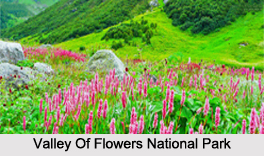
 The land of magnificence, enchantment, trance and splendor, the valley of flowers is undoubtedly the most important part of the Bhyundar Valley of Uttaranchal. Perched almost 3 kms climb from Ghangria, the valley of flowers is as if a dream suddenly turned into reality. Beauty drops her image on almost everything and everywhere. The motley of colours, the fusion of shades and indeed the vibrant magic of the valley have that entire exotic and mysterious splendor, veiled in her heart. With hundreds of flowering plants playing magic on the beholders mind and sight, with the seethe of those nameless flowers the valley is sure to enchant one whilst leaving, awestruck. The land of magnificence, enchantment, trance and splendor, the valley of flowers is undoubtedly the most important part of the Bhyundar Valley of Uttaranchal. Perched almost 3 kms climb from Ghangria, the valley of flowers is as if a dream suddenly turned into reality. Beauty drops her image on almost everything and everywhere. The motley of colours, the fusion of shades and indeed the vibrant magic of the valley have that entire exotic and mysterious splendor, veiled in her heart. With hundreds of flowering plants playing magic on the beholders mind and sight, with the seethe of those nameless flowers the valley is sure to enchant one whilst leaving, awestruck.
The Valley of Flowers National Park is located in Chamoli Garhwal, about 595 km northeast of India's capital Delhi. Govindghat (1800 m) is a 22kms drive from Joshimath en-route to Badrinath. After the 15 km trek from Govindghat to Ghangria, lies the land of beauty, dream, colours and romance- " the Valley of Flowers". Spreading over an area of 87.5 Sq. Kms and with the varying altitude ranging from 3,200 m to 6,675 m, the valley with its magical touch provides a great diversity of landscape and microhabitats. Thick white snow and colourless glaciers covers almost 73 percent of the valley. Forests in the National Park constitute only about 5.29-sq km that is only 6 percent area while the alpine meadows cover 18.63 sq km that is 21 percent of the valley. A riot of color amidst the frosty whispers of the snow and the evergreen verdure of the lushness makes the Valley of flower a dream world where magic weaves the saga of love. The vast expanse of fluorescent green enclosed by cliffs of glacial ice paints a magical picture of the valley The brilliantly colored valley, which can amuse, bewitch, entice and mystify stands as the icon of freshness and sparkle whilst encircled by the peaks like Nar Parbat (5,245m) to the northwest, Nilgiri Parbat (6,479m) to the north, Rataban (6,126m) across the Bhuindhar Pass, with Gauri Parbat (6,708m) to the east and Saptasring (5,038) to the south. The flowing Lakshman Ganga from Lokpal lake (4,150m) in the Hemkund valley offers a holy dimension to the valley. Sub Alpine between 3,200m and 3,500m. Lower Alpine between 3,500m and 3,700m, and the higher alpine above 3,700m are the three main vegetation zones of the valley. The credit to popularize the Valley of Flowers among masses generally goes to a British mountaineer- Frank S. Smythe who accidentally visited this area in 1931 and published a book "The Valley of Flowers" 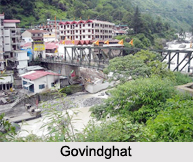 The valley has been described as 'Nandan Kanan' meaning "Garden of Indra in Paradise" in the Hindu mythology. Legends and myths lace the valley. Legend associates this valley with the area from where lord Hanuman collected 'Sanjeevani' herb to revive Lakshman, younger brother of lord Rama, when Lakshman fell unconscious during war with Meghnad, son of Ravana. The valley has been described as 'Nandan Kanan' meaning "Garden of Indra in Paradise" in the Hindu mythology. Legends and myths lace the valley. Legend associates this valley with the area from where lord Hanuman collected 'Sanjeevani' herb to revive Lakshman, younger brother of lord Rama, when Lakshman fell unconscious during war with Meghnad, son of Ravana.
The three kilometers trail to the valley just after crossing the log bridge over the Laxman Ganga from Ghangaria is indeed a gentle journey. The magical seethe of wild flowers, the exotic sight of those nameless, endless vast verdure lining the way, makes the journey as if a trip to paradise. The matching brilliance of colours teamed with the fluorescent hues of the butterflies that flit by makes the valley even more charming. Among the important species that are found here are numerous mammalian species, namely, Leopard, Himalayan Tahr, Musk Deer, Red Fox, Himalayan Weasel, Ye How-throated Marten, Himalayan Black Bear, Brown Bear, Himalayan Mouse-hare, Bharal (Blue Sheep), Indian Flying Squirrel. Also some carnivorous birds like Lammergeier, Himalayan Griffon, Common Kestrel, Golden Eagle, Black Eagle, thrive in some reclusive corners of the park. Other birds include Himalayan Monal, Koklass Pheasant, Kalij Pheasant, Himalayan Snowcock, Snow Partridge, Hill Partridge, Chukar, Red-billed Chough, Yellow-billed Chough, Common Raven, Grandala, Snow Pigeon, Spotted Laughingthrush, Variegated Laughingthrush, Plain-backed Thrush, Upland Pipit, Rosy Pipit, Rock Bunting, White-capped Bunting. In fact the whole valley is filled with the music of these chirping birds. Along side the coastal areas , numerous birds throng. These include Brown Dipper, White-throated Dipper, Spotted Forktail, Little Forktail, pines, maples, firs, spruces, rhododendrons, silver birch, asters, balsams, dandelions, edelweiss , gentians, geraniums, irises, lilies, poppies , potentillas, primulas, saussurea and senecios. |
| |||



Valley Of Flowers National Park
| With its ancient tradition and heritage and amidst its lushness the Park is indeed the hub of colorful flowers and plant |
| ||||||||||||||||||||||||||||

