


 In East India, a handful of tiger reserves proliferated in plenty. Among them, Simlipal Tiger Reserve deserves special mentioning. Located in the Mayurbhanj District of Odisha, Simlipal Tiger Reserve is one of the largest reserved areas in the whole of Indian subcontinent. A forested, rugged terrains lying 200 km southwest of Kolkata, the reserve has rich ecological heritage. In fact, it got its name from semul or red silk cotton trees, which are found in abundance within the territory especially during the first few months of the year. In East India, a handful of tiger reserves proliferated in plenty. Among them, Simlipal Tiger Reserve deserves special mentioning. Located in the Mayurbhanj District of Odisha, Simlipal Tiger Reserve is one of the largest reserved areas in the whole of Indian subcontinent. A forested, rugged terrains lying 200 km southwest of Kolkata, the reserve has rich ecological heritage. In fact, it got its name from semul or red silk cotton trees, which are found in abundance within the territory especially during the first few months of the year.
Topography of Simlipal Tiger Reserve The topography of the Simlipal Tiger Reserve is quite rugged, nicely intercepted by a number of stream and rivers. The wild habitats are found on the banks of mighty rivers, namely, East Deo, Palpala, Budhabalang, Khadkei, Khairi and Bandhan. Also the swampy tracts and impressive waterfalls are no less in number, the premium and most popular are Barheipani and Joranda. The stretches of semi-evergreen and moist-deciduous forests are interspersed with splendid sal trees and flat meadows. Huge conglomeration of wildlife is concentrated in various places of Simlipal tiger reserve, namely Chahala, Bachurichara, Devsthali and Sapaghar. History of Simlipal Tiger Reserve The origin of Simpilal Tiger Reserve has an interesting story behind it. The reserve was the hunting conserve of the Mayurbhanj maharajas. In the year 1957, a small area was announced as a sanctuary. The tiger reserve covers more than 2,750 sq km, out of a total area of 4,374 sq km that forms the 'biosphere reserve'. The Simpilal Tiger Reserve is an integral part of Simlipal National Park, covering an area of 845 sq km. It is a pathway of total wilderness. Over the years, many initiatives have been taken by the forest department to preserve the treasures of the reserve. Numerous jungle visits have been organized for the tourists, keeping the restrictions of limited traffic infiltration in the northern part of the Simlipal Tiger Reserve. Unfortunately, certain areas have degenerated into picnic spots. Flora and Fauna of Simlipal Tiger Reserve Simlipal Tiger Reserve is copious in restoring the beauty of wild flowers and plants. There are almost thousand types of flowering plants that blossom here. Out of these, 94 are orchids, finding place even in flower show organized in grandeur at the small "orchidarium" at Gurguria region. 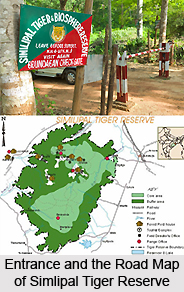 Simlipal Tiger Reserve is a fountainhead of wild fauna and flora. The three of India's most popular animals, namely tiger, Asian Elephant and Gaur are its denizens. However, the tourists can catch a glimpse of these wild beasts occasionally due to rugged terrain and dense vegetation.
From the leafy covering, the giant squirrel's howling cry nicely enmeshes those of chirping birds. These are near about 250 bird species that throng the region. Woodland birds include Painted Spurfowl, Red Spurfowl, Red Junglefowl, Grey Francolin, Malabar Pied Hornbill, Lineated Barbet, Malabar Trogon, Blue-bearded Bee-eater, Chestnut-headed Bee-eater, Blue-faced Malkoha, Asian Fairy Bluebird, Spangled Drongo, Black-naped Oriole, Hill Myna, Large Wood shrike, Scaly Thrush, White-rumped Shama, Striped Tit Babbler, and Crimson Sunbird. Also Crested Serpent Eagle, Black Eagle, Oriental Honey-buzzard, Changeable Hawk Eagle, Booted Eagle, Peregrine Falcon, Dusky Eagle Owl, Brown Hawk Owl are some bird raptors that too are found in any of the dense forest nook of the region. In the Simlipal Tiger Reserve, numerous bils and rivers are found enriching the aquatic life to grow in leaps and bounds. The Stork-billed Kingfisher has a regular habitat. Marsh Crocodiles, better known as Muggers, and several other reptiles like King Cobra, Rock Python can be seen along the rivers. In fact, a captive-engendering project, namely, the Mugger Crocodile Scheme at Jashipur, has been undertaken in the northwestern fringes of the reserve, aiming to reinstate this viable crocodile specie to Simlipal Tiger Reserve. Mammals like tiger, Leopard, Leopard-cat, Jungle Cat, Wild Dog (Dhole), Wolf, Striped Hyena, Small Indian Civet, Ratel, Sloth Bear, Asian Elephant, Gaur (Indian Bison), Sambar, Spotted Deer (Chital), Barking Deer, Mouse Deer, Chowsingha (Four-horned Antelope), Indian Pangolin too are found in abundance. 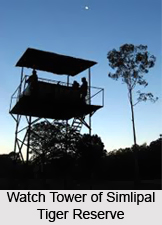 Protection of wildlife at Simlipal Tiger Reserve
Too much of hunting in the past seriously damaged the wildlife of Simlipal Tiger Reserve. Local tribal communities still indulge in an annual ritual hunt, popularly known as akhand shikar, with the help of bows and arrows. Illegal Intrusion, livestock pasturing, cooking and varied visitors aggravate the problems. What is the need of the day is the effective protection and awareness. In spite of nature's bounty, these measures are essential for the sustenance of this wilderness.
Protection of wildlife at Simlipal Tiger Reserve
Too much of hunting in the past seriously damaged the wildlife of Simlipal Tiger Reserve. Local tribal communities still indulge in an annual ritual hunt, popularly known as akhand shikar, with the help of bows and arrows. Illegal Intrusion, livestock pasturing, cooking and varied visitors aggravate the problems. What is the need of the day is the effective protection and awareness. In spite of nature's bounty, these measures are essential for the sustenance of this wilderness.
Visiting Information Private or shared bus and jeeps are available for a trip to the tiger reserve. The nearest Railway Station is Balasore Railway Station which is located at a distance of 76 Kms from Simlipal. It is well connected to many major cities like Midnapore, Rourkela, Kolkata, Sambalpur and Hyderabad etc. People coming in from outside the country can fly in to the Netaji Subhash Chandra Bose International Airport in Kolkata, or the Biju Patnaik International Airport in Bhubaneswar; each situated roughly 365 km and 191 km away from Similipal respectively. The nearest town from Similipal is Baripada; situated on the junction of National Highway 5 and 6. |
| |||



Home > Reference > Flora & Fauna > Indian National Parks > Tiger Reserves in India > Simlipal Tiger Reserve
Simlipal Tiger Reserve
| To the lovers of wild life, Simlipal Tiger Reserve is a known name due to its preserve of wild life. |
| ||||||||||||||||||||||||||||

