


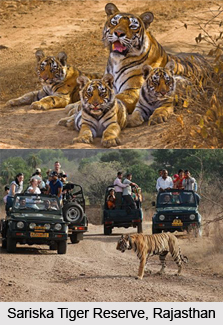
 Sariska Tiger Reserve is one of the famous trigger reserves of the country. This reserve is situated at around 200 kms from Delhi and 107 kms from Jaipur. Although larger than Ranthambore Tiger Reserve, it is less commercialised and has less tigers but a similar topography. It covers an area of 800 sq km in total, with a core area of approximately 500 sq km. The area was declared a sanctuary in the year 1955 and became a National Park in the year 1979. Remnants of past architectural wonders are being available in every hook and nook of the Sariska Tiger Reserve. Mughal emperor, Aurangzeb, is said to have locked up his elder brother, Dara Shikoh, in the rugged hilltop fort of Kankwadi. The ruins of a myriad Hindu and Jain temples built between the 8th and the 12th centuries are a proof to the great architecture of the past. Pandupole that lies in the south eastern region had an association with the Pandavas of the Hindu epic, Mahabharata. Sariska Tiger Reserve is one of the famous trigger reserves of the country. This reserve is situated at around 200 kms from Delhi and 107 kms from Jaipur. Although larger than Ranthambore Tiger Reserve, it is less commercialised and has less tigers but a similar topography. It covers an area of 800 sq km in total, with a core area of approximately 500 sq km. The area was declared a sanctuary in the year 1955 and became a National Park in the year 1979. Remnants of past architectural wonders are being available in every hook and nook of the Sariska Tiger Reserve. Mughal emperor, Aurangzeb, is said to have locked up his elder brother, Dara Shikoh, in the rugged hilltop fort of Kankwadi. The ruins of a myriad Hindu and Jain temples built between the 8th and the 12th centuries are a proof to the great architecture of the past. Pandupole that lies in the south eastern region had an association with the Pandavas of the Hindu epic, Mahabharata.
The landscape of Sariska Tiger Reserve comprises hills and narrow valleys of the Aravalli mountain ranges. The topography of Sariska supports scrub-thorn arid forests, dry deciduous forests, rocks and grasses. The broad range of wildlife here is a wonderful example of ecological adoption and tolerance and is supported by the climate, which is quite erratic. Sariska Tiger Reserve has steep hills, low slopes and dry but dense forest covering its rugged landscape. It is located in Alwar District and is the legacy of the Maharajas of Alwar. Pavilions and temples within Sariska are ruins that hint at past riches and glory. The nearby Kankwadi Fort has a long and turbulent history. Sariska Tiger Reserve blends with stretches of grassland where herbivores such as the Sambar (the largest Indian deer), the Spotted Deer or Chital, 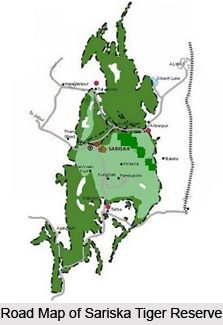 the Wild Boar and the Langur can be seen, usually with bands of peafowl. Nilgai (Blue Bull) and Chowsingha (Four-horned Antelope) are also common grazers. the Wild Boar and the Langur can be seen, usually with bands of peafowl. Nilgai (Blue Bull) and Chowsingha (Four-horned Antelope) are also common grazers.
Beautiful birds also are no less significant. In fact the entire Sariska Tiger Reserve is filled with the melodious tunes of the chirping birds. Among various species, important one are Grey Francolin, Indian Peafowl, Jungle Bush Quail (below), White-eared Bulbul, Kufous Treepie, Lesser Flameback, Blue-tailed Bee-eater, Sirkeer Malkoha, Alexandrine Parakeet, Oriental Turtle Dove, Yellow-footed Green Pigeon, Painted Sandgrouse, Southern Grey Shrike, Rufous-fronted Prinia, Marshall's lora, Babblers, Purple Sunbird, Eurasian Thick-knee, Yellow-wattled Lapwing and others. Along the side of the rivers, numerous birds like Stork, Kingfisher, etc are found in huge numbers. Various bird hunters throng the park. These include Oriental Honey-buzzard, Lesser Spotted Eagle, Imperial Eagle, Short-toed Eagle, Common Kestrel, Shikra, Dusky Eagle Owl, and Eurasian Eagle Owl. The park is home to numerous carnivores including Leopard, Wild Dog, Jungle Cat, Civets Hyena, Jackal, and Tiger. These feed on species such as Sambar, Chital, Nilgai, Chausingha, Wild Boar and Langur. Sariska is also well known for its large population of Rhesus Monkeys, which are found around Talvriksh. Nilgai (Blue Bull) and Chowsingha (Four-horned Antelope) are also are found grazing on the grass fields. They are quite dissimilar from the antelopes so far as the shape of their horns are concerned. The horns are usually reeled in the front, and not circular as such. They are found only in the Indian territories. Numerous waterholes are prevalent in the Sariska Tiger Reserve, throng by the animals especially in the sultry days of summer months. At the secret hideouts at places like Kalighati and Slopka, animals in huge droves roam around at ease. Sariska Tiger Reserve has seen tumultuous times. Nowadays, huge population of urbanities utilises the reserve and its resources to fulfill their needs, thereby depleting the beauty of the reserve day by day. Sariska Tiger Reserve is open almost whole throughout the year, but the months in between October to April are considered best for wildlife viewing. |
| |||



Home > Reference > Flora & Fauna > Indian National Parks > Tiger Reserves in India > Sariska Tiger Reserve
Sariska Tiger Reserve
| Sariska Tiger Reserve is a peace haven for the tigers and other endangered animals, birds and flowers. Sariska Tiger Reserve has a long history behind its origin and development. |
| ||||||||||||||||||||||||||||

