Parashurama Avatar - Informative & researched article on Parashurama Avatar
  Indianetzone: Largest Free Encyclopedia of India with thousand of articles Indian Religion


in  
Art & Culture | Entertainment | Health | Reference | Sports | Society | Travel
Forum  | RSS Feeds  | Free E-magazine
Indian Religion : Vastu Shastra l Indian Religions l Indian Myths l Indian Mythology l Gods of India l Goddesses Of India l Religious Thinkers of India l Types of Religion in India l History of Indian Religion l Indian Yogis l Ajivikas l Sacred Scriptures in Indian Religion l Tantra l Shaivism l Indian Communities l Sacred Animals in India l Roman Impact on South Indian Art and Society l Bhattacharyas l Indian Classical Terms
Home > Society > Indian Religion > Types of Religion in India > Hinduism > Hindu Gods > Lord Vishnu > Avatar > Parashurama Avatar
Parashurama Avatar
Parashurama Avatar glorifies the Towering Might of the Unrivalled Vishnu.

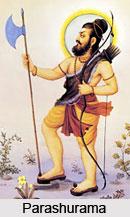
Parashuram Avatar is the sixth Incarnation of the Dasavatars of Vishnu. Since his childhood, he used to move around with his formidable weapon, Parashu, meaning axe. Therefore he was called Parashurama.

The history of Parashurama made for an engaging read. Parashurama appeared on earth to cleanse it of the tyrannical torment of the corrupt warrior class or Kshatriya clan. Parashuram was born to Jamadadgni Muni or monk and his chaste wife Renuka. The angry, Kshatriya -like warrior stance of Parashurama, was inherited from Jamadagni. Jamadagni was the son of Princess Satyavati, the daughter of King Gandhi of Chandravamsha and the great sage, Rucheeka. Both Satyavati and his mother, the wife of King Gandhi, deeply desired for the birth of a male child, to perpetuete the lineage. Rucheeka, gifted both of them a magical herbal concoction for child-conception. But Satyavati`s mother thinking Satyavati`s potion as more effective, did the blunder of interchanging the potion. Subsequently, the functions of the potions were reversed. Jamadagni, imbued with royal temper and bravery was born to Rucheeka, instead of a peace-loving hermit.

Parashurama  Avatar Parashurama is noteworthy among the Dasavatars for his irascibility. Once, King Kaartaveerya-arjuna and his troops ventured out on an expedition in the forest. They went weary, after the day`s toil, and came down to the ashram or haven of the sage Jamadagni, which was in vicinity. The sage treated the guests with a royal feast. When the impressed king asked him about the secret behind the preparation of such delicacy, Jamadagni revealed that all the credit goes to the Divine Cow, Kamdhenu. Lord Indra, the king of gods, offered Kamdhenu, to him. Kamdhenu had the power to confer any favour instantly. Allured, with the facilities given by the divine cow, the greedy king unduly demanded Kamdhenu. But Jamadagni refused him on the valid ground, that since the Cow was a gift from Indra, he had no right to donate it to someone else. But the obstinate and arrogant king paid no heed to Jamadagni`s requests. Under his order, the royal soldiers snatched away Kamdhenu, to their capital at Mahishmati.

On his return from the forest, when Parashurama heard of the miscreant, committed by the voracious king, Kaartaveerya-arjuna, he blasted in fuming fury. He left out with his deadly axe, and bows and arrows, to punish the depraved king.

What ensued was a bloody battle between Kartaveerya`s army and Parashurama. Parashurama in his wrath chopped of the opponents. Finally, he severed the thousand-arms (as was blessed by Lord Dattareya for his penance) of the heroic king, Kaartyaveera-arjuna and slaughtered him. With his head upright in the pride of this outstanding victory, Parashurama returned to the ashram with Kamdhenu.

Once Renuka, was fascinated by the beautiful lovemaking of Gandharva or Nymph Chitraratha with his wives in water, while she went to the river to fetch water. Her momentary lapse into the enchantment, made her return home late, Jamadagni, the visionary had already known the reason of her late-coming and he, was terribly agitated. He asked his four sons to kill their mother, Renuka as punishment. But they stood bewildered at the thought of such a horrible act. Only Parashuram, the fifth had the courage. He obeyed his father`s order and killed his mother as well as his four brothers. When Jamadagni, calmed down, and asked for boon in lieu of his marvelous devotion to his father, Parashuram entreated Jamadagni to restore life in the dead bodies. Jamadagni resurrected all. This prayer shows the love that Parashuram had for his dear ones.

Parashurama, along with his brothers, once went out on a mission. The enemy, sons of Kaartaveerya-arjuna, waiting eagerly for revenge grabbed the opportunity. Despite the several pleadings from Renuka, who begged before the Kshatriyas to spare her husband`s life, the royal army beheaded the meditating Jamadagni. The adversaries took the head of the sage to Mahishmati. Meanwhile the five sons of Jamadagni were retiring to ashram. They witnessed the traumatized and wailing Renuka, lying in a pool of blood.

Parashurama hurried to Mahishmati to destroy the villainous sinners. Parashurama massacared the princes and brought back his father`s head to the ashram. There the sons sincerely performed the death-ceremony rituals in honor of the departed soul of Jamadagni.

Nothing could mollify the fire of anger that was burning inside the depressed and relentless soul of Parashurama, sad with his father`s ghastly murder in the hands of the Kshatriyas. Twenty-one times he fought with the warrior class, and smashed with his axe, any and every coercive and vitiated Kshatriya. He established Dharma or righteousness on earth, with the fortification of the pure and the elimination of evil.

At the end of all sabotage, Parashurama, felt penitent for the bloodshed, and decided to purify himself through penance at the foot of Mahendra Mountain. But since he had given away all the land that he possesed to pious people during religious sacrifices, his settling down on any land for hermitage meant taking back that land, which would amount to a breach of gift-giving custom. Therefore in earnest appeal he threw his axe into the sea and requested the Sea-god Varuna, to grant him land equal to the stretch that his axe could encompass. He threw it from Gokarnama and it fell on Kanyakumari. According to his craving, the gratified Varuna gave way to the emergence of a land. This came to be known as "Parashurama Srishti". This land is but the present-day Kerala. It has been a traditional belief that prosperity would rule the land and no disease or natural calamity would invade its peace.

Parashurama had an encounter with the next incarnation of Vishnu, Lord Rama, when he heard of the phenomenal breaking of the bow, before Rama`s wedding to his consort Sita.

Parashurama is a Chiranjeevan or an immortal being like Asvathama of the epic, Mahabharata. He will continue to dwell on earth till the advent of Kalki Avatar in the Kali Yug . He would be the spiritual tutor for Kalki , in his way of devastating evil under Shiva`s grace.

More on Parashurama
Parashuram Temple, Kullu, Himachal Pradesh
Parashurameswar Temple, Orissa

(Last Updated on : 27/01/2009)
  More on Avatar...
 
Matsya Avatar Parashurama Avatar Vamana Avatar
Kurma Avatar Varaha Avatar Buddha Avatar
Kalki Avatar Krishna, avatar of Vishnu Vittora
Narashima Avatar Narasimha Avatara Narayana
Parasurama    
Recently Updated Articles in Indian Religion
  • Dhammapada
    Dhammapada, the core of Buddhist teaching in Pali language, is considered the gospel of Buddhism even today
  •  
  • Brahma Nirvana
    Brahma Nirvana is the ultimate communion with the eternal Reality of life that is the Brahma.
  •  
  • Ahmadiyya Sect,
    Ahmadiyya Sect is an Islamic sect founded in India by Mirza Ghulam Ahmad of Qadian.
  •  
  • Arahant
    Arhant according to the philosophy of Dhammapada is an individual who has attained the highest degree.
  •  
E-mail this Article | Post a Comment
Free E-magazine
Subscribe to Free
E-Magazine on Indian Religion

 
Parashurama Avatar - Informative & researched article on Parashurama Avatar
Sitemap
Contact Us   |   RSS Feeds
Copyright © 2008 Jupiter Infomedia Pvt. Ltd. All rights reserved including the right to reproduce the contents in whole or in part in any form or medium without the express written permission of Jupiter Infomedia Pvt. Ltd.
