


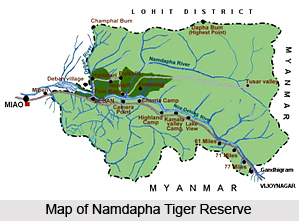
 National parks, wildlife sanctuaries, and tiger reserves throng the eastern region. Namdapha Tiger Reserve is drawing admiration to the tourists. It is located in the Arunachal Pradesh, amidst the lush evergreen trees, rich epiphytes, ferns, and tendrils, tree creepers. Namdapha is a home to one of the most unsual and significant wildlife sanctuaries in India. Being a land of rich diversity, it charms the tourists with the chirping of the Hoolock, the only chimpanzee in India, and the clamor of countless birds. Also a rare chimpanzee, called Hoolock, finds solace in the midst of the dense forestry of the Namdapha Tiger Reserve. National parks, wildlife sanctuaries, and tiger reserves throng the eastern region. Namdapha Tiger Reserve is drawing admiration to the tourists. It is located in the Arunachal Pradesh, amidst the lush evergreen trees, rich epiphytes, ferns, and tendrils, tree creepers. Namdapha is a home to one of the most unsual and significant wildlife sanctuaries in India. Being a land of rich diversity, it charms the tourists with the chirping of the Hoolock, the only chimpanzee in India, and the clamor of countless birds. Also a rare chimpanzee, called Hoolock, finds solace in the midst of the dense forestry of the Namdapha Tiger Reserve.
The story of its formation is quite exuberant. Being situated in the Noa-Dehing catchments that open in to the west, including Upper Brahmaputra Valley, Namdapha is typically devoid of snow. In the 1940s, a national park had been recommended; the area then a part of the North East Frontier Agency (NEFA). However, the reserve was thus formed under the Assam Forest Regulation of the year 1970. It was later granted the prestige and status of a wildlife sanctuary. In the year 1983, it got promoted to a national park whilst it was also incorporated in Project Tiger. Namdapha Tiger Reserve is situated in high altitudes ranging from a low of 200 meters to 4500 m. It then extends to 4,598 meters Dapha Bum peak in the north, also covering a colossal mix of home ground of damp bamboo forests; thick, damp evergreen jungles, moist pleasant and alpine scrublands. Over ninety percent of the total 1,985 sq km tiger reserve has been restored as the focal area. Much of Namdapha Tiger Reserve has the traces of wild and well-preserved lands. Only one road communicates through the southern part of the reserve. It extends to the western central part, to enjoin to Miao to the Myanmar border that lies in its close proximity. Much before Namdapha was declared a tiger reserve, this road was built that passes close to the sides of the Noa-Dehing River. 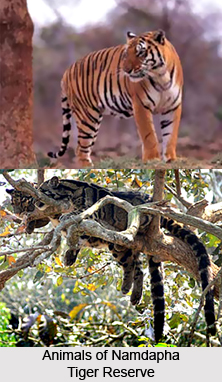 Few huge goat antelopes called the Mishmi Takin, the Binturong or Bearcat, the Golden Cat the Marbled Cat, all live in this reserve. Special rare specie called Red Panda, better known as the Cat-bear, is a special attraction. Namdapha is highly acclaimed for the fact that it provides shelter to four species of large cats. These are namely Tiger, Clouded Leopard, Leopard and Snow Leopard. Almost seventy mammalian species are found in large numbers. Few of the smaller cats, multitudes of squirrels, monkeys, chimpanzees, White-browed Gibbon, are the denizens of Namdapha Tiger Reserve. Tiger, Clouded Leopard, Snow Leopard (Ounce), Binturong, Leopard-cat, Marbled Cat, Golden Cat, Mishmi Takin, Wild Dog (Dhole), Red Panda, Large Indian Civet, Himalayan Palm Civet, Gaur (Indian Bison), Goral, Musk Deer, Slow Loris, Serow, Hoolock Gibbon, Assamese Macaque, Capped Langur, Himalayan Weasel, Hog Badger, Sambar, are also no less significant.
Wide varieties of birds are found here thereby increasing its status as one of the highly reputed sanctuaries in India. More than four hundred bird species can be seen in hook and nook of the Namdapha Tiger Reserve. They generally thrive in the woodlands and these include Blyth's Tragopan, Rufous-throated Partridge, Red Junglefowl, Grey Peacock Pheasant, Great Hornbill, Rufous-necked Hornbill, and Wreathed Hornbill. Great Slaty Woodpecker, Bay Woodpecker, Greater Yellownape, Golden-throated Barbet, Ward's Trogon, Dollarbird, Green Cochoa, Chestnut-winged Cuckoo, Mountain Imperial Pigeon, Collared Treepie, Rufous-vented Laughingthrush, Greater Rufous-headed Parrotbill, Large Niltava, Whiskered Yuhina, Grey headed Parrotbill. One can view beautiful birds, mostly migrated from far-flung areas just to remain in the cozy nests of lakes and rives of the Namdhapa Tiger Reserve. Also quite a few of the local water birds are found in abundance. The endangered White-winged Duck lures the admiration of the nature lovers. White-winged Duck, Ibisbill, White-bellied Heron, Slaty-backed Forktail, White-crowned Forktail, Crested Kingfisher, Brown Dipper are all worth noting. In close association, few bird raptors too can be found, including Lesser Fish Eagle, Mountain Hawk Eagle, Rufous-bellied Eagle, Pied Falconet, Oriental Hobby, Crested Serpent Eagle, Crested Goshawk etc. Information of myriads of wild life inhabitants is also being tracked down within the premises of Namdapha Tiger Reserve. In the view of its exclusive significance, Namdapha Tiger Reserve requires special mentioning. |
| |||



Home > Reference > Flora & Fauna > Indian National Parks > Tiger Reserves in India > Namdapha Tiger Reserve
Namdapha Tiger Reserve
| Namdhapa Tiger Reserve has a plethora of wild habitats, with due mentioning of birds in their glory. |
| ||||||||||||||||||||||||||||

