


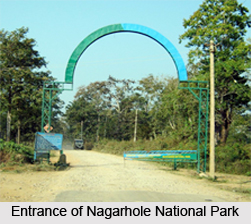
 The Nagarhole National Park ranges from the foothills of the Western Ghats spreading down the Brahmagiri hills and south towards Kerala state. More specifically, this park is jointly located in Kodagu district and Mysore district in the Indian state of Karnataka. This park derived its name from naga, meaning snake and hole, referring to streams. It is also known as the Rajiv Gandhi National Park. This park was declared as the 37th Project Tiger reserve in 1999. It is a part of the Nilgiri Biosphere Reserve. An area of 6,000 km2 (2,300 sq mi) covering the Western Ghats Nilgiri Sub-Cluster, including all of Nagarhole National Park and is under consideration by the UNESCO (United Nations Educational, Scientific and Cultural Organization) World Heritage Committee for selection as a World Heritage Site. The Nagarhole National Park ranges from the foothills of the Western Ghats spreading down the Brahmagiri hills and south towards Kerala state. More specifically, this park is jointly located in Kodagu district and Mysore district in the Indian state of Karnataka. This park derived its name from naga, meaning snake and hole, referring to streams. It is also known as the Rajiv Gandhi National Park. This park was declared as the 37th Project Tiger reserve in 1999. It is a part of the Nilgiri Biosphere Reserve. An area of 6,000 km2 (2,300 sq mi) covering the Western Ghats Nilgiri Sub-Cluster, including all of Nagarhole National Park and is under consideration by the UNESCO (United Nations Educational, Scientific and Cultural Organization) World Heritage Committee for selection as a World Heritage Site.
History of Nagarhole National Park For the kings of the Wodeyar dynasty, Nagarhole National Park served an exclusive hunting reserve. They were the former rulers of the Kingdom of Mysore. In 1955, this park was established as a wildlife sanctuary. In 1988, this park was upgraded into a national park. Geography of Nagarhole National Park Globally, the Nagarhole National Park can be pinpointed at 12 degrees 15 minutes 37.69 seconds north latitudes and 76 degrees17 minutes 34.4 minutes east longitudes. After its establishment, the park was further expanded, covering an area of about 643.39 km (399.78 mi). The elevations of the park range from about 687 to 960 m (2,254 to 3,150 ft). Together with the adjoining Bandipur National Park (870 km2 (340 sq mi)), Mudumalai National Park (320 km2 (120 sq mi) and Wayanad Wildlife Sanctuary (344 km2 (133 sq mi)), it forms the largest protected area in Southern India, a total of about 2,183 km2 (843 sq mi). This park is located north-west of Bandipur National Park and the Kabini reservoir separates the two parks. During summer, the temperature is known to slightly crossing 30 degree C mark. This season generally continues from March to May. Winters are comparatively brief with temperature dropping down to 14 degree C. This season generally continues from November to January. Characteristically, monsoon is erratic. The park receives an annual rainfall of about 1,440 millimetres (57 in), generally from June to September. The Lakshmmantirtha River, Sarati Hole, Nagar Hole, Balle Halla, Kabini River, 4 perennial streams, 47 seasonal streams, 4 small perennial lakes, 41 artificial tanks, several swamps, Taraka Dam and the Kabini reservoir comprise the water sources of the park. D.B.Kuppe, Machur, Balle Elephant Camp, Karapura, Nisana Belathur, Hemmankette, Dommanakatete, Antharesanthe, Lakshmi pura comprise the local villages and settlements in this park. The primary inhabitants of the forest area in the park are the Jenu Kurubas. They are the tribe in the Karnataka state. Biodiversity of Nagarhole National Park 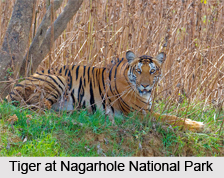 The Nagarhole National Park is graced by moist deciduous forests of the north Western Ghats. Dry deciduous forests of the Central Deccan Plateau are found towards the east. Some of the trees growing in this region are rosewood, teak, sandalwood and silver oak, Indian kino tree and cotton tree. The Nagarhole National Park is graced by moist deciduous forests of the north Western Ghats. Dry deciduous forests of the Central Deccan Plateau are found towards the east. Some of the trees growing in this region are rosewood, teak, sandalwood and silver oak, Indian kino tree and cotton tree.
This park shelters and conserves wildlife. Some of the mammals found in this park are golden jackals, Bengal tiger, grey mongoose, sloth bears and Indian bison or gaur. This park is recognized as an important bird area, conserving over 270 species of birds. Some of the birds protected in this park are the 'critically endangered' oriental white-backed vulture, 'vulnerable' lesser adjutant, greater spotted eagle, 'near threatened' species like darters and the Nilgiri wood-pigeon. Reptiles like bamboo pit viper are also commonly found here. The insect biodiversity includes over 96 species of dung beetles and 60 species of ants. Ecological Crisis Faced by Nagarhole National Park Uncontrolled activities have significantly compromised the ecology of the Nagarhole National Park, over the years. Factors disturbing the ecology of this park are deforestation, poaching, forest fire, cattle disease, human wildlife conflict, irregular payment of forestry staff and human habitations. Deforestation This park witnessed large scale cutting of sandalwood and teak trees for timber smuggling. In July 2002, hundreds of trees were known to cut down in the Veeranahosalli range. Poaching Poaching was also prevalent in this park. Elephants were killed for their ivory in huge figures. The survey carried out on 49 active and 19 retired hunters revealed that 26 species of wildlife were hunted at an average intensity of 216 hunter days per month per village. As much as 48% of the hunters reported hunting for the 'thrill'. The study showed that in Nagarhole, 16 mammal species weighing over 1 kg were regularly hunted with shotguns and also by traditional methods used by tribal communities. 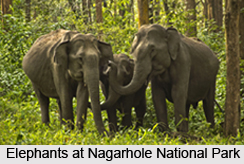
Forest Fire In January, 2012, a tragic forest fire destroyed over 6,000 acres (2,400 ha) of forest. Unfortunately, many wild animals have migrated to other greener spaces, consequent to forest fires and seasonal droughts coupled with water shortage. Cattle Disease The first week of September 2005 at G M Halli, on the border of Antharasanthe Forest Range in the park, 4 cattle died and about 25-30 cattle were affected, due to the outbreak of rabies. Human Wildlife Conflict This park has also witnessed human wildlife conflict. This happened when wild animals and elephants invaded nearby villages. The consequent retaliation by the villagers is another threat to the parks wildlife. Irregular Payment of Forestry Staff Another reason for the ecological crisis in the park is irregular payment of forestry staff. A report submitted by The Project Tiger Steering Committee stated that barely 25% of the park's staffs were involved in vigilance work, thus putting the park at high risk of both poaching and tree felling. Human Habitations In 1997, a resort called the Gateway Tusker Lodge was supposed to be constructed by the Taj Group of Hotels. With nearly 125 villages present inside the park, some tribal activist groups actively worked against the setting up of this lodge. They aimed to protect the tribal communities in this park. The Karnataka High Court passed a judgment in favour of these activist groups. Restoration of Nagarhole National Park Local non-governmental organizations (NGOs) are known to be working to control deforestation in this park. As an attempt to control human wildlife conflict, in 2001, the Karnataka state government sanctioned Rs 2 crores, to dig elephant proof trenches and install solar fencing around the park. The threatened ecology of the Nagarhole National Park even made relocation of the local tribal population imperative. The relocation of the tribes to the periphery of the forests were being made to conserve the existing tiger populations and elephant habitats which were being compromised due to change in lifestyles of the tribal people within the forests. In 2000, under the World Bank funded eco-development project, the first relocation attempts commenced, shifting about 50 tribal people. The relocated families were given land possession certificates for five acres of land and houses at Veeranahosalli, near Hunsur. The budget for the relocation of 1,550 tribal families was fixed at Rs. 15.5 crore by the state and union government. Visiting Information October to May is generally considered the best season to visit Nagarhole National Park. The park usually remains closed during monsoon season. Nearest airports to this park is located in Mysore and Bangalore. Regular flights are available to Bangalore from all the key cities in India. Mysore railway station (80 km) is the nearest railway station from this park. Bus services are available from the places around Nagarahole like Mysore (96 km), Bangalore (236 km), Madikere (93 km) and Hunsur. Related Articles: Indian National Parks Indian Wildlife Conservation of Indian Wildlife Wildlife in Karnataka Wildlife in South India Bandipur Tiger Reserve Nagarhole National Park Someshwara Wildlife Sanctuary |
| |||



Nagarhole National Park
| Nagarhole National Park has a rich variety of wild flora and fauna, thus making it popular amongst tourists. |
| ||||||||||||||||||||||||||||

