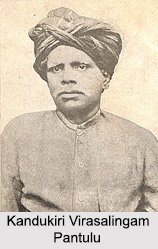
 Kandukuri Virasalingam Pantulu was one of the most prominent social reformers hailing from South India. He was born in Rajahmundry, the capital of Godavari District, in a Telugu-speaking district of Madras Presidency. Virasalingam spent his life being involved in movements to promote the Telugu language for modern education and communication. He is considered as the father of renaissance movement in Telugu. Above all, he believed in the necessity of purifying religion by opposing obsolete customs. He believed that purified religion, social reform and vernacular education would be the three pillars of a regenerated society, purged of its evil ways. He was one of the foremost reformers in the realm of women`s rights and he fought ardently for their upliftment, focussing particularly on widow remarriage and female education. He also fought against the dowry system.
Early Life of Kandukuri Virasalingam Pantulu
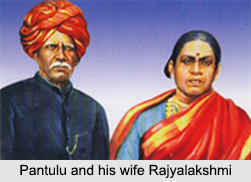
He was the son of Subbarayudu and Punnamma. At the tender age of four, Pantulu"s father passed away. He was then adopted by his paternal uncle, Venkatatatnam, as his own son. His was from a traditional Brahmin family. In 1861, he was married to Bapamma Rajyalakshmi. He was then only a 13 year old boy and his wife was eight. Though they were married in childhood, the pair set the example of a perfect match, in adulthood. When Pantulu`s wife, Rajyalakshmi, grew up, she aided her husband in his mission of life. He adhered to his tradition, by cultivating his inclination towards Indian classics. Afterwards, he embraced the gift of Western education, when he joined an English school. He was extolled for his analytical prowess, and scholarly attributes. He was crowned the best performer in school, not only for his academic brilliance, but was also for the gentleness of his conduct. A true erudite, he was well versed in English as well as Sanskrit.
Influences on Kandukuri Virasalingam Pantulu
The influential leader of the Brahmo Samaj (a Samaj or community that aimed at social reform) Atmuri Lakshmi Narasimha, created a deep impact on him. His mind imbibed the spirit of Renaissance ushered in by the reformist stalwarts like Raja Ram Mohan Roy, Ishwar Chandra Vidyasagar and Keshab Chandra Sen. Pantulu had a true idea of the plight of Indian women in the face of the various oppressive customs of society and wanted to work towards their upliftment.
 Reform Campaigns of Kandukuri Virasalingam Pantulu
Pantulu realized the urgency to redeem religion of its false superstitions and distorted practices. He said that "purified religion", "social reform" and "vernacular education" should form the foundation of a world of equality and liberty. K.V. Pantulu became a member of the Brahmo Samaj and Prarthana Samaj to give a concrete shape to his dreams. He published his own journal, Vikeka Vardhani ("Journal to Promote Enlightenment") to encourage social reform, most particularly women"s education. He advocated against the Dowry System. He also started a school in Dowlaiswaram in 1874.
His journal was extremely vocal about women`s elevation in status, exposure to the light of education and the destructive effect of social stigmas. His journal which spread its wings from Chennai, turned out to be so popular, that he established his own press at Rajahmundry. He went ahead and dispatched another alarming magazine, called Satihitabobhini. It focussed on the rights that women deserve. Among the highlights of his program for social change were the issues of widow remarriage and female education.
Widow Remarriage: By 1879, Virasalingam had made widow remarriage the key issue. Rajahmundry celebrated its first widow remarriage in 1881 with Virasalingam performing the ceremony. The town was hostile towards this practice but Virasalingam persisted and before long there was a small community of remarried couples. Virasalingam continued to look for prospective candidates while writing numerous articles about the need for a change in public opinion. In 1891 a Widow Remarriage Association was formed, and thirty Brahmin households signed a pledge promising to participate in the ceremonies and marriage feast whenever a remarriage occurred. Eventually the majority of the prominent citizens of Rajahmundry joined Virasalingam`s association. For his reformist activities, Virasalingam gained attention all over the world. The Government conferred on him the title of Rao Bahadur in 1893. He also established a widow home.
Women"s Education: Virasalingam had a significant impact on women education. The issue of education of women in Rajahmundry was significantly different from the same in Kolkata and Mumbai where colonial power was evident. Here the language of debate was Telugu and the controversy was conducted without referring to the colonial criticisms of Indian society. In this context reforms for women were not equated with westernization. Kandukuri Virasalingam Pantulu established his first Girl`s School in 1874, to dissipate the mantra of women`s education. He subsequently carved out the Rajahmundry Social Reform Association in 1878. At the beginning, the members of his group conducted an anti-Nautch movement. They tried to prevent people from indulging in exploitation of the Nautch or dancing girls, by hiring them for cheap delight in occasions.
Virasalingam retrieved female education from the stasis of social disinterestedness. He opened the first Theistic High School, the Hithakarini School at Rajahmundry in 1908. Simultaneously, he legally gifted all his property for the welfare of Rajahmundry Widows` Home and the school. He showed enough of practical wisdom, by entrusting the Hithakarini Samaj with the responsibility of looking after these two institutions. This educational enterprise expanded from Rajahmundry to Coconada (the recent Kakinara), Parlakimedi, Palakole, Narsapur, Vijaywada and Tenali.
Consequences of Pandulu"s Campaigns
The consequences of the reform movements were far-reaching: The widow marriage campaign was the catalyst which initiated the first generation of Western-educated Andhras into social, religious and political reform activities. A symbolic effort to change the status of women, the fight for women"s education posed a fundamental challenge to orthodox concepts of women and their role in family and society. The campaign had a major ideological impact upon the development of modern Telugu literature and the nationalist movement in Andhra.
Literary works of Kandukuri Virasalingam Pantulu
Virasalingam was a scholar in languages such as Telugu, Sanskrit, and Hindi. He considered literature as an instrument to fight against social evils. He wrote plays which criticised the attitude of Brahmin priests, for example “Prahlada†(1885) and “Satya Harischandra†(1886). He published a novel Rajashekhara Charita in 1880. Recognized as the first Telugu novel, it is inspired by The Vicar of Wakefield, a novel by Oliver Goldsmith.
Political affiliation of Kandukuri Virasalingam Pantulu
Virasalingam during the 1880s was involved in the party politics of the INC. He served as one of the members of the first Indian National Congress (INC) meeting in 1885.