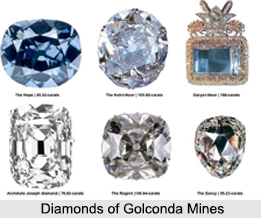
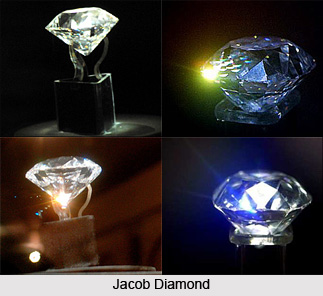
 The Jacob diamond was discovered in the Orange Free State in South Africa. The Jacob diamond also known as the Imperial, Great White or Victoria. Though the history of its unearthed remained undiscovered but there is a faint idea that it was unearthed in the Jagersfontein Mine, the Kimberley Mine or on the farm of a Dutchman who, kept it in a secret hiding place for fear of attracting a mad rush of diamond hunters, for a year before revealing its existence. However, the most widely thought version relating to its discovery is somewhat like that of an officer of the Central Mining Company found a diamond weighing 457.50 (old) carats in the Kimberley Mine in 1884. This officer on his person carried the stone out of the mine and he sold it illegitimately to a group of four diamond buyers. The outstanding gem made its way to London from Cape Colony after again being the focus of an illicit transaction.
Hatton Garden, the diamond quarter of the city, went through a sensation while the diamond appeared in London. The hunt soon instigated for an eligible rich buyer, but when none were accommodating. Then a consortium of eight persons, bought the gem for £45,000 that was headed by a former resident of the Cape mines. The syndicate came to a decision that there is a need to have the diamond cut and for that it was sent to the reputed Dutch firm of lacques Metz. In the presence of the Queen of Holland, on April 9, 1887, the master cutter M B Barends began the fine faceting of the stone. The gem resulted into an extent oval-shaped brilliant with 58 facets, weighing 184.50 carats and measuring 39.50 mm long, 29.25 mm wide, and 22.50 mm deep and the process took a year.
The marvelous diamond joined one of the most enviable collections of jewellery when it came to be owned by the sixth Nizam of Hyderabad, Mahboob AN Pasha when it was offered for sale and it. The sixth Nizam of Hyderabad supposedly the richest man in the world during that time. The Nizam`s desire for marvelous `objets d`art` had his Chow Mahalla Palace packed with priceless treasures. The story of how he came to acquire the Jacob diamond is a captivating one.
A man by the name of Alexander Malcolm Jacob during 1871 arrived in Simla and set himself up as a gem dealer. Multifariously, Jacob was supposed to be an Armenian, a Jew, and even a Russian or British agent. This magical power possessor and a weird character offered to sell the diamond to the Nizam. To make a handsome profit, Jacob was clutching the opportunity, and he promised to buy the diamond then known as the Imperial, which was kept in England, on behalf of Mahboob Ali Pasha. In 1891, after seeing a model of the diamond, the Nizam agreed to pay Rs 23 lakhs as a deposit. It was settled between them that Nizam would pay the half price of the gem money, and the other half was to be paid only if he accepts the stone. The perceptive behind that was that if the Nizam did not like the diamond, the deposit would be returned to him.
However, the British Resident at Hyderabad, Sir Denis Fitzpatrick, before the matter could continue further, heard about the transaction and interfered in order to save the Nizam`s government from bankruptcy. The Nizam expressed his discontent with the stone later, when Alexander Jacob arrived in Hyderabad with the diamond, and also refused to buy it. The Nizam now demanded that the deposit be returned. But Jacob was unable to pay him back and the Nizam in the Calcutta High Court filed a case against him. Jacob was finally cleared. Conversely, the ownership of the diamond, the issue regarding that was settled out of court and the Nizam for only half its asking price acquired the diamond. Jacob did not receive the original price that he had quoted for the diamond to the Nizam and he was remunerated only for the legal costs. He simply in an old ink-stained cloth rolled up the diamond and tossed it into a drawer. It is believed that the next Nizam, Mir Osman Ali Khan, in due course found it entrenched in an old slipper of his father. He later used it as a paperweight
After the amalgamation of the princely states in 1948, into the Union of India, one question became very important, relating to wealth, property, succession and inheritance of the former rulers. Osman Ali Khan set up `H.E.H. The Nizam`s Jewellery Trust` in 1951, in order to preserve his wealth. The Jacob diamond was acquired by the government of India in 1995, which was attributed to this trust along with the other jewels that formed a part of this trust. This extraordinary diamond came into public for displayed for the first time in 2001 at the National Museum in New Delhi.