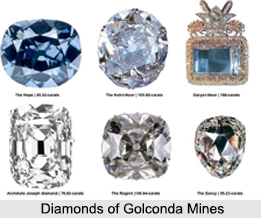
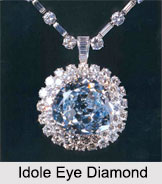
 Idole Eye Diamond is a 70.21carats, pale diamond with a little bluish shade. It was originated from the Golconda Mines in Southern India. The cut of the diamond is in between an old-mine cut and a triangular sparkling. It was stolen from the eye of the statute of a Hindu deity in India.
History of Idole Eye Diamond
Idole eye Diamond holds an early history that merges a rich combination of myths. Idole eye is a diamond of in between16th or 17th century. The Kollur Mines, near Golconda were discovered it in the mid of 16th century. The first validated information about the history of the diamond is that it was put up for sale on July 14th 1865, at a Christie`s auction in London. After the first appearance of the diamond, it was the part of the collection of jewels, belonging to Sultan Abdul Hamid II of Turkey.
There are several legends associated with the early history of the Idole eye diamond. According to one such legend, Idole eye was given as a payoff for Princess Rasheedah, by the Sheik of Kashmir, to the Sultan of Turkey, who had seized her. Another legend says that, Idole eye was grabbed from the Persian Prince Rahab, in the early 17th century by the East India Company, as reward for debts owed by him to the company. Idole eye, together with some other large diamonds belonging to Salomon Habib, was put up for sale in Paris, on June 24th 1909. Then Idole eye re-surfaced right away after World War II, when it was purchased by a Dutch diamond dealer, who sold it in 1946 to the New York diamond dealer Harry Winston. One year after this in 1947, Harry Winston profitably negotiated the sale of the diamond to Mrs. May Bonfils Stanton. Idole eye was purchased at Park-Bernet Galleries Inc. of New York sale by the Chicago Jeweller Harry Levinson.
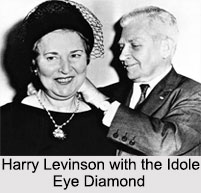 After that, the diamond was then taken to Johannesburg, South Africa, in 1967, by the De Beers Company, to be exhibited at a show held at the diamond pavilion. Afterwards the diamond was put up for sale at an auction in New York, by Levinson. Again the diamond was displayed at the Metropolitan Museum of Art in New York in connection with the 50th anniversary celebrations of Harry Winston Inc. Eventually in 1979; Mr. Harry Winston was capable to sale the Idole eye to Mr. Laurence Graff, the head of the Graff Diamonds of London, in a confidentially negotiated deal.
Present status of Idole Eye Diamond
In January 1983, Mr. Laurence Graff was capable to put together a profitable deal with Sultan Abdul Hamid II, to the unidentified buyer, for an undisclosed amount. It was considered to be one of the extremely priced diamond transactions ever known. Idole eye is still believed to be owned by this unidentified buyer.