


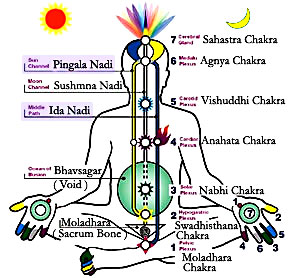
 Kundalini Yoga enlaced with its eternal elements has supported in the "regulation of the pairs of opposites." This ancient yogic form affirms the fact that there is a serpent coiled in the spinal cord of every human being and the spinal cord limiteds itself in three nerve channels known as the Ida, Pingala and the Sushuma, which is the central channel. Kundalini Yoga enlaced with its eternal elements has supported in the "regulation of the pairs of opposites." This ancient yogic form affirms the fact that there is a serpent coiled in the spinal cord of every human being and the spinal cord limiteds itself in three nerve channels known as the Ida, Pingala and the Sushuma, which is the central channel.
Ida is the left channel, which is white, feminine, cold, represents the moon and is associated with the river ganga. Ida originated in Muladhara and ends up in the left nostril. Pingala is the right channel, red in colour, masculine, hot, represents the sun and is associated with the river Yamuna. Originated in muladhara, pingala ends up in the right nostril. The technique of kundalini yoga consists in using prana guiding its circulatory movement through Ida and Pingala down to the base of spine into the space where kundalini lies coiled. Shakti kundalini will then awaken and rise up sushumna , energizing the seven charkas. The first step in kundalini awakening is balancing the flow of energy in Ida and Pingala. The breath flowing evenly in two nostrils evidenced that equal amount of prana is flowing in the left and right sides. The goal of kundalini awakening process is to balance or center the energies. This affects the subtle body as well as brings tremendous health benefits by positively regulating the autonomic nervous system. There is a natural transition between Ida and Pingala. For those with very healthy body and mind, the shift happens approximately every 90 minutes, for others the energy may be more or less stuck in either ida and Pingala. The union of balancing of Ida and pingala is like a marriage. This wedding is called sandhya and it's a time of great meditative joy where the mind and the breath are joined in a happy union. Ida flows along the left side of the spine, circles the ganglion of ribrs, and converges on its left side. Pingala flows along the right side of the spine, circles the ganglion of ribes, and converges on its right side. Thus, the two forces of Ida and Pingala converge at the ganglion of ribes, in the space between the eyebrows, the ajna chakra. The meditation on this space is extremely useful and often recommended. Ideally solid foods are taken when pingala is more active that is when the right nostril is open. Since this is more dominant in midday, that is the best time to take major meal as it helps in digestion. Liquid is taken when ida is predominant that is left nostril is open. |
| |||



Ida and Pingala
| Ida and pingala are considered as most important nadis among the fourteen principle nadis in shiva samhita. |
| ||||||||||||||||||||||||||||

