 The western region of India is plentiful with various national parks and wild life sanctuaries. It is in fact most colorfully inhabited natural desert of the world. It has at its heart the golden city of Jaisalmer. The Desert National Park has an area of 3,162 sq km, situated 45 kms in the western side of this city.
Geography and Location of Desert National Park
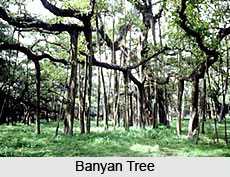
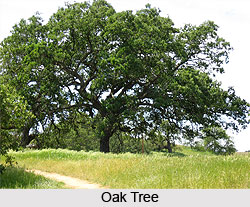
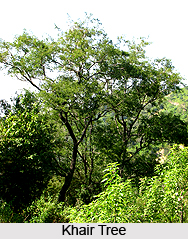
Being situated in the heartland of Indian Thar Desert of Rajasthan, it had adopted to the typography of the desert region. Sand dunes, both flat and uneven, low rock stones, and few tinges of grasses lying scattered here and there are common. Few areas are covered with sewan grass, and also the aak shrub and khair, khejra and rohira trees are prevalent. The parched, sandy tracts with scarcity of water bodies are among various other characteristics, thereby making the park unique in its own way. The Desert National Park covers an area of 3162 sq. km of which 1900 sq. km is in Jaisalmer district and remaining 1262 sq. km is in Barmer district of Rajasthan State.
Flora of Desert National Park
The vegetation of major part of the arid region of the Thar falls under thorn forest type (Champion and Seth 1968). Khejri Prosopis cineraria is commonly found, which is revered and protected by the local communities specially the `Bishnois`. The vegetation of DNP is quite sparse with open grassland, throny bushes, plantation and dunes as the broad habitat types. 168 plant species belonging to 48 families have been reported from this area (Pandey et al. 1985). Tree species namely Commiphora wightii, Ammannie desertorum, Acacia spp., Dipcadi erythraem, Enneatogon, Ephedra foliata, Glossonema varians, Helitropium rariflorum, Limeum indicum, Tecomella undulata brachystachyus Moringa concanensis, Rhynchosia schimpari, Seddera latifolia, Sesuvium sesuvioides, Tephrosia falciformis, Tribulus rajasthanensis and Ziziphus truncate provide sustenance to the desert fauna.
Fauna of Desert National Park
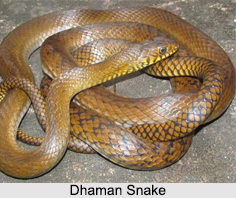
Many animals have taken shelter in the dry, rugged terrain of Desert National Park. There are more than 40 species of reptiles, namely the burrowing Spiny-tailed Lizard, Russel`s Viper, Saw-scaled Viper and the dragon-like Common Monitor. Special type of fish, known as the Desert Skink is a found locally. It is better known as the sand fish as it `swims` or goes on by digging tunnels through sand, down to a depth of 30 cm. The tourists overwhelm by the scene of hoards of birds flying, singing. Nearly 120 species of birds add color to the rugged shades of the desert.
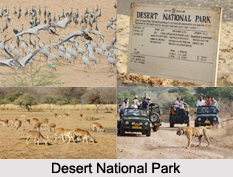 There is prevalence of wolves sheltering in the sand dunes to escape the heat of sultry days. Other voracious animals are Desert Fox, Common Fox etc. Blackbuck, Chinkara (Indian Gazelle), Nilgai (Blue Bull), Wolf. Desert Pox (below), Jackal, Desert Cat, Caracal, Desert Hare, Common Mongoose, Indian Desert Gerbil, Long-eared Hedgehog are some of the popular mammalian species of Desert National Park. The small and elegant Chinkara (Indian Gazelle) moves around especially in the sandy hilltops.
Since water is most scanty, it is natural that few waterholes that are present will be crowded by animals. The Sudasari waterhole is one such excellent site for observing the animals. Observation hides also offer close encounters with desert wildlife. Swamps of Pin-tailed Sandgrouse, Black-bellied Sandgrouse, Chestnut-bellied Sandgrouse, turn up in winter season from central Asia and can be seen at more or less particular time in the morning and that too near the waterholes. During this season, various waterfowl and flocks of migratory Demoiselle Crane are also found. Larks, partridges, doves, bec-eaters, shrikes, chats, parakeets, babblers remain throughout the year. Sometimes these small birds become prey to the ferocious bird raptors. Buzzards, eagles, falcons and kites etc. are some of them that soar high over the landscape . The ductile and shy Jackal and the black-spotted Desert Cat are mostly seen at waterholes.
In the Desert National Park other beautiful birds that are found, include Grey Francolin, Cream-colored Courser, Indian Courser, Eurasian Thick-knee, Common Raven, Bimaculated Lark, Southern Grey Shrike, Stoliczka`s Bushchat, Variable Wheatear, Desert Wheatear, Desert Warbler etc.
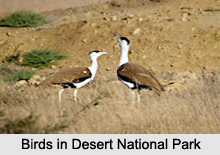
Instances of the engendered species freely roaming around the park are quite evident. The remarkably beautiful Blackbuck is a special type of antelope found in India. They are quite few in number in this park. The Indian Bustard and the MacQueen`s waders are extremely endangered species that are preserved in the Desert National Park with great care.
Visiting Information
Jaisalmer has no airport of its own. The nearest airport to reach the Desert National Park is the Jodhpur Airport situated at a distance of 300 km. Jaisalmer Railway Station is the nearest railhead to reach the Desert National Park. The Jaisalmer railhead is situated at 13 km distance from the Dessert National Park and will require only 20 minutes. Jaisalmer shows decent connectivity to other states by road. Both deluxe and ordinary bus services are available from Jodhpur, Bikaner, Jalore, Jaipur, Barmer, Ahmedabad, etc.
With the passage of time this reclusive park too becomes a victim of rash demands of mankind. It is the most thickly populated desert park of the world. As per numerous surveys of wildlife experts, the Desert National Park has been acclaimed as an exclusive heritable storehouse of desert wildlife of India. In fact it took minimum of efforts for the region to grow so much lavishly. Prevention measures are being taken so that the park can retain its lavish treasure in the future.