C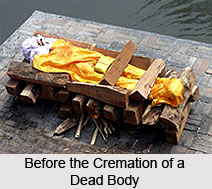 remation is the way of the disposing off the dead body according to Hinduism by burning the deceased in the holy fire. According to Hinduism burning the dead body liberates the soul quickly as the old body is disposed more quickly than any forms of disposal and can enter the new body. Conventionally, these rites are not meant for young children, unmarried girls and ascetics or sanyasis as young children and unmarried girls were then generally immersed in river. Since a sanyasi is believed to have overcome all his sins by doing penance and therefore does not require purification .So a burial ceremony is detailed in the scriptures. For suicide related deaths or rather unnatural deaths Antyesti is also not performed. When a pregnant woman dies she is cremated but her foetus is removed and buried .If a man dies away from home, by performing proper rites he is cremated at home by using an effigy made of kusha grass.
The dead body of the person is placed on the floor with the head pointing towards the North .A burning oil lamp is placed near the dead body which burns continuously for the first three days. The dead body is considered to be impure, physical contact with the dead body is avoided so that infections and germs do not spread to others. Giving a bath and then dressing him/her in new clothes purify the dead body. For the male and widow white clothes are used and for married women whose husband is still alive or a young unmarried girl, red or yellow dress is used.
 On the head Bhasma or sacred ash is applied especially for the worshippers of Lord Shiva (Saivites) and sandalwood paste is applied if the dead was the worshipper of Lord Vishnu .Few basil leaves (tulsi) is soaked in Ganga water is put into the mouth of the deceased so that the soul attains liberation.
The body is adorned with gold jewels and also with garlands of different flowers like jasmine, roses and marigolds and the body is almost covered with the flowers. The dead body facing upwards is put on the stretcher and then carried on the shoulders of four closest male relatives of the deceased person. Other friends and relatives follow this. If the cremation ground is located at a distance then the stretcher is placed on a vehicle.
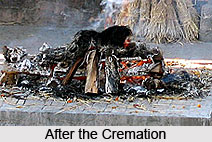
If a man is dead then a man`s eldest son performs the funeral ceremonies or any close male relatives .A woman`s husband, eldest son or brother performs her ceremony. After reaching the cremation ground a suitable place is chosen for the funeral pyre .The place is purified by sprinkling water using stalks of durva .The pyre is built according to the specifications given in the Ashvalayana Grihyasutra for the type of wood to be used, the size of the pyre .The hair and nails of the corpse are trimmed and the corpse is again bathed in the preparation of the journey ahead. More logs of wood are placed on the top of the body .The son goes around the pyre three times with a pot of water he brings with him. After going around the pyre thrice, he stands at the head of the body and drops the pot so that it breaks. With a lit log of wood he lights the pyre on all four sides while the priest recites prayers to Agni. Relatives wait until the body is completely burnt.