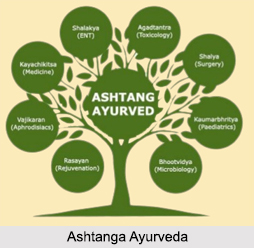
Ayurveda is an age-old science with its origin steeped in antiquities. For a detailed understanding of what is naturally healthy living, the concept of Ayurveda is indeed an invaluable link.
According to the concept of Ayurveda, an individual is a bundle of "Spirit". The individual is desirous of expressing itself hence uses subjective consciousness or "Satwa" to manifest sense organs and a mind. Spirit and mind then project themselves into a physical body, created from the Pancha Mahabhutas - which arise from Tamas. Thus in the concept of Ayurveda, the body becomes the mind"s vehicle, its physical instrument for intellectual satisfaction.
According to the concept of Ayurveda, the Bhutas combine into "Tridoshas" or bio-energetic forces that govern and determine people"s health or physical condition. While the three Gunas (Rajas, Tamas and Satwa) which balances the first two or psychic forces determine people"s mental and spiritual health. Ayurveda is thus a holistic system of health care that teaches one to balance these energies in order to achieve optimum health and well-being.
Body Matrix in Ayurveda
The Body Matrix is indeed an important concept of Ayurveda. Life in Ayurveda is conceived as the union of body, senses, mind and soul. The living man is a conglomeration of three humours (Vata, Pitta and Kapha), seven basic tissues (Rasa, Rakta, Mansa, Meda, Asthi, Majja and Shukra) and the waste products of the body such as faeces, urine and sweat. Thus the total body matrix comprises of the humours, the tissues and the waste products of the body. The growth and decay of this body matrix and its constituents revolve around food, which gets processed into humours, tissues and wastes. Ingestion, digestion, absorption, assimilation and metabolism of food have interplay in health and disease, which are significantly affected by psychological mechanisms as well as by bio- fire.
According to the concept of Ayurveda, all objects in the universe including human body are composed of five basic elements (Pancha Mahabhutas) namely, Earth, Water, Fire, Air and Space. There is a balanced condensation of these elements in different proportions to suit the needs and requirements of different structures and functions of the body matrix and its parts. The growth and development of the body matrix depends on its nutrition, i.e., on food. The food, in turn, is composed of the above 5 elements, which replenish or nourish the like elements of the body after the action of bio-fire (Agni). The tissues of the body are the structural whereas humours are physiological entities, derived from different combinations and permutations of Pancha Mahabhutas.
Health or sickness depends on the presence or absence of a balanced state of the total body matrix including the balance between its different constituents. Both the intrinsic and extrinsic factors can cause disturbance in the natural balance-giving rise to disease and this very concept of Ayurveda is further supported by the various Ayurvedic treatment.
This loss of equilibrium can happen by dietary indiscrimination, undesirable habits and non-observance of rules of healthy living. Seasonal abnormalities, improper exercise or erratic application of sensory organs and incompatible actions of the body and mind can also result in creating disturbance of the existing normal balance. The treatment consists of restoring the balance of disturbed body-mind matrix through regulating diet, correcting life-routine and behaviour, administration of drugs and resorting to preventive Panchakarma and Rasayana therapy.