


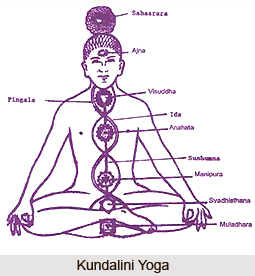
 Kundalini in English means the serpent power. It is the common Hindu belief that within each person resides a "serpent" coiled tightly up at the base of the spine. Kundalini in English means the serpent power. It is the common Hindu belief that within each person resides a "serpent" coiled tightly up at the base of the spine.
Through practicing Kundalini yoga, along with chanting, meditation, and an impartation from the guru one can have their Kundalini awakened. The energy of kundalini is released from the naval canter and rises to the crown chakra at the top of the head then the energy descends down the chakras to the base of the spine and after reaching the root chakra it again returns to the naval center. This is called the flow of kundalini. The components of kundalini yoga are as follows: Asana: It is a dynamic position, which helps the practitioner to balance the mind and body. It brings a superior balance and awakens the subtle energies of the body. It is not just a physical practice but also a spiritual practice based on the vibrating energy of every human being. This is mainly a posture, which is designed to stimulate glands, organs or body awareness. It quiets the mind for meditation. It also pressurizes the nerves and acupressure points, reflecting to the brain and body for certain points. Mudras and bandhas: These are certain postures of the body, which successfully awakens kundalini. These are usually a position of the hands that locks and guides energy flow and reflexes to the brain. One can simply talk to the body by curling, stretching and touching the fingers or hands as each of these reflexes to a certain part of the mind and body. Mudras and bandhas can cure dyspepsia, constipation, piles, cough, asthma, enlargement of spleen, veneral diseases, leprosy and all sorts of incurable diseases. They are the most effective exercises for maintaining brahmacharya, without which nothing can be made in the spiritual path. Mantras: A mantra is a syllable, word or phrase in one of the sacred languages like Sanskrit & Gurmukhi or sometimes in English, which elevates or modifies consciousness through its meaning. Mantra is mainly use of specific sounds to change the consciousness of the mind and chemistry of the brain. Each sound of mantra is a formula, causing the tongue to strike specific points in the mouth. These points trigger response in the brain. Some mantras are used silently. In this case, it is a mental focus for the mind. Use of mantra is a fun and uplifting experience. It is a part of all Kundalini Yoga classes. Students who are uncomfortable with use of mantra are not required to chant and may enjoy just listening. Mantra can be called "The Yoga of the mind". Meditation: 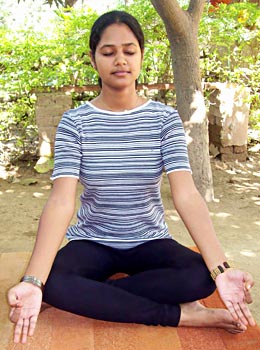 Meditation usually refers to a state of extreme relaxation and concentration, in which the body is generally at rest and the mind quieted of surface thoughts. The earliest mention of meditation comes from the Vedas and yoga with the Sanskrit term 'Dhayana. Another form of meditation is prayer and worship, wherein the practitioner turns spiritual thoughts over in the mind and engages the brain in higher thinking processes. Consistent meditation promotes inner peace, happiness and life in higher consciousness. Through meditation one can achieve the technique to produce a calm, sensitive less emotional, alert, intuitive, effective, efficient and self-controlled personality, and an enhanced sense of being and consciousness. Meditation usually refers to a state of extreme relaxation and concentration, in which the body is generally at rest and the mind quieted of surface thoughts. The earliest mention of meditation comes from the Vedas and yoga with the Sanskrit term 'Dhayana. Another form of meditation is prayer and worship, wherein the practitioner turns spiritual thoughts over in the mind and engages the brain in higher thinking processes. Consistent meditation promotes inner peace, happiness and life in higher consciousness. Through meditation one can achieve the technique to produce a calm, sensitive less emotional, alert, intuitive, effective, efficient and self-controlled personality, and an enhanced sense of being and consciousness.
Meditation generally tries to avoid wandering thoughts, fantasies and calming and focusing the mind. Physical postures in this include sitting cross-legged, standing, lying down, and walking. Some people use repetitive activities such as deep breathing, humming or chanting to help induce a meditative state. Meditation can be done with the eyes closed or with the eyes open by focusing these on a certain point of an object or image, and keeping the eyes constantly looking at that point. Meditation serves as a means of relaxation from a busy daily routine or of communicating with one's God. Many have found improved concentration, awareness, self-discipline and self-control through meditation |
| |||



Components of Kundalini yoga
| The different components of Kundalini yoga are Asanas, Mudra and Bandhas, Mantras and Meditation. |
| ||||||||||||||||||||||||||||

