Badami Cave Temples
|
The Badami Cave Temples, an exemplary production of Indian architecture, are situated in the town of Badami.
|
|
|
 The Badami Cave Temples are a living testimony of the excellence of Indian rock-cut architecture. They are located at Badami, a town in the Bagalkot District in the north part of Karnataka in India. Badami was the capital city of the Early Chalukyas, who ruled a large part of the state of Karnataka between the sixth and eighth centuries. It lies at the mouth of a canyon with stony hills on either side. Water from this canyon flows into a tank. Pulakesin I of the Chalukya dynasty established this town in the 6th century A.D. From the Chalukya dynasty was born a new architectural style, models of which can be seen in Badami, Aihole, Pattadakal and other neighbouring areas. Their temples and monuments led the pathway for the Hindu style of architecture. This new style combined the finer aspects of two distinctive styles - the North Indian or Indo-Aryan Nagara style and the South Indian Dravidian style. Commonly referred to as the Chalukyan style, this style can be observed in many cave temples dedicated to the Brahmanical deities and also the numerous Buddhist and Jain monasteries in the area. The Badami Cave Temples are a living testimony of the excellence of Indian rock-cut architecture. They are located at Badami, a town in the Bagalkot District in the north part of Karnataka in India. Badami was the capital city of the Early Chalukyas, who ruled a large part of the state of Karnataka between the sixth and eighth centuries. It lies at the mouth of a canyon with stony hills on either side. Water from this canyon flows into a tank. Pulakesin I of the Chalukya dynasty established this town in the 6th century A.D. From the Chalukya dynasty was born a new architectural style, models of which can be seen in Badami, Aihole, Pattadakal and other neighbouring areas. Their temples and monuments led the pathway for the Hindu style of architecture. This new style combined the finer aspects of two distinctive styles - the North Indian or Indo-Aryan Nagara style and the South Indian Dravidian style. Commonly referred to as the Chalukyan style, this style can be observed in many cave temples dedicated to the Brahmanical deities and also the numerous Buddhist and Jain monasteries in the area.
The special attraction of the town of Badami is its ancient cave temples engraved out of the sandstone hills.
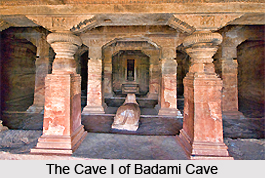
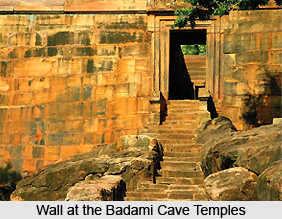
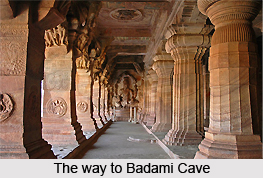 The Badami Cave Temples, which date back to 600 and 700 A.D, are four in number. Each one has a sanctum, a hall, an open verandah and columns. The exceptional features of these cave temples are the large number of delicate carvings and sculptures. In the extremely talented hands of the Chalukyan craftsmen, the sandstone seems to have become a flexible and elastic material that can be randomly shaped into any beautiful artifact. There are countless beautiful frescos as well. The first cave, built of red sandstone, was presumably the first to be carved. There are forty steps leading to the verandah that comprises a series of arches. Other structures include a hall with numerous pillars and a square shaped sanctum. The beams of the columns are magnificently crafted. On the ceiling one comes across the paintings of couples in amorous postures. There are also pictures depicting Shiva with his partner Parvati, and a coiled serpent. An eye catching feature is the 18-armed lord Nataraja who, if watched closely strikes eighty-one dancing poses. The second cave is situated on a sandstone hill. It is dedicated to lord Vishnu who is portrayed here as a dwarf or 'Trivikrama' of awesome proportions with one foot getting command over the earth and the other the sky. One more shape of Vishnu portrayed here is as 'Varaha' or a boar. There is also a wall painting depicting Vishnu as Lord Krishna. Still higher is situated the third cave. The front elevation of the cave is nearly 70 feet wide. There is a pedestal with numerous carvings.
  The other attractive features of this cave are the depictions of Vishnu with a serpent, Vishnu as Narasimha (Vishnu as Man-Lion), Varaha, Harihara (Shiva Vishnu) and Vishnu as Trivikrama. The wonderful artistry and sculptural brilliance makes this cave a masterpiece of Deccan art. It provides a detailed portrayal of the art and culture of the 6th century, specially costumes, jewelry, hairstyle, lifestyle and the like. All the three caves so far mentioned are Hindu caves. The fourth cave is the only Jain cave whose construction started in the 6th century and was completed nearly 100 years later than the earlier three caves. Here one can see the carvings of the 24th Tirthankara Parshavnatha with a serpent at his feet as well as Mahavira in a sitting position. The other attractive features of this cave are the depictions of Vishnu with a serpent, Vishnu as Narasimha (Vishnu as Man-Lion), Varaha, Harihara (Shiva Vishnu) and Vishnu as Trivikrama. The wonderful artistry and sculptural brilliance makes this cave a masterpiece of Deccan art. It provides a detailed portrayal of the art and culture of the 6th century, specially costumes, jewelry, hairstyle, lifestyle and the like. All the three caves so far mentioned are Hindu caves. The fourth cave is the only Jain cave whose construction started in the 6th century and was completed nearly 100 years later than the earlier three caves. Here one can see the carvings of the 24th Tirthankara Parshavnatha with a serpent at his feet as well as Mahavira in a sitting position.
The Badami Cave Temples are situated on the bank of the ancient Bhutnatha Lake. On the other side of the bank is a temple amidst a massive tamarind tree, dedicated to Nagamma, the local serpent goddess. Located close by are two Shiva temples, which idolize Him as Bhutanatha, the God of Souls. Inside the inner sanctum of the temple, on the edge of the water the lord sits in an exclusive majestic pose.
The Badami Cave Temples provide ample insight into the Chalukyan style of architecture through the various noteworthy constructions. It is believed that the caves of Elephanta and Ellora were modelled on these temples.
|
|
|
|





