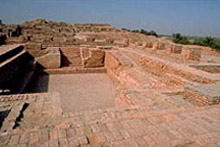
 According to the historical accounts Aryan Invasion Theory may refer to a model of invasion that had backing in the nineteenth and early twentieth century. It is during this time that the violent aspects of human migration were stressed upon. Aryan Invasion Theory has been one of the most controversial topics of history for over a span of hundred years. But due to the mergence of several recent hypothesis the Aryan Invasion Theory has been seriously been challenged.
The excavations at the sites of Mohenjo-daro and Harappa were taken into consideration by the indologists and were declared that a nomadic tribe from foreign lands had plundered the Indian subcontinent. It was also strongly marked that ruins dated back to an era before the Aryan invasion and this was actually never verified. After assigning a period of 2 years to each of the several layers of the pre-Buddhist Vedic literature, indologists arrived at a time frame of somewhere between 1500 and 1000 B.C. for the Aryan invasion. Referring to the Biblical chronology the scholars thus postulated that the invasion of the Aryans could not have taken place anytime before 1500 B.C. The excavation remnants mostly consisted of human skeletal remains, which was evident of the fact that a large-scale massacre has taken place in these cities by the invading hordes of the Aryan origin.
It is also stated in the Vedas that the light-skinned nomads from the Central Asia wiped out the indigenous culture and enslaved or butchered the people after imposing their alien culture upon them. The Vedas in fact strengthened the Aryan Invasion Theory, which is a series of poetic tales about the skirmishes between two barbaric tribes. Based on literary analysis many scholars dismissed any idea of Aryan invasion on several bases. First they raised an argument on the fact that why it is so that the Aryans don`t name any places outside India as their religious sites.
The Aryan Invasion Theory was also linked with references of horses in the Vedas with the assumption that the Aryans brought horses and chariots with them giving them military superiority that made it possible for them to conquer the indigenous inhabitants of the Indian subcontinent. Several indologists tried to credit this theory by claiming that the domestication of horse took place just before 1500 B.C. another important point in this regard is that the nomadic tribes do not use chariots. Similarly it was also claimed in the Iron culture that the invading Aryans gained the upper hand because their weapons were made of iron.
The advocates of the Aryan Invasion Theory argue that the inhabitants of Indus Valley were the worshippers of Lord Shiva. Since Saivism is more prevalent among the Indians residing in the southern part of India, the inhabitants of the Indus Valley Civilization must have been Dravidians. With so much evidence against the Aryan Invasion Theory one might wonder as to why this ugly vestige of the imperialism of British colonial rule is still taught. Accepting the facts that the Aryans were the original inhabitants of the Indus Valley region and not only a horde of invading foreign tribes can solve such misconceptions.