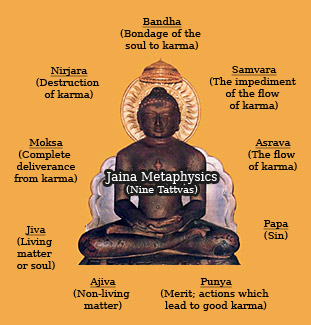
 Different types of Karma are associated with Jainism. According to them since the beginning of the time every life form or soul remains attached with karma which is an integral part of life. They also believe that every living being remains in a state of delusion or is ignorant of its true nature. Thus the main objective of the religious faith is to eradicate this delusion through self-knowledge and self-effort. They believe that this knowledge would help in removing karma which is associated with it from the beginning of time. Once all karma is removed from the living being, the soul becomes an enlightened soul.
Types of Karma
There are many types of karma. They have been broadly classified into the following eight categories:
Mohniya karma: This karma generates delusion in the soul in regard to its own true nature. It makes it identify itself with other external substances.
Gyan varaniya karma: This karma covers the soul`s power of ideal knowledge.
Darasna varaniya karma: This karma covers the soul`s power of ideal visions.
Antaraya karma: This karma hinders the usual and natural quality or energy of the soul such as charity and will power. It also obstructs the soul from achieving nirvana. It also prevents a life form from doing anything good and enjoyable.
Vedniya karma: This karma obscures the blissful nature of the soul and thus produces pain and pleasure.
Nama karrna: This karma obscures the non corporeal existence of the soul. It generates the body with its limitations, qualities, faculties, etc.
Gotra karma: This karma obscures the soul`s features of equanimity, and determines the household, social standing, and individuality.
Ayu karma: This Karma determines the span of life in one birth. It thus obscures the soul`s nature of timeless existence.
Destruction of Karma
While trodding on the path of divine progress, an individual or living being destructs all eight types of his karmas in a particular sequential order. First it destructs Mohaniya Karma (delusion), then Gyan varaniya Karma (knowledge), Darasna varaniya Karma (vision), and Antaraya Karma (natural qualities) all three together. Once he is rid of his karmas he achieves Kewal-Gyan and he is known as Arihant. This is also known as Tirthankara, Jin, Arhat, Kewali, or Nirgantha.
Lastly the remaining four karmas which are Vedniya Karma (pain and pleasure of the body), Nama Karma (body), Gotra Karma (social standing), and Ayu Karma (life span) are destructed in due process. At this point of life he achieves total nirvana and he is thus known as Siddha.
The first four karmas are classified as `Ghati karmas` as they obscure the natural qualities of the soul. The last four karmas are categorised as `Aghati karmas` because they don`t affect the qualities of the soul. However, they are associated to the physical body of the soul. Thus once an individual is able to destruct all his Ghati karmas, he will definitely be able to destruct all of his Aghati karmas before his death. One cannot fall back after the destruction of his Ghati karmas.