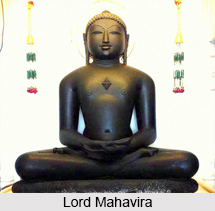
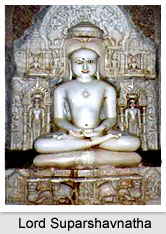
 Lord Suparshvanath was the seventh Jain Tirthankara of the current age, Avasarpini. As per Jain philosophy, he became a siddha, an enlightened soul which has destructed all of its karma.
Lord Suparshvnath was born to Emperor Prathisth Raja and Queen Prithvidevi at Varanasi in the Ikshvaku dynasty. His birth date was the twelfth day of the Jayesth Shukla month of the Hindu calendar.
There are certain legends associated with all the Jain Tirthankars which may include some historical matter. In the Mahavagga, there is a mention of a Jain temple of Lord Suparsva, the seventh Tirthankara. It is located at Rajagriha of Bihar state of India in the time of Lord Buddha. There is an old stupa of the Jains located in Mathura with the inscription of 157 AD. According to the inscription an image of the Tirthankara Aranath was set up at the stupa built by the Gods. In 157 AD., this stupa was so old that it was considered as the work of the Gods. It is thus believed that it was probably erected several centuries before the Christian era.
Jinprabha in the Tirtha Kalpa was a work of the 14th century. Established on ancient materials it mentions that the stupa was originally made of gold. It was erected by the Kubera in honour of the 7th Jain Tirthankara Suparsvanatha for two Jain Saints named Acharya Dharmaruchi and Dharmaghosh.
During the time of 23rd Jain Tirthankara, Parsvanatha, the golden stupa was built of bricks and a stone temple was erected outside. Even Somadeva, the author of the Yasastilaka who is about four hundred years earlier than Jinaprabha refers to it as built by Gods. All these legendary accounts points out that there was the tradition of worship of Suparsvanatha several centuries before the Christian era.
When Suparshva became young he was married and later ascended the throne. He successfully handled the kingdom and conducted the affairs of the state. He looked after the well being of his individuals. One day while he was enjoying the nature sitting at the rooftop, he observed the falling of leaves and wilting of flowers. Suddenly he became aware of the transient nature of life. This gave a rising to the feeling of detachment in him. He gave his kingdom to his son and became an ascetic. After nine months of disciplined practices he became knowledgeable on the sixth day of the dark half of the month of Phalgun. For a long period he worked for the spread of right knowledge. He got enlightened and attained nirvana on the seventh day of the bright half of his month of Palgun at Sammetshikhar.