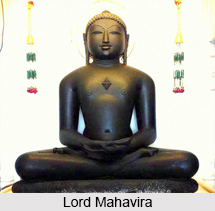
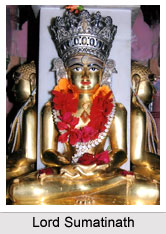
 Lord Sumatinatha was the fifth Jain Tirthankara of the current age, Avasarpini. As per Jain philosophy, he became a siddha, an enlightened soul which has destructed all of its karma.
Lord Sumatinath was born to Emperor Megh Raja and Queen Mangala Rani at Ayodhya in the Ikshvaku dynasty. He was born on the eighth day of the Vaishakh shukla month of the Hindu calendar. Vijayasen was the Emperor of Shankhpur town in the Purva Mahavideh area. He had a son by the name Purushasimha. One day he had gone for a walk in the garden and listened to the discourse of Acharya Vinayanandan Dev. Upon hearing him, Purushasimha became detached and a turned ascetic. He earned the Tirthankar-nam-and-gotra-karma for his vigorous penance and higher divine practices. After completing his age, he reincarnated as a God in the Vijayant dimension.
Resurrection of Lord Sumatinath
From Vijayant dimension, the soul that was Purushasimha descended into the womb of Queen Mangalavati/Sumangala, wife of Emperor Megh of Ayodhya. As soon as the news of the queen being pregnant spread in Ayodhya the atmosphere became filled with bliss and joy.
Once an incident took place in Ayodhya. Two women and a little boy came to the Emperor`s court to seek justice. One of the women put forth her case before the Emperor; saying that they were the two wives of a rich seafaring merchant. Their husband had left for his heavenly abode leaving behind two of them, a son and heaps of wealth. She said that the child truly belonged to her but the second wife of the merchant claims the son to be hers so as to grab the wealth that would be inherited by the child. The opther woman also narrated the same story.
Both the woman began shouting charges and counter charges at each other. The child too could not identify his true mother as he had got equal affection from both. As the boy was born in some remote place, there was no eye witness available also.
The Emperor even after a lot of probing and weighing the case could not come to a proper conclusion. Any ill conceived solution could end up in doing injustice to the innocent. The dinner time was nearing and the Emperor was getting late for his dinner. He adjourned the case and went into the palace for dinner.
The queen asked him why he was late for dinner that day. The Emperor narrated the whole story to her. Upon hearing the queen told that she would solve the case. Next morning the queen herself came to the Emperor`s court. Both the women and their son were produced before the queen. All of a sudden, the queen got an insight and said that this problem has no simple solution. Under such circumstances the only solution is to keep the matter pending. She said that she carries a pious soul in her womb and it will upon its birth resolve the issue. She also proposed that till the child is born the son and the property of the deceased would be under the custody of the state. Hearing this, one of them readily accepted the decision but the other started weeping. In a choked voice she pleaded not to separate her from her son. She said that she wishes to withdraw her claim and would allow the other woman to take the child and also all the possessions of her husband.
The queen immediately recognized the pain and concern of actually mother`s heart. She thus gave her judgment that the first woman who immediately agreed to the proposal is the impostor. Her attachment is not to the child but to the wealth. However, the second woman is the actual mother of the child and thus her son and the wealth may be given to her with all honours. Everyone present in the assembly was surprised by this witty method of judgment.
The queen gave birth to a son on the eighth day of the bright half of the month of Vaishakh. Upon the birth of the child a wave of peace and goodwill swept the whole world. It was believed that the wisdom and sense of judgment during the pregnancy was the influence of the presence of the illustrious and pious soul. Thus, Emperor Megh named the new born as Sumati, wisdom or right thinking.
When he became an adult Sumati Kumar was married. He was crowned after his father and reined successfully for many years. After a long Sumatinath left his kingdom and became an ascetic. He achieved nirvana under a Priyangu tree on the eleventh day of the bright half of the month of Chaitra. He founded the four pronged religious ford and became a Tirthankara. On the ninth day of the bright half of the month of Chaitra he got Nirvana at Sammetshikhar.