


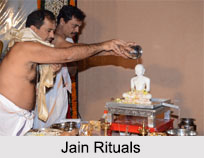
 Jain Rituals are performed by Jain monks and nuns. They practice strict asceticism. They strive hard to make their present birth their last, thus ending their cycle of transmigration. According to the Jains, true spirituality begins when one achieves Samyak darshana, or true perception. Such souls are on the path to Moksha, and are striving to remain in the nature of the soul. The different rituals in Jainism have profound meaning attached to them. Various virtues like ahimsa, forbearance, simplicity and straightforwardness are cultivated during religious rites. Jain Rituals are performed by Jain monks and nuns. They practice strict asceticism. They strive hard to make their present birth their last, thus ending their cycle of transmigration. According to the Jains, true spirituality begins when one achieves Samyak darshana, or true perception. Such souls are on the path to Moksha, and are striving to remain in the nature of the soul. The different rituals in Jainism have profound meaning attached to them. Various virtues like ahimsa, forbearance, simplicity and straightforwardness are cultivated during religious rites.
Various Rituals in Jainism Jain rituals are performed on daily basis and also on certain special occasions. The rites which are must, are called ‘Essentials’ or ‘Awashyak’, and are meant for Sadhus and Sravakas. It is believed that these essentials were revealed by the Jain Tirthankaras. These essentials should be performed everyday to achieve control over ones senses. Following are the rituals performed by the Jains. Samayika: Samayika is one of the important religious rituals of Jainism. Samayika is a Sanskrit word that means equanimity. The goal of Samayika is to achieve equanimity. Samayika is begun by attaining a balance in time. It is believed that if someone performs just Samayika with devotion, it is regarded that he or she has observed the main tenets of Jainism. Samayika is the achievement of being ideal for certain time where one becomes kashaya-free, remains in supreme peace and finally stabilizes in the richness of soul. Chatur Vimsati: An individual when attains Sambhav in Samayika, the thought of those great personalities who showed the path of 'samta' come to the mind. One also thinks about their gunas and cannot avoid praising them. This is the concept behind the Chatur Vimsati. The 24 Tirthankaras, who founded the teerthas, are remembered along with their gunas. 'Loggass' are recited for this purpose. Vandana: Vandana is an important part of the religious rituals of Jainism. It is an important ritual of Jainism to bow down to the gurus. One can realise the ultimate truth only after getting rid of his ego and self-arrogance. Therefore, once a person becomes free from arrogance, he becomes empty from inside. This helps in progressing in the path of truth and achieving Moksha. Pratikramana: Pratikramana is an important religious ritual of Jainism. The strength of sanyam is in kriya and kriya's strength is Pratikramana. It is a tool of internal purification of heart. Pratikramana usually means to turn back from shortcomings or mistakes. Pratikramana tells a man to come back from where one does not belong; i.e. where all impurities due to karma-bandha exist. 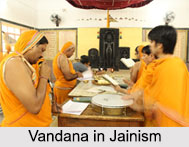 Kayotsarga: Kayotsarga is part of samayika-pratikramana and chaitya vandan, and it is performed repeatedly. The time period for Kayotsarga is decided along with number of breath. In Kayotsarga, one recites mantra and tries to see the picture of the objects in that sutra. Kayotsarga: Kayotsarga is part of samayika-pratikramana and chaitya vandan, and it is performed repeatedly. The time period for Kayotsarga is decided along with number of breath. In Kayotsarga, one recites mantra and tries to see the picture of the objects in that sutra.
Pratyakhyana: Pratyakhyana means vow. The incorrect and wrong acts of the past are corrected in Pratyakhyana. Thus to avoid oneself from performing wrong acts, vows are taken. According to the Jain principals, unless one takes vows; his ways are open to the areas where all sinful activities take place and one becomes a part of it. The twelve vows of Sravaka help in forming boundaries. Vows are taken to remain clean. |
| |||



Jain Rituals
| Jain Rituals also called Essentials are an important part of the daily lives that help in achieving control over ones senses. They need to be performed everyday with devotion. |
| ||||||||||||||||||||||||||||

