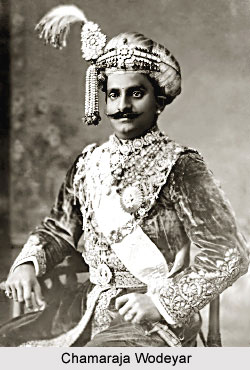
 Chamaraja Wodeyar, also known as Chamaraja Wadiyar, was the 23rd ruler or Maharaja of Mysore, who reigned from the year 1881 to 1894. The official full name of Chamaraja was His Highness Maharaja Sri Sir Chamaraja Wadiyar, GCSI, Maharaja of Mysore. He was born on 22nd February 1863, at the old palace in Mysore. Chamaraja was the 3rd son of Sardar Chikka Krishnaraj Urs, who belonged to the Bettada Kote branch of the ruling family. Rajkumari Sri Puta Ammani Avaru, his mother gave birth to Chamaraja Wodeyar after a week of his father`s death. She was the eldest daughter of Krishnaraja Wodeyar III, the ruling king of Mysore during that period. As the Maharaja did not have any male heirs, Krishna Raja Wodeyar III adopted Chamaraja, his grandson, as heir. This was finalised on 18th June, 1865 and was also approved by the British administration in India on 16th April 1867.
Chamaraja Wodeyar`s Accession to the Throne
The then Maharaja Krishnaraja Wodeyar III died on 27th March 1868 and his grandson Chamaraja ascended the Gadi or throne on 23rd September, 1868 at the royal palace, Mysore. Since the year 1831, the territory of Mysore had been under the direct government and command of the British Empire in India. Due to various accusations of misrule, Krishnaraja Wodeyar was deposed by the British. Bur later the decision of the British East India Company to annex Mysore was reversed by an order from the privy council of the United Kingdom. The princely state of Mysore was restored and reconstituted to the Wodeyar dynasty by the Rendition of 1881. Chamaraja Wodeyar was trained and guided by the British authorities to take proper charge of the administration of Mysore. In the year 1881, he received the reins of governance.
Rule of Chamaraja Wodeyar
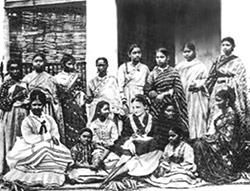
Chamaraja Wodeyar was the 23rd Maharaja of the princely state of Mysore. Although he ruled over the region for a brief period of time, he left an ineradicable impression on the territory of Mysore and thus has shaped the present state of Karnataka. The Representative Assembly of Mysore state was instituted by him in the year 1881. This was the earliest modern and democratic legislative institution in its category in princely India under the British indirect rule. Chamaraja also sponsored the renowned trip of Swami Vivekananda to Chicago in the year 1893. He diligently worked towards the development of education of women and established the Kannada Bashojjivini School. Chamaraja Wodeyar also took efforts for the advancement of industrialization of the princely state of Mysore. He also established various industrial schools and conducted the annual Dasara Industrial Exhibition.
The Maharaja of Mysore also assisted in founding the Agricultural Banks to help farmers to attain finance and also instigated Life Insurance for government employees. Some of the most prominent landmarks in Mysore were constructed by him. These include Fern Hill Palace, Mysore Zoo, Dufferin Tower, Lansdowne Bazaar, Government Office, Maharaja`s Sanskrit School, Maharaja College, Oriental Research Institute Mysore, Lalbagh Glass House, Bangalore Palace and others.
Chamaraja Wodeyar was a benefactor of fine arts and music, and many eminent artists were present in his court. He was also a connoisseur of Javalis, a genre of Carnatic music.
Personal Life of Chamaraja Wodeyar
Chamaraja Wodeyar got married to Vani Vilasa Sannidhana Kempananja Ammani Avaru in May 1878. The couple had 3 daughters and 4 sons, but only Krishnaraja Wodeyar IV and Prince Kanteerava Narasimharaja Wodeyar survived adulthood. His three daughters were named Princess Chaluvaja Ammani, Princess Krishnaraja Ammani and Princess Jayalakshmi Ammani.
Chamaraja Wodeyar died at the age of 31 on 28th December 1894 in Calcutta (now Kolkata). He was suffering from severe diphtheria. Krishnaraja Wodeyar IV succeeded him.