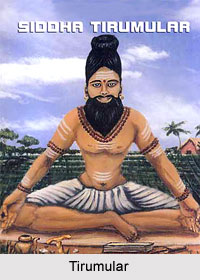
Tirumular, Tamil Poet - Informative & researched article on Tirumular, Tamil Poet
 Indianetzone: Largest Free Encyclopedia of India with thousand of articlesIndian Literature


in  
 Art & Culture|Entertainment|Health|Reference|Sports|Society|Travel
Forum  | Free E-magazine  | RSS Feeds  
Indian Literature : Indian Literature |History of Indian Literature |Sanskrit Literature |Indian English Literature |Regional Indian Literature |Indian Comics |Indian Poetry |Indian Literary Personalities |Indian Epic Poetry |Renaissance in Indian Literature |Indian Novels |Indian Literary Organisations |Indian Literary Movements |Contemporary Indian Literature |Medieval Indian Literature |Ancient Indian Literature |Themes In Indian Literature |Genres in Indian Literature |Influencing Factors On Indian Literature |Forms of Indian Literature |Religious Influence on Indian Literature |Modern Indian Literature |Vedas
Home > Reference > Indian Literature > Regional Indian Literature > Tamil Literature > Tirumular
Tirumular, Tamil Poet
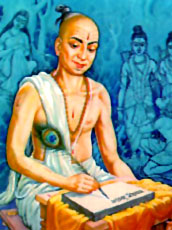
Tirumular was Tamil poet and a Shaivite saint who composed the Tirumantiram in 5th CE. It is believed that he transmigrated into the body of Mulan through yogic powers.

 Tirumular, Tamil PoetTirumular or Thirumoolar, was Tamil Shaivite sage and poet who was originally known as Sundaranatha. He was considered as one of the 63 Nayanars (Shaivite devotee) and one of the 18 Siddhars. In the 5th CE, Tirumular wrote Tirumantiram (Tirumandhiram) which is a devotional poetic work of Tamil literature. It comprises of almost three thousand verses and is amongst the major texts of the Tamil Shaiva Siddhanta, known as the Tirumurai. According to legends, Tirumular was a scholar and a Shaivite saint who traveled from Kailash and used his yogic abilities to transmigrate into the body of Mulan, a cowherd. It is believed that Tirumular awoke from his trance only once in a year and wrote one poetry until he obtained salvation.

Life of Tirumular
The period of Tirumular existence is much debated as his poetic work makes many references of various currents of religious thought. Different scholars allocate different dates. It is claimed in verse 74 of the Tirumantiram that before composing the Tirumantiram, the Shaiva poet lived for 7 yugas (aeons). Therefore, some scholars place his composition much before the Common Era. But according to scholar S. Vaiyapuripillai, Tirumular lived during the early 8th century AD, as he uses reference of the Tevaram hymns of Sambandar, Appar and Sundarar. Moreover in his poetic work of Tirumantiram, Tirumular used much later words and also mentioned about the weekdays. According to others Tirumular existed during the 11th or 12th century AD.

Philosophy of Tirumular
Tirumular emerges as a moral philosopher and teaches the ethics of non-violence (ahimsa), abstinence from meat, alcohol and others. In his much celebrated poetic work known as Tirumantiram, Tirumular gave emphasis to the concept Love is God (Anbey Sivam) and those who have this knowledge are enlightened and acquire the traits of godliness. In another verse, he proceeds from the recognized reality of love to an unidentified reality of God. He concludes that there is no difference between love and God. In another verse Tirumular denounces the strict austerities which are practiced by the devotees of Lord Shiva. Tirumular urges that service to humans is more imperative than the worship of gods in temples with offerings. He denounces the desire of one man for another man`s wife, but also states that love is God. Moreover, Tirumular states about the unity of man and God and stresses on the attainment of knowledge. He also believes God created both good and evil forces and it is upto the judgment of mankind to choose the correct one.

The three thousand verses written in Tirumantiram by Tirumular in the viruttam metre discloses many exceptional truths. Tirumular implements allegorical language to describe that human can attain realisation of God by disciplining the 5 senses. It is more important to analyse the inner mind that to scrutinize the external world. It is rather imperative to choose from the many noble things to lead a good life. Tirumular effortlessly expressed the eternal truth that man can only see the transitory nature of life after his eyes are opened by death. Tirumantiram is written in a range of rhythm that depends on the pace of his ideas.
(Last Updated on : 24/01/2013)
 
 
Subramaniam Bharati Subramanya Bharathi Vedanayagam Pillai
Dr U.Ve. Swaminatha Iyer Kamban Medieval Tamil Literature
Purananuru- Sangam Literary Work of India Ahananuru- Sangam Literary Work of India Tiruvalluvar
Sangam Literature of Tamil Nadu Ottakuttar Tolkappiyam
Sekkizhar Musicological Literature of South India Chintamani
Kural Sangam Age in Tamil Literature Post-Sangam Age in Tamil literature
Vijayanagar and Nayak Age in Tamil Literature Modern Era in Tamil literature Poetry in Twentieth Century Tamil Literature
Vedanayaka Sastri Folk Literature in Tamil Constanzo Beschi
Maraimalai Adigal Tirukkural Prathapa Mudaliar Charithram
Jeyamohan Kalki Krishnamurthy C. Viruthachalam
S. Ramakrishnan Charu Nivedita Bharathidasan
Meenakshi Sundaram Pillai Forms of Poetry in Tamil Literature History of Tamil Literature
Prose in Tamil Literature Ettuttokai Kalittokai
Arruppatai Tirumurukaruppatai Porunararruppatai
Cirupanarruppatai Malaipatukatam Mullaippattu
Kurincippattu Pattinappalai Netunalvatai
Maturaikkanci Ethical Tamil Literature Epics in Tamil Literature
Muttollayiram Pattupattu Folk Songs in Tamil Literature
Influence of Bhakti Movement on Tamil Literature Tirumular Karaikkal Ammaiyar
Campantar Tirunavukkaracar Cuntarar
Nambiyandar Nambi Manickavasagar Gandaraditya Chola
Periyalvar Antal Tirumankai Alvar
Nammalvar Nantik Kalampakam Tiruppalliyelucci
Tattuvarayar Kovai Tiruppavai
Madhurakavi Alvar Parani Kalinkattupparani
Ula Thirumalisai Alvar Bhoothath Alvar
Thondaradippodi Alvar Thiruppaan Alvar Poigai Alvar
Peyalvar Nathamuni Ottakoothar
Kambar Nakkeerar Iraiyanar Akapporul
Agattiyam Patirruppattu Tirutakkatevar
Akananuru Auvaiyar Nikantukals
Nambi Akapporul Religious Works in Tamil Literature Tancaivanan Kovai
Patinenmelkanakku Perumpan Arruppatai Porunar Arruppatai
Puranas in Tamil Literature Talapuranams Astappirapantam
Thiruppugazh Arunakiriyar Pattinattar
Bharatam Nalavenpa Ativiraramar
Kalamekam Irattaippulavar Antakakkavi Viraraghava Mudaliyar
Kumarakuruparar Civappirakacar Civanana Munivar
Cantalihika Cuvamikal Citampara Cuvamikal Tayumanavar
Catakams Alakarkillaivitututu Patikkacup Pulavar
Nalla Pillai Mmatcicuntaram Pillai Tantavarayar
Ramalinkar Cuvamikal Kopalakirusna Parati Capapati Mudaliar
Velayuta Mudaliar Tantapani Cuvamikal Tamil Islamic Literature
Umaru Pulavar Panaikkulam Abdul Majid Tamil Christian Literature
Viramamunivar G. U. Pope Krisna Pillai
Plays in Tamil literature Novelists in Tamil Literature V.V.S. Iyer
K.P. Rajakopalan Batlagundu Subramanian Ramaiya T. Janakiraman
K. Alakiricami Cuntara Ramacami Vindan
Jeyakantan K. V. Jakannatan Curiyanarayana Sastriyar
Pinnattur Narayanacami Iyer Annamalai Reddiar R. Rakava Iyengar
V.O. Citamparam Pillai Caminata Iyer Maraimalai Atikal
T. V. Kaliyanacuntarar Biography in Tamil literature K. Namaccivaya Mudaliar
Paratiyar Paratitacan Kavimani Tecikavinayakam Pillai
Children’s Literature in Tamil Namakkal Kavinar V. Ramalinkam Pillai Murukeca Pakavatar
Recently Updated Articles in Indian Literature
Romuald D`Souza
Romuald D`Souza is the founder of Goa Institute of Management who holds a place of eminence amongst the Indian scenario due to his contribution to Indian education.
Irwin Allan Sealy
Irwin Allan Sealy is one of the underrated writers of Indian subcontinent who has created a niche for himself by his pinching eye for detail and inclusion of Indianness amidst the length and breadth of Indian writing in English.
Contribution of Sreemanta Shankaradeva to Ankiya Nats
Contribution of Sreemanta Shankaradeva to Ankiya Nats depicts the thresholds of Assamese dramaturgy.
Bimal Mitra
Bimal Mitra is one of the exponential writers of Bengali literature whose contribution to literature has surpassed the stereotypical borders of black and white literature as well as round and fixed characters.
Kamalakanta Bhattacharjya
Kamalakanta Bhattacharya was a poet who belonged to the Oronodoi age who succeeded in revolutionizing poetic diction.
E-mail this Article | Post a Comment
Forum
Forum on Indian Literature
Free E-magazine
Subscribe to Free E-Magazine on Reference
 
 
Tirumular, Tamil Poet - Informative & researched article on Tirumular, Tamil Poet
Sitemap
Contact Us   |   RSS Feeds
Copyright © 2008 Jupiter Infomedia Ltd. All rights reserved including the right to reproduce the contents in whole or in part in any form or medium without the express written permission of
Jupiter Infomedia Ltd.