


 Equipments of Cricket are mainly varied and the game of cricket can be traced back to 1550. The game of cricket was first played in Guildford, Surrey. Later in 1598, cricket was cited in an Italian English dictionary written by Florio. In the year 1676, British residents in Aleppo played cricket abroad for the first time. In cricket there are wide ranges of equipment that are used. Cricket clothing is slightly loose fitting so that it is comfortable. Equipments of Cricket are mainly varied and the game of cricket can be traced back to 1550. The game of cricket was first played in Guildford, Surrey. Later in 1598, cricket was cited in an Italian English dictionary written by Florio. In the year 1676, British residents in Aleppo played cricket abroad for the first time. In cricket there are wide ranges of equipment that are used. Cricket clothing is slightly loose fitting so that it is comfortable.
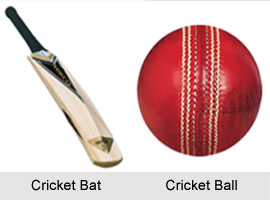
Cricket Ball A red or white ball with a cork base, wrapped in twine covered with leather. The ball should have a circumference of 23 cm (9.1 inches) unless it is a children's size. A bit like a baseball (in size and hardness), but the leather covering is thicker and joined in two hemispheres, not in a tennis ball pattern. The seam is thus like an equator, and the stitching is raised slightly. The circumference is between 224 and 229 millimetres (8,81 to 9.00 inches), and the ball weighs between 156 and 163 grams (5.5 to 5.75 ounces). Traditionally the ball is dyed red, with the stitching left white. Nowadays white balls are also used, for visibility in games played at night under artificial lights. Cricket Bat Blade made of willow, flat on one side, humped on the other for strength, attached to a sturdy cane handle. The blade has a maximum width of 108 millimetres (4.25 inches) and the whole bat has a maximum length of 965 millimetres (38 inches). Wickets 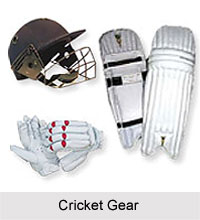 There are two wickets - wooden structures made up of a set of three stumps topped by a pair of bails. These are described below.
Stump: Three wooden posts, 25 millimetres (1inch) in diameter and 813 millimetres {32 inches) high. They have spikes extending from their bottom end and are hammered into the ground in an evenly spaced row, with the outside edges of the outermost stumps 228 millimetres (9 inches) apart. This means they are just close enough together that a cricket ball cannot pass between them. Bails: Two wooden crosspieces which sit in grooves atop the adjacent pairs of stumps. Protective Gear 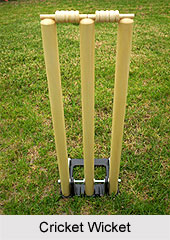 Pads, gloves, helmet, etc., for batsmen to wear to prevent injury when struck by the ball.
Shoes The used in cricket matches are generally made of leather, with spiked soles for grip on the grass. Clothing Clothing of cricket mainly consists of pants, shirt (long or short sleeved depending on the weather), possibly a sleeveless or long-sleeved woollen pullover in cold weather. For games played with a red ball, the clothing must be white or cream. With a white ball, players usually wear uniforms in solid team colours. A hat or a cap to keep the sun off is also used. There are no regulations as such regarding identifying marks or numbers on clothing Batsmen are allowed to wear gloves while batting. The batsman can be also caught out if the ball touches the glove instead of the bat, provided the hand is in contact with the bat. This is because the glove is considered to be the extension of the bat. The batsman may also wear protective helmets usually with a visor to protect themselves. Helmets are usually employed when facing fast bowlers. While playing spinners, it might not be employed. Fielders cannot use gloves to field the ball. If they wilfully use any part of their clothing to field the ball they may be penalised 5 penalty runs to the opposition. If the fielders are fielding close to the batsman, they are allowed to use helmets and leg guards worn under their clothing. The wicketkeeper, due to being directly behind the batsman and therefore having the ball bowled directly at him is allowed to wear leg guards, a helmet, a light internal glove and a large external glove like a mitt. |
| |||



Equipments of Cricket
| Equipments of cricket contains ball, bat, wicket, protective gears, shoes and cloths. |
| ||||||||||||||||||||||||||||

