Introduction
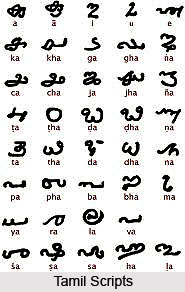 The Tamil Scripts is utilised to write the Tamil language and other minor languages like Paniya, Irulas and Badaga. Tamil script is also utilised to write Saurashtra and Tamils use it to write Sanskrit, with the use of diacritics to represent aspirated and voiced consonants that are not depicted in the basic script. The Tamil script varies from other Brahmi-derived scripts in numerous ways. Unlike other Indic scripts, Tamil script utilses the same character to represent both a voiced stop and n unvoiced one. Thus the character k represents both k and g. Conventional Tamil grammar has comprehensive rules, observed in formal speech, to determine when a stop is to be pronounced without and with voice. Further more, unlike other Indic scripts, it barely uses special consonantal ligatures to depict conjunct consonants that are much less frequent in Tamil than in other languages in India.<
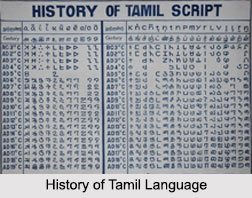
History of Tamil Script
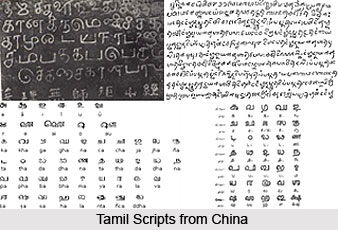 The history of Tamil scripts is very rich and dates back to the period just after the Asokan era. The Tamil script is considered to have evolved from the Brahmi script. The initial Tamil inscriptions were constructed in Grantha, Brahmi and Vatteluttu scripts. Inscriptions that date after the 7th century AD have characters resembling the modern Tamil scripts. Thus some experts and scholar opine that vatteluttu and Tamil scripts instigated from Brahmi scripts. But, as there are elaborate descriptions of Tamil scripts provided in the Tolkappiyam, the earliest extant grammatical work in Tamil from the 3rd century BC, this argument lacks a concrete base. Tamil language had a distinctive script of its own even at earliest epoch. In fact, Vatteluttu is written in the ancient Tamil script.
The Tamil script is believed to have developed from the Brahmi script. The oldest inscriptions of Tamil writing date back to a period after the Asokan era. The script utilised by the inscriptions is usually called the Tamil Brahmi. Initially, Tamil Brahmi used different vowel markers and had extra characters to represent letters which are not found in Sanskrit. Moreover, letters for sounds not present in Tamil, like voiced consonants and aspirates, were omitted. Inscriptions from the 2nd century AD portray a later variety of the Tamil Brahmi script that is considerably similar to the writing system explained in the ancient Tamil grammar Tolkappiyam. The Tamil letters evolved gradually and during 5th century AD and 6th century AD, it adopted a form known as early vatteluttu.
In 7th century, new script for Tamil was created by the Pallava dynasty that was formed by simplifying the Grantha script. The vatteluttu letters were also added to it for sounds which are not available in Sanskrit. By the 8th century, the new script replaced vatteluttu in the Chola and Pallava kingdoms. Vatteluttu sustained to be utilised in the Chera and Pandyan kingdoms until the Pandyan kingdom was occupied by the Cholas in the 11th century. Over the course of time, the Chola-Pallava script advanced into the modern Tamil script. As palm leaves were used as the prime medium for writing, therefore several changes were made in the script accordingly.
The use of the pulli to differentiate pure consonants became uncommon, with pure consonants generally being written as if the inherent vowel were present. The vowel marker for the kurriyal ukaram, a half-rounded u which occurs at the end of some words and in the medial position in some compound words, also were not in use and was swapped by the marker for the simple u. after the introduction of printing, the pulli reappeared, but the kurriyal ukaram, a marker, was never put back into use, the sound still exists and has a vital role to play in the Tamil prosody.
The forms of few letters were uncomplicated in the 19th century to make the script easier to typescript. Further, in the 20th century, the Tamil script was simplified in a series of reforms. The vowel markers were regularized, which were used with consonants by removing special markers and most unbalanced forms.
Classification of words in Tamil Scripts
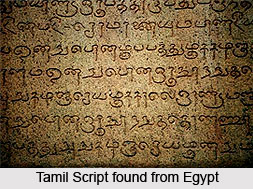 There are 4 types of words in Tamil scripts. Uriccol formed the root words amongst them and was used in ancient poems but are not common at present. Other than that, there are only 3 types of words, nouns, verbs and particles or itaiccol. The nouns represent inanimate and animate categories of gender, person, things and number. Tinai is divided into Uyartinai and Akrinai. Uyartinai denotes the nouns that depict personal class of beings, such as gods, demons and humans. Akrinai denotes the inferior class of beings which could be inanimate, animate or neuter. Uyartinai also comprises of higher classes of animate beings such as human beings.
The category of Akrinai comprises of other animate and inanimate things. Uyartinai consists of 3 types of genders masculine, feminine and neuter. Palar pal or neuter plural gender portrays many in number. Masculine and feminine genders in Tamil depict only singular number. Akrinai is divided into onran pal that is singular of the impersonal class and palvin pal that is plural of the impersonal class. Distinction between animate and inanimate objects and feminine and masculine genders are normally done based on the meaning of the words.
Tamil Letters
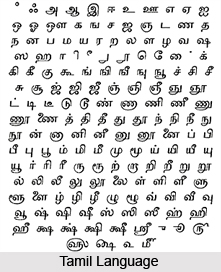
The Tamil characters that are used at present are believed to have initiated from vatteluttu. There are 12 vowels in Tamil consisting of 5 short vowels.
Basic Consonants in Tamil Scripts
Consonants are known as the body or mei letters. The consonants of Tamil scripts are divided into 3 parts:
* Vallinam - Hard consonants,
* Mellinam - Soft consonants, including all nasals, and
* Idayinam - Medium consonants.
Moreover, the Tolkappiyam describes some lexical rules for formation of words.
Modern Consonants in Tamil Scripts
The Tamil speech includes several phonemes that were not part of the Tolkappiyam categorization. The alphabetical characters known as Grantha are a fraction of contemporary Tamil. These are now a part of accepted Tamil alphabets which are taught from elementary school and integrated in Tamil Nadu Government encoding known as TACE 16 (Tamil All Character Encoding). In recent times, 3 combinations of Tamil basic letters are generally used to represent sounds of English letters f, z, and x. This is for writing English and Arabic words and names in Tamil script.
Vowels in Tamil Scripts
Vowels in Tamil scripts are called the life or soul letters or uyir. Along with the consonants they shape compound, syllabic (abugida) letters which are known as living letters or uyirmei, meaning letters that have both body (consonants) and soul (vowels). Tamil vowels are classified into short and long (5 of each kind) and 2 diphthongs. The long vowels, called nedil, are almost twice as long as the short vowels called kuril. The diphthongs are normally pronounced around one and a half times as long as the short vowels, even though some grammatical texts set them with the long vowels (nedil).
Tamil in Unicode
Unicode encodes the character in rational order, with the consonant always first, while legacy 8-bit encodings (such as TSCII) favour the written order. As a result, it is essential to rearrange when converting from one encoding to another; it is not adequate simply to map one set of code points to the other.
The Unicode range for Tamil is U+0B80-U+0BFF. Grey areas specify non-assigned code points. Both Unicode and ISCII encode Tamil as an abugida.