Introduction
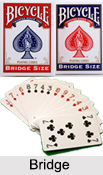 Bridge is a type of playing card in India, which is divided into four major categories. The first type is contract bridge and the second type is Duplicate Bridge. Rubber Bridge and Chicago Bridge happens to the third and fourth type of bridge game respectively. Contract bridge, which is also known as Bridge, is a trick taking game using a standard deck of 52 playing cards.
Types of Bridge
Contract Bridge was invented in the 1920`s and in the following decades it was popularized especially in the USA by Ely Culbertson. Bridge currently occupies a position of great prestige, and is more comprehensively organized than any other card game. There are clubs, tournaments and championships throughout the world. Rubber Bridge is the basic form of Contract Bridge, played by four players. Informal social bridge games are often played this way, and Rubber Bridge is also played in clubs for money.
Duplicate Bridge : This is the game normally played in clubs, tournaments and matches. The game is basically the same but the luck element is reduced by having the same deals replayed by different sets of players. At least eight players are required for this. There are some significant differences in the scoring. Two types of duplicate bridge will be covered, and they are a) Teams of four b) Pairs.
Idea of playing Duplicate Bridge was derived from whist. The application of duplicate to contract bridge was developed rapidly. In the US, the first national championship was held in 1928 under the auspices of the American Bridge League. In this form of Bridge the same hand is played more than once by the competing units who have to try to perform better than the one before. It can be played either as a team of four, pairs or individuals. In a team of 4 the same boards are played by the two teams sitting in compass directions on two tables, opposite to one another.
Chicago Bridge : This is played by four people (like rubber bridge), but a game is complete in four deals.
Rubber Bridge : In this type of bridge game, two people participate in the game at one table and the main objective remains to score the most number of points in the play of various hands. Just like the Duplicate Bridge this too requires chance and skills.
Contract Bridge : It developed from Auction Bridge, which is different mainly in the scoring. In Auction Bridge, overtricks count towards making game, so it is only necessary to bid high enough to win the contract.
Auction Bridge : Before Auction Bridge there was Bridge-Whist or Straight Bridge (at the time this game was just called Bridge). Earlier published rules of Bridge appeared in 1886 under the name Biritch or Russian Whist. In Bridge-Whist there is no bidding at all - the dealer either names a trump suit or passes, in which case the dealer`s partner must choose trumps. In either case the dealer`s partner is "dummy", so the opponent may double before the lead to the first trick and if doubled the dealer`s side may redouble. In the earliest form of the game, after any redouble, the other side can redouble again, and this can continue indefinitely.
History of Bridge
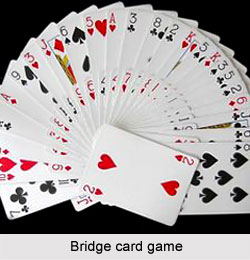 History of Bridge goes back a long way during the times of 1900. The name Bridge may have been derived from the Russian card game Biritch which is not in vogue now. Auction bridge was invented in 1902 which is based on the highest bidder, who names the trump. The contract principle as seen in planfond (a French game) was introduced by Harold S. Vanderbilt, an American millionaire, on 1st November 1925, during a Caribbean voyage aboard SS Finland. References also indicate that the British soldiers, based in India, had substantially contributed towards the growth of bridge. The game became extremely popular after the famous challenge match between the UK and USA at Almach`s Club, London. Romania-born Ely Culbertson and Lt. Col Walter Thomas More Buller shot into fame throughout the world.
The contract bridge which was played throughout the work replaced the auction bridge in the 1920s. In 1927, a new code essentially based on the 1926 laws of auction bridge, was adopted. Subsequently, in 1928, the first laws of duplicate bridge were published The first recognized championships were held in 1935 and the other landmarks were the organization of the first post-war world championship series in 1950, followed by the foundation of the World Bridge Federation in 1958 and the first team of four Olympiad in 1960.
The World Bridge Federation controls competitive bridge all over the world through the respective national associations of the country.
Besides competitive bridge, Rubber Bridge is played for enjoyment and skill at homes throughout the world. The laws of duplicate bridge differ marginally from the rubber bridge which is played for relaxation. The basic rules of the game are common to both Rubber Bridge and duplicate bridge.
Rules of Bridge
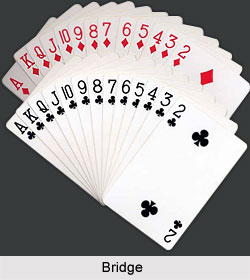 Rules of bridge have been formulated to make the game more advanced and appealing to the players. Here are some of the rules that are mentioned for the game;
1. The game is played by four players out of which one becomes the Dummy when the play starts.
2. A pack of cards is thoroughly shuffled before the play starts and there is a cut if either opponent so desires.
3. Opponent to the left of the dealer shuffles the cards and passes to his partner to cut for the next deal.
4. There are two packs of cards which are used alternately. The Cards of each suit rank in descending order starting from Ace followed by king, Queen and so on. The suits are also ranked. Spade is the highest followed by Hearts, Diamonds and Clubs. There is also the `No Trump` which is ranked the highest.
5. The dealer distributes one card face down at a time, starting from his immediate left opponent. After all the 52 cards have been equally dealt among all the players, the cards are picked up by each player.
Bidding Process in Bridge
1. After the cards have been dealt the dealer makes the first call and thereafter each player in turn from the dealer`s left calls. When there are 3 passes in continuation following a call, the auction is deemed to have closed and the contract decided.
2. Each bid has to denote a number of tricks from 1 to 7 as well as a denomination of the suit including "No Trump". The next bid to be followed must supersede the previous bid if it names the same number of odd tricks in a higher ranking denomination suit including "No Trump" or a greater number of odd tricks in any denomination.
3. A player may also double a preceding bid and a player following may re-double but that bid must have been made by an opponent.
4. Partnership that names the highest ranking denomination with the greatest number of tricks wins the auction. The player who named the first denomination of the suit that won the auction becomes the declarer.
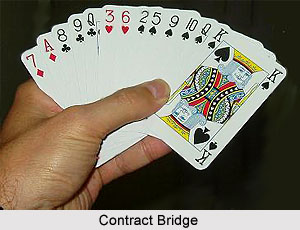 Contract bridge or bridge as it is also known as is a game about trick taking and is played with the standard deck of 52 playing cards. Four players can play this game with two competing partnerships, where partners sit opposite to one another around a table. Many people across the country and around the world play this game with friends sitting in a club or at home with family. For the purpose of scoring and reference each player is marked by one of the points of compass and thus South and North play against West and East. It consists of many deals each moving forward through 4 phases: dealing of the cards, the auction, playing the hand and scoring the results. Dealing with the cards and scoring results are part of procedural activities while auction and playing the hand are two actively competitive segments of the game.
Dealing : Partnerships are actually determined by self or by cuts of cards the two highest cut playing against the two lowest; the first dealer is the player cutting the highest card. Cards are dealt clockwise, one at a time and face down starting on the dealer`s left so that each player receives thirteen cards. In duplicate bridge the dealer is predetermined by the board. The board also contains the four hands which have been dealt and placed in the board prior to commencement of the game; these hands are not reused over the course of the event.
Auction or Bidding : The process of bidding starts with the dealer and also rotates around the table in a clockwise direction with each player making a call. The main purpose of course is to find out which partnership will contract to take more tricks given a particular trump suit or with no trump.
The partnership that makes for highest final bid is called declaring side and is also said to have won the contract. During the auction, the player on declaring side first stated the suit ultimately becoming trumps (or first stated no-trump if that is the final strain) is referred to as the declarer)
Playing : The rules used for contract bridge is similar to some of the other trick games that are quite popular as well. There are some other additional features as well like the hand of declarer partner is displayed face up on the table after the opening lead to the left of the declarer has been made by the member of the defending side. The hand that is displayed is referred to as Dummy and is played by declarer.
Scoring : After all the thirteen have been played with the score is calculated by comparing the original number of tricks taken by the declaring partnerships with what is proposed in the awarding points and contracts accordingly. For the declaring side, the available scoring side are dependent upon both the strain and level of the contract and are also awarded to them only when the contract is made which is at least the contracted for number of tricks are won by them; failure to do so results in the defending side`s receiving points instead and they are said to have `defeated` the contract. Individual scores of several hands are accumulated to determine the overall game score.