Introduction
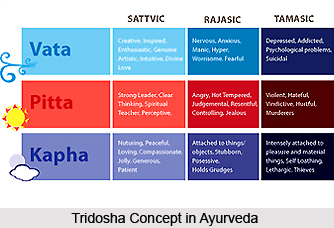
 Vata Dosha, the first of the Tridoshas is made up of the elements earth and air. It controls every body movement and mind activities including blood circulation, sensation, respiration, speech, hearing, touch, natural urges, excretion, formation of foetus, sexual act, retention and feelings like fear, anxiety, grief and enthusiasm. In short, most of the physical phenomena associated with the nervous system of human beings are under the dominance of vata. As long as Vata Dosha is in balance, one will be lively and enthusiastic, with a lean body.
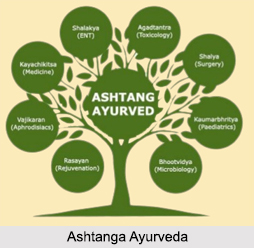
Vata is said to exist below the naval and the lower part of the body. Ashtanga Ayurveda considers the human body to be composed of five elements - space, air, fire, water and earth, which are collectively termed as the Pancha Mahabhutas. From these elements originate the three bodily humours or doshas - Vata, pitta and kapha. These three administer all the physical and mental functions of the body and thus are necessary for good health, vitality and immunity.
Characteristics of Vata Dosha
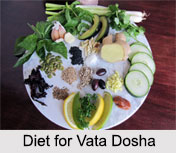 People who have vata type of constitution are usually physically active and thin. Their skin and hair are dry and joints are prominent. Under stressful conditions, they tend to lose their decision-making power and become insecure, fearful and anxious. They are light sleepers and prefer warm climate. The vata people are characterised by immense creativity and enthusiasm. Their digestive system, particularly the colon is vulnerable and often gives rise to problems. The renowned Ayurvedic text, the Charaka Samhita, precisely lays down the characteristics of Vata Dosha: dry and rough (rookshaha), light or lacking weight (laghuhu), cool (sheetoha), always moving (chalota), unbounded (vishadaha) and rough (kharaha).
Types of Vata Dosha
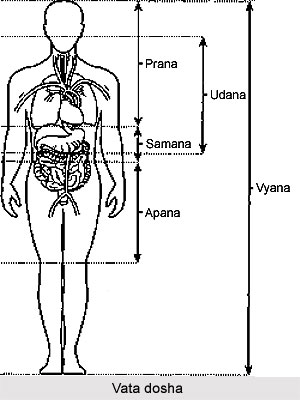 The five types of Vata dosha are: prana, udana, samana, apana and vyana. Prana is also known as air of respiration. It also means `life` which is the first air of the universe and of the body. Although located in the body between the diaphragm and throat, it pervades the region of the heart, chest, face and brain. Prana helps in chewing and swallowing of food and provides immediate nourishment to all vital tissues of the body. The system is being rejuvenated through inhalation, exhalation and timely preservation. The main function of prana is extracting life from the digested food and diffusing it into all of the tissues in the body.
Prana facilitates all movement in and out of the body. It moves in the region of the heart thereby causing it to beat. The food is carried by it through the oesophagus into the stomach. It sustains the heart, arteries, veins, senses, and our intelligence.
If prana cannot function properly life is threatened. It results in respiratory ailments such as bronchitis and asthma, heart ailments and the urge to vomit. Udana is the second type of Vata which means rising of air that flows upward from the navel through the lung and into the throat and nose. It is also recognized as the air of ejection, it provides the vocal powers and clarity of sense perceptions. It preserves the natural forces of the body like the strength of will and capacity for effort.
Udana keeps track of the number of breaths we use. It also has the capacity to preserve memory, both experiential and cognitive. Harm to udana can result in memory loss, impaired speech, heaviness in the head, deep-seated fears, and a shortened life span.
Samana, the third air of Vata, is located between the diaphragm and navel. It aids the movement of food through the stomach and small intestines by stimulating the production of gastric juices and digestive enzymes. It also helps in the assimilation of nutrients that have been extracted from our food. It is the moving force that transports these nutrients to the various tissue elements and discharges wastes into the colon. When samana is disturbed, it can cause mucus accumulation in the stomach called `ama`, as well as indigestion, poor assimilation and diarrhoea.
Apana is the fourth air of Vata that is located in the colon and the organs of the pelvic region. It is also known as the air of elimination. Its major function is to relieve the body of feces, urine, flatus, semen and menstrual waste. Its down ward pressure maintains the foetus position and the flow of its eventual birth. Apana is the most dominant of the five airs as it is situated in Vata`s primary location. Apana maintains the delayed nutrition of prana in the organism. Any harm to apana causes diseases of the bladder, anus, testicles, uterus, menstrual problems and persistent urinary diseases, including diabetes.
Vyana is the final air of the Vata and is located in the heart. It diffuses the energy that is derived from food and breath throughout the entire organism. It is circulatory in nature. It functions in the body`s circulation channels like the blood vessels, to transport nutritive juices and blood throughout the body. It also carries sweat from the glands to the skin and is the force behind bodily expressions like yawning and blinking. When there is a malfunctioning in Vyana skin becomes dry and causes other body extremities. Circulation becomes poor.
Remedies for Vata Dosha
Vata Dosha is stimulated by pungent, bitter and acidic food products and weakened by sweet, sour and salty tasting foods. Ashtanga Ayurveda recommends sweet, sour or salty food to a person with Vata personality. These people should refrain from watching too much television or from rushing around doing many things at the same time because these activities stimulate vata. Deficiency of vata in the body leads to uneasiness, languor and loss of consciousness while vata excess is responsible for thinness of the body, dark complexion, roughness of the voice, desire for heat, hard stool, insomnia, throbbing sensation and weakness. Apart from these, the vitiation of vata can cause swelling in the abdomen and rumbling sound in the intestines.
Thus people in whom vata dosha dominates, Ashtanga Ayurveda suggests proper diet and various Yoga therapies.
Diet for Vata Dosha
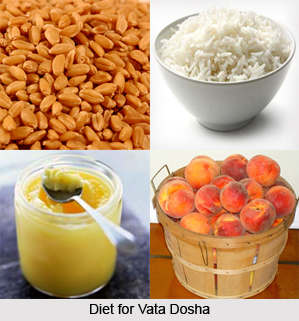 Ayurveda recommends that a person should be very careful about his eating habits. One should not eat foods, which aggravates the dosha, which is dominant in the person. People with a predominant vata dosha are very active, restless and energetic. These kind of people usually have fast metabolisms, so are often thin with little muscle development and protruding joints that may make cracking noises. It can be said that the best quality of vata dosha is rough, dry, cold and subtle. Thus, diet for vata dosha should incorporate warm, moist, oily, soft and heavy foods.
Foods to Include in Diet : A person with vata dosha should consume vata pacifying food. Vata can be pacified with nutritive and tissue-building foods. The foods should taste sweet, sour and salty. Soft dairy products like ghee and grains like oat, wheat, rice are also recommended for a person with vata dosha. Hot cereals with ghee, healthy soups with vegetables are ideal food for such persons.
Vegetables like asparagus, carrots, green beans, bhindi, cucumber, onions, garlic, radish, beets and sweet potatoes are good for such persons.
 Fruits like apricots, banana, cherries, fresh figs, peaches, citrus fruits, dates, mango, papaya, grapes, berries, pineapple, and plums can be eaten. Beverages like warm drinks, herbal or spiced teas, warm milk, fruit and vegetable juice without ice can be good option for vata dosha people.
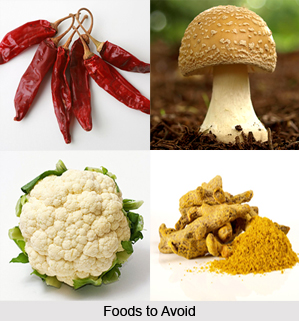
Foods to Avoid : There are certain foods, which should be completely avoided as they aggravate the vata dosha. Frozen deserts and large amounts of raw vegetables and salads should be avoided. Foods, which have a pungent, bitter, astringent taste, should be avoided. Cold, dry and light food should also not be taken.
Foods made of refined white flour and sugar are said to have light and dry quality and should be avoided. Vegetables, which should be avoided, include, cabbage, cauliflower, brinjal, leafy green vegetables, peas, mushroom, capsicum, sprouts, tomatoes, celery and potatoes enhances vata dosha and therefore should be avoided.
Smoking, consuming alcohol, junk food, brown rice and tea prepared with long leaves should be kept off. Vata dosha people should not consume fruits like apples, pears and pomegranates. Dry and hot spices like dried chilli, turmeric, methi seeds, saffron and dhaniya (coriander) powder should be avoided.
Moong Dal Khichari for Vata Dosha
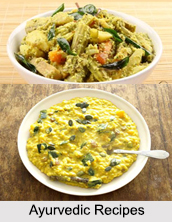
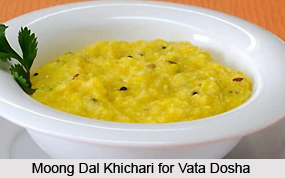 Moong dal khichari for vata dosha is an easy to digest nutritious preparation. Although this recipe is good for all doshas, it is especially beneficial for vata dosha. The primary ingredients for preparing this recipe are basmati rice, yellow split moong dal, ghee and some spices. It is easy to cook and can be made at home at any time.
Ingredients of Moong Dal Khichari
• One cup of basmati rice
• Half cup of yellow split moong dal
• Three tablespoonful of ghee
• One teaspoonful of black mustard seeds
• One teaspoonful of cumin seeds
• Half teaspoonful of turmeric
• Two pinches of asafoetida
• Half teaspoonful of salt
• Four cups of water
Method of Preparing Moong Dal Khichari : Wash the rice and the moong dal. It is better to soak the moong dal few hours before cooking as it becomes easier to digest. For cooking khichari, it is advisable to use a cooker or saucepan. The food should be cooked in medium heat. First, ghee is heated and mustard seeds are added with cumin and hing. Then after a few moments, the seeds start popping. Add the moong dal, rice, turmeric and salt and stir for five minutes till it is well blended.
After this, water should be added and it should be made to boil for five minutes, uncovered and stir it occasionally. The flame should be lowered and the cooker or saucepan should be covered leaving the lid slightly open. It should be cooked this way for nearly half an hour.
Benefits of Moong Dal Khichari for Vata Dosha : There are various health benefits of moong dal khichari. Some of the key benefits are:
• Moong dal which is one of the main ingredients of this recipe ensures myriad health benefits. It aids in weight loss, lowers cholesterol levels, produces resistance against infectious diseases and promotes heart health.
• Rice being cold in potency, nourishing in nature mainly alleviates pitta dosha, without aggravating kapha and vata doshas and is easier to digest.
• The preparation is very filling and healthy and is easy to digest.
• It gives a grounding, calming and warming effect.
• The recipe is a balance of carbohydrate and protein.