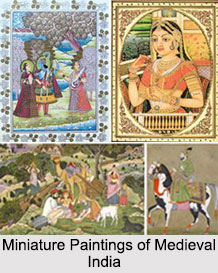
The miniature paintings in medieval India ushered in by the rise of
Islam to political supremacy in India and can be divided into two broad movements. One of these exemplifies an attempt to preserve past traditions with almost superstitious persistence. These traditions, though often emptied of meaning, retained at least the trappings of outer form which, in more propitious times, were again to quicken with life.
The old and the new, the "foreign" and the "indigenous", had gradually come to terms with each other; and this process, in which the individual qualities of each were enhanced and brought to a new fulfilment, resulted in some of medieval
Indian miniature painting"s greatest achievements. A mode of development in which fresh stimulus is received, reinterpreted, and transformed is hardly new to
Indian art and can be seen at almost every great epoch in its history.
Origin of Miniature Paintings in Medieval India
The beginning of Indian miniature paintings can be traced back to the 6th and 7th centuries. Though, it was throughout the medieval period that this beautiful form of art flourished under the aid of the monarchs and aristocracy. In the western valleys of the great
Himalayas Miniature School of Painting flourished in the form of both illuminations and independent pieces of art in the 17th century. The Indian miniature paintings were included in medieval
manuscripts. The artists who created Indian miniatures, used a variety of materials to give their paintings an exceptional and eye-catching look.
History of Miniature Paintings in Medieval India
The history of Indian miniature painting from the 13th to the 19th century is filled with many riches and the information found supply only from the faintest indications of its wealth. The
Mughal School had been studied for the longest time, so that it is more or less well known. As far as
Rajasthani painting is concerned, most of the material has come to light only during the last twenty years or so. The broad currents are becoming clear but the details remain obscure, and fresh discoveries make constant reappraisal necessary. Many difficulties remain in the understanding of the
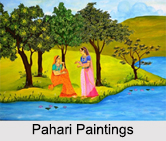
Pahari style, though its obvious beauty and charm evoke an immediate response. This is applied to the various
schools of the Deccan. Lacking the monumentality of
architecture, it is nevertheless of the greatest vitality and richness, and, on a more intimate level, as precious an expression of artistic skill.
Features of Miniature Paintings in Medieval India
The style of the medieval Indian miniature painting was emphatically linear, the forms flat, with sharp angular contours, the faces generally in profile but with both eyes shown, one of them protruding into empty space. The colours are few, red, green, blue, yellow, and black predominating, a monochrome patch of red often constituting the background.
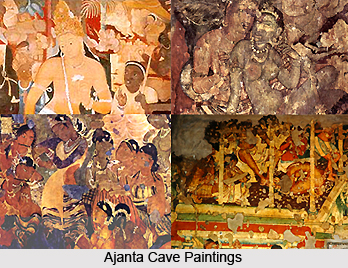
The most persistent feature of the medieval Indian miniature paintings are very brilliantly represented and preserved at
Ajanta and is the result of a progressive simplification, abstraction, and linearization, the various stages of which are clearly demonstrable.
The line flows more smoothly, the forms are fuller and the figures begin to lose their hieratic, effigy-like character. It should be obvious that these manuscripts herald the birth of a new style, and that this new style did come into being and was flourishing by at least the early years of the 16th century. It is confirmed by the discovery of an illustrated manuscript of the Aranyaka Parvan of the
Mahabharata dated A.D. 1516 and of a Mahapurana manuscript dated A.D. 1540. The promise of this new style is carried to fulfilment in the splendid
Bhagavata Purana.
Development of Miniature Paintings in Medieval India
The first half of the 16h century, as far as the medieval Indian miniature painting is concerned, was a time of fervent activity. At this time Indo-Persian styles are found to exist, patronised presumably by Muslim courtly circles. In the
history of India, the culture of medieval Indian miniature painting attained huge patronisation. Under the general supervision of some artists of Mughal Empire and the discerning enthusiasm of
Akbar, a vigorous atelier of
painters drawn from all parts of the Indian Empire grew up at the imperial court. With the development of medieval Indian miniature painting under the patronage of
Mughal emperors, the trends of Mughals were included in the style and texture of paintings. The Mughal painters, most of whom were
Hindus, had a subject close to their hearts, and they rose to great heights, revealing an endlessly inventive imagination and great resourcefulness in illustrating the
myths.
The medieval Indian miniature painting of Jahangir"s reign (A.D. 1605-1627) departs markedly from the style of the Akbar period. The great "darbar" pictures, thronged with courtiers and retainers, are essentially an agglomeration of a large number of portraits. The compositions of these paintings are also much more restrained, being calm and formal. The colours are subdued and harmonious, as is the movement, and the exquisitely detailed brushwork is a wonder to behold. A large number of studies of
birds and
animals were also produced for the Emperor, who was passionately interested in natural life, and who never ceased to observe, describe, measure, and record the things rare and curious with which the natural world abounds.
To
Jahangir, painting is the favourite art; he prides himself on his connoisseurship, and greatly honours his favourite painters. Even
Shah Jahan was a keen connoisseur of painting, and during his time the Jahangiri traditions continued in a modified way. The compositions become static and symmetrical, the colour heavier, the texture and ornament more sumptuous. The freshness of drawing, the alert and sensitive observation of people and things, was overlaid by a weary maturity, resulting not in the representation of living beings but in effigies with masked countenances.
During the reign of
Aurangzeb (A.D. 1658-1707) patronage seems increasingly to shift away from the court; works which can be identified as products of the imperial atelier are extremely few and continue the style of Shah Jahan. The large numbers of paintings assigned to the reign of Aurangzeb were executed for patrons other than the Emperor.
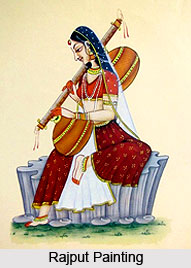
The Rajasthani style of Indian miniature painting is spread mainly over the various states of
Rajasthan and adjacent areas. The subject-matter here is essentially Hindu, its primary concern the Krishna myth was the central element in the rapid expansion of devotional cults at this time. The style, in marked contrast to the naturalistic preferences of
Mughal painting, remains abstract and hieratic, and its language, though mystical and symbolic, must have immediately evoked a sympathetic response in the heart of the Hindu viewer.
The Rajasthani style of Indian miniature painting developed several distinct schools, their boundaries seemingly coinciding with the various states of Rajasthan, notably
Mewar, Bundi, Kota, Marwar,
Kishangarh, Jaipur (Amber),
Bikaner and yet others whose outlines are slowly beginning to emerge. During the seventeenth century, The School of Mewar was considered as the most important among the other schools, producing pictures of considerable power and emotional intensity.
The themes of Bikaner miniature painting are the same as other Rajasthani schools. The delicacy of line and colour are strong Mughal features which first become evident in painting of the mid-seventeenth century executed by artists imported from
Delhi, and these features are retained to some extent even when the school begins to conform more closely to the neighbouring schools of Rajasthan.
The Deccani style of miniature painting again germinates as a combination of foreign and strongly indigenous elements inherited seemingly through the artistic traditions of the
Vijayanagara Empire. This style was more poetic in mood, though similar in technique to the Mughal School. The various kingdoms of the Deccan plateau evolved idioms with their own distinctive flavour from the middle of the 16th to the 19th century. Of these, the
Bijapur version, particularly under the patronage of the remarkable
Ibrahim Adil Shah II (1580-1627) was marked by a most poetic quality. Important work was also done in the powerful sultanates of
Golconda and
Ahmednagar.

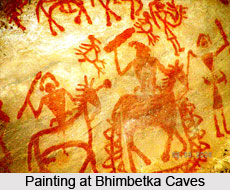
 History of Indian paintings has lots of riches for people to enjoy and experience. For the usual humid climate in India the preservation of paintings have been difficult than other forms of art. Some of the earliest Indian paintings have been rock paintings of the prehistoric times. In places like Bhimbetka, petrogyyphs are found, some of them happen to be from 5500 BC.


 Indian paintings in pre-historic age dated back to the period which was found before the ancient
  The Hoysala dynasty ruled in ancient Karnataka area from the 11th to the13th centuries A.D. They constructed many beautiful temples in South India, which reflected a unique style of architecture and sculpture of them. They are still remembered for that unique feature of their art and architecture.