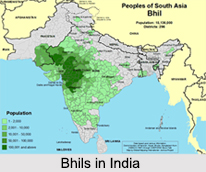
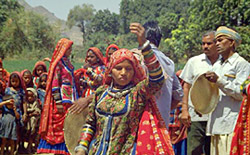
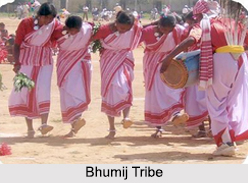
 Bhumij are the tribal or Adivasi people existing mainly in the Indian states of Assam, West Bengal, Odisha and Jharkhand, for the most part of the old Singhbhum district. Bhumij tribe are Austric-speaking people who have adopted Bengali as their second language due to their contact with the Bengali-speaking people of Purulia district. They still live in Bhumij, in integrated social groups all over the district of Purulia.
History of Bhumij Tribe
Bhumij dwell in that area of the country which lies on both the sides of Subarnarekha River. Previously Bhumij were given the lands by the kings in view of the acts of courageousness for agricultural purposes. They were recognized as "robbers". The people in the nearby areas were to a certain extent scared of them. In the year 1798, when the Puncheet estate was sold to pay arrears of profits, the Bhumij raised their head fiercely and disturbed the peace of the country till this was cancelled. The Bhumij revolution of 1832 is quite famous.
Language of Bhumij Tribe
The spoken language of the Bhumij is Austro-Asiatic. They talk in the Mundari language of the Austro-Asiatic language family or at times the main local language such as Bengali.
Religion of Bhumij Tribe
The Bhumijs profess Hinduism with their own religious conviction Sarnaism. Most of their spiritual activities are connected with farming process or with diseases, waves, etc.
Culture of Bhumij Tribe
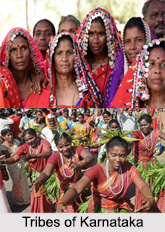
Rice is their main food and is consumed all through the year. They are not vegetarians, but they do not consume pork or beef. The Bhumijs also eat white-ants and insects. Drinks like rice beer and toddy are generally consumed by them. Mahua liquor is used splendidly during feasts and festivals. The male dress consists of a shirt, a dhoti and a towel. Women dress in saree and blouse. Young girls love the ornaments such as nose-rings, earrings, beads necklaces, armlets and bangles made of brass. They also put on flowers in their hair. The rule of exogamy is so firm that a man may not get married to a woman of his own wish or a woman who comes within the standard procedure for weighing up banned degrees.
At birth, a woman is attended by a midwife of the Ghasi society. After death, the Bhumijs usually burns the bodies of adults and the poor ones bury them due to cost of firewood. The Bhumijs worship Sun under the name of Sing-Bonga and Dharam, both considered to be their ultimate deities. They worship Jahuburu in the holy wood of the village at the Sarhul celebration in the months of Baisakh and Phalgun. The Bhumijs also worship Paori, a lady goddess, in the month of Jaistha and yet again in Asadha for well-timed rains and broad wellbeing of the village. Asadhi puja is performed before ploughing and transplanting of paddy sprouts. The Bhumijs also take part in a variety of Hindu festivals and worship Shiva, Durga, Kali, Saraswati, Lakshmi, Jagannath, and Ganesha, etc. Festivals like Diwali and Holi are celebrated. Under the impact of Hinduism, the Bhumijs have started worshipping idols as well.