


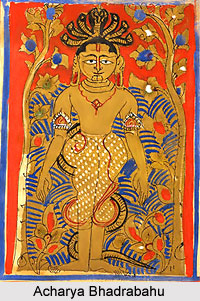
 Acharya Bhadrabahu was a Jain monk and reformer. He is more famously known as a spiritual teacher of Chandragupta Maurya. Bhadrabahu is the author of several texts related to Jainism. This includes some of the most important works like Upsargahara Stotra and Kalpasutra. Bhadrabahu was born in Pundravardhana which is now in Bangladesh. Acharya Bhadrabahu was a Jain monk and reformer. He is more famously known as a spiritual teacher of Chandragupta Maurya. Bhadrabahu is the author of several texts related to Jainism. This includes some of the most important works like Upsargahara Stotra and Kalpasutra. Bhadrabahu was born in Pundravardhana which is now in Bangladesh.
Bhadrabahu was born in Pundravardhan. During that time Ujjain was the secondary capital of the Mauryas. Bhadrabahu was able to foresee through his nimitta jnan that there would be a 12-year famine across North India. He decided to migrate with a group of monks to Shravanabelagola in South India and brought with him Chandragupta. Chandragupta Maurya was devoted to him and therefore left the throne to his son Bindusara. Bhadrabahu is believed to be the founder of Digambara sect. He authored three of Jainism's sacred books as well as the Niryuktis, short commentaries on 10 of the 12 original sacred books. Some say he retired in seclusion to Nepal; others say he remained in Mysore. It is believed that had undergone the process of sallekhana, the Jain ritual of ultimate triumph over human passions in which the believer renounces the world and starves to death. While Bhadrabahu was away the monks stayed in North India. They soon realized that the sacred scriptures were being forgotten. An ascetic named Sthulabhadra convened an assembly to recompile the Purva scriptures. However, as Sthulabhadra's knowledge on these texts was imperfect, he went to Bhadrabahu to study about the texts. Though Bhadrabahu taught Sthulabhadra, he instructed him not to preach others the same as he had witnessed a demonstration by Sthulabhadra of certain extra corporal powers. These recommended that with the passage of time these sacred scriptures would become corrupted. Thus, the 14 Purvas in their original form perished with these two men. Works of Acharya Bhadrabahu After Bhadrabahu the Sangha got separated into two teacher-student lineages of monks. Digambara monks belong to the lineage of Acharya Vishakha and Swetambara monks follow the tradition of Sthulabhadra. Bhadrabahu is credited with composing some new texts also. In the Swetambara tradition, Brihatkalpa, Vyavahara, and Nisitha are regarded as his works. Bhadrabahu is regarded as the last expert of 14 Purvas, of 12th Anga called Dristivaad, one of the scriptures of Jainism. Of these, he passed 10 Purvas to Sthulibhadra who was his chief disciple. Bhadrabahu went to Nepal for twelve years to perform a tantric exercise, "Mahaprana Sadhana". Bhadrabahu, according to Digambaras is said to have died after committing Sallekhana. Acharya Bhadrabahu had a brother named Varahmihir. Both lived in the same kingdom. When a son was born to the Emperor, Varahmihira declared that he would live for a hundred years. However, Bhadrabahu said that he would live for only seven days, and that he would be killed by a cat. Thus, on the eighth day the prince died because of a door's anklet falling on his head which had a picture of cat drawn on it. Because of thus Varahmihira left the kingdom and died after some time. It is said that Varahmihira became evil and tortured the Jains, especially the followers and devotees of Bhadrabahu. Hence, Acharya Bhadrabahu formed a mantric prayer to 23rd Jain Tirthankar Parshvanatha. It was known as upsarghar stotra (now known as Uvassagaharam Stotra). This helped in defeating Varahmihira which relieved the Jain society. The mantric prayer is still recited bythe Jains and they chant it with due devotion and faith. The prayer has also made Bhadrabahu's name immortal amongst Jain monks. |
| |||



Acharya Bhadrabahu
| Acharya Bhadrabahu was a Jain monk who was considered as the spiritual teacher of Chandragupta Maurya. He had created a mantra known as upsarghar stotra. |
| ||||||||||||||||||||||||||||

