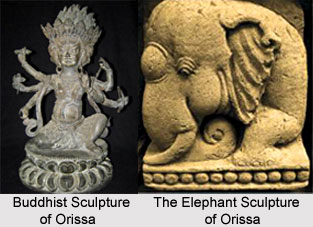
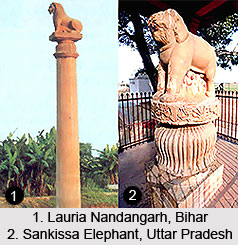
 Animal sculpture under Mauryan Empire is manifested by the colossal animal sculptures that crown the Mauryan columns along with the elephant of Dhauli in Orissa. The Basarh-Bakhira lion evidently is one of the earliest stages of this kind of sculpture. The next definite development in the field of animal sculpture was accomplished at Dhauli where the elephant but half emerges from live rock which can be dated back to the 12th or 13th century, during the reign of emperor Ashoka. The elephant of Sankissa in Uttar Pradesh is also attributed to the Muaryan age. Other significant forms of sculpture under Mauryan Empire include the Lauria Nandangarh lion and Rampurva bull, both located in the eastern Indian state of Bihar.
Animal Sculpture of Basarh-Bakhira
The Basarh-Bakhira lion sculpture, Bihar is clumsy in form and appearance and crude in execution. Linear rhythm is evident in the flowing line gliding downwards from the top of the head. It ends abruptly at the hard line of the slab where the tail turns inwards. The manes are highly stylised and locks are treated in separate volumes that are arranged clumsily. The facial expression is picturesque and primitive. However, the attitude lacks dignity.
Animal Sculpture of Dhauli Elephant
The Dhauli elephant, Orissa displays a much more developed sense of form and is artistically far superior to Sankissa elephant. Its right front leg is slightly tilted and the left back straight in short angle exhibits a slight forward motion and with its heavy trunk flowing rhythmically in a curve. It symbolises Ashoka presenting himself with dignity before the people of Kalinga.
Animal Sculpture of Sankissa Elephant
The Sankissa elephant, Uttar Pradesh is on a lower level as far as its artistic conception is concerned. There is some evidence of movement in the modelling of the muscles. The front legs are treated pillar-like though the intended effect was one of tension, since the animal appears to shrink backwards with the body-weight pressed in that direction. A stylised treatment is evident in the treatment of the upper but more in the lower portion of the chest and abdomen of the Sankissa elephant.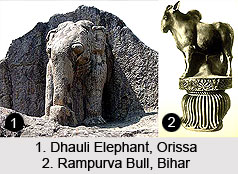
Animal Sculpture of Lauria Nandangarh
The lion of Lauria Nandangarh, Bihar is tense and tight. The surface treatment is clear and precise. The stylisation of treatment of veins, muscles and flesh is on the increase, the form and treatment is predictable. In visualisation and realistic presentation of volume there is no improvement, nor is there any attempt to harmonise the animal form with the component parts of the columns.
Animal Sculpture of Rampurva
The Rampurva lion, Bihar is clear compared to that of Lauriya Nandangarh. There has been a precise cutting of the stone. There has also been an advance in modelling which is powerful and vigorous, especially in the muscle. However, the entire artistic conception is conventional. Besides this, the Rampurva bull is also quite renowned and consists of a dexterously sculpted model, exhibiting good representation of soft flesh, sensitive nostrils, alert ears and strong legs.
Animal Sculpture of Sarnath
Sarnath quadripartite, Uttar Pradesh is the best known of all the Mauryan sculptures. The animal relics on the abacus are all worked in such a way showing deep contrast of light and shade. Technically it is far more advanced than numerous other contemporary animal sculptures. One of the four animals of the Sarnath abacus is a galloping horse that is spirited in movement. This is applicable to the two other animals on the abacus that is the vigorously striding lion and the humped Indian bull. The only animal on the abacus that is treated in a different manner and viewed from a different attitude is the elephant. It is less conventional.
The Sanchi equivalent of Sarnath also has the same style. The manes of the lions are rendered with increasing schematisation which indicates that it was built later than Sarnath. The Sanchi abacus is decorated like the Rampurva lion capital which is narrower than the Sarnath one, and is aesthetically in harmony with the capital below and the crowning lions above.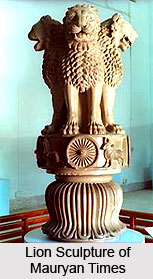
Lion Sculptures under Mauryan Empire
The lions in Mauryan art are invariably done in a manner that seems to have been fixed by convention. Their formal pose and appearance, the rendering of their volume, bold and vigorous but stylised and the sense of form as revealed in them is on the whole the same and pre-determined. The aesthetic vision and imagination and the conventional style and fixed expression are evident in the crowning lions. Compared to the later figural sculptures in the round of Yakshas and the relics of Bharhut, Sanchi and Bodhgaya, the art represented by these crowning lions belongs to an altogether different world as far its conception and execution, of style and technique are concerned. There is nothing primitive about them. There is a possibility that Hellenistic plastic tradition that was practised by Graeco-Bactrian artists influenced Mauryan art. Sarnath`s Lion Capital, which is now the National Emblem of India is one of the most reputed specimens of animal sculpture under Mauryan Empire.
However, the Dhauli elephant or the Rampurva bull belongs to a somewhat different aesthetic vision and outlook. As far its volume and its reproduction are concerned they belong to the fully developed stage of art. It can be assumed that the Dhauli elephant, the Rampurva bull and perhaps also the Sankissa elephant are works of Indian artists. The crowning lions of the early phases: the Basarh-Bakhira and Lauria Nandangarh are works of Indian artists but instructed in the style and tradition of contemporary Western art. The stone elephant at Dhauli was also probably carved by local craftsmen and not by the special craftsmen who were responsible for the animal capitals. The image of the elephant emerging from the rock is a most impressive one, and its purpose was probably to draw attention to the inscription nearby