Introduction
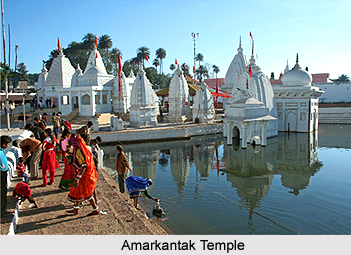 Amarkantak is a pilgrim town and a Nagar Panchayat in Anuppur District in the Indian state of Madhya Pradesh. With the Maikal Hills being the fulcrum the city is majestically located in the midst of magnificent Vindhya Mountain Range and Satpura Mountain Range at an elevation of 1065 meters. Amarkantak is situated at 22.67degreeN 81.75degreeEast.
Amarkantak is known primarily as a religious place. The holy rivers like Narmada River, Sone River and Johila River emerge from here. The city is also called `Teerthraj` meaning the king of pilgrimages. The holy town of Amarkantak attracts thousands of sages and devotees all through the year. Therefore numerous ashrams or religious retreats have been established around this place.
History of Amarkantak
Steeped in myths the history of Amarkantak is a tale of valour, camaraderie and severe struggle and religious stability and the associated tales. Amarkantak is a Sanskrit word with much mythological significance, which gains it the prestigious sobriquet as Theertharaja.
Holiness of Amarkantak is greatly associated with the holy river Narmada. Perhaps it is due to the presence of this holy river that this locale in the Vindhyas gets much popularity as a devout centre. As per the Holy Scriptures, River Narmada transcends all other sacred rivers with her indomitable virtue as the daughter of Lord Shiva. Legends has it that a mere glance of this beloved daughter of the destroyer God would fetch innumerable boons and the devotees strongly believe that who ever dies at Amarkantak would fetch salvation.
A land with a vivid history, Amarkantak narrates the tales of various dynasties, right from the Pandavas to the foreign rule of the modern times. Due to occupation of this area by Mandhata the descendants of King Yayati moved from this area to west of Madhya Pradesh and settled on the banks of Narmada River.
According to tradition, this Vindhyachal area was included in the Kingdom of Ayodhya, Kapila Muni, Bhrigu Rishi and Markandeya Rishi had ashrams here. It is also said that Pandavas stayed here and gained spiritual benefits during their exile. Each edifice in Amarkantak portrays diverse styles that recount the period during which these architectural grandeurs were materialized. This stunning facade of Amarkantak gently adds the magnificence of this legendary spot to a great extent.
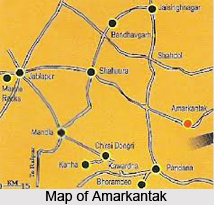 Amarkantak in addition to waterways that necessarily do not find their mention in the Indian Vedas have their clear-cut mention in the Puranas, Ramayana, Mahabharata, Vashishtha samhita in addition to "Shatapatha Brahmana". Immediately after Mahabharata becomes a history of a period of concerning 3000 many years is dim Mentor Arjun Chaube Kashyap wraps up how the Puranic name associated with Amarkantak had earlier been "Riskh Parvat". Concerning 6000 many years back again the particular Suryavanshi Samrat Mandhata set up a new village inside the valley Riksh Parvat in addition to referred to as that Mandhata. The actual full story associated with samrat Purukutsa, who was son associated with Mandhata, afforded the particular title associated with Narmada for the pond. Mandhata the particular descendants associated with Yayati shifted out of this region to west associated with Madhya Pradesh in addition to setting up their abode around the banking companies associated with Narmada Water.
The Vindhyachal region had been the abode of mythical allusions as they were intermittently associated with Ayodhya, Kapila Muni, Bhrigu Rishi in addition to Markandeya Rishi who even got ashrams his right here. It`s also explained which Pandavas spent the night`s right here in addition to the accumulated non secular benefits during their exile.
Almost 3000 years of Mahabharata have passed when the great sage and litterateur Adi Shankaracharya was born in 788 AD and consecrated on the banks of Narmada River. It was his enlightened vision that led to the establishment of Pataleshwar Mahadeva in Amarkantak at the origin of Narmada River from the bamboo clumps. Currently this region is known as Surajkund today. There are no bamboo clumps now. However in the more recent history, this area was given in dowry to the Kalachuri King by the Chedi King (10th to 11th century AD).
Kalchuri Maharaja Karnadeva (1042-1072 AD) had constructed temples at Surajkund. In 1808 Amarkantak was ruled by the King of Nagpur and later came under foreign rule. More recently, Amarkantak has been selected by the UPA government as the place for India`s first tribal university.
Flora and Fauna of Amarkantak
The temperate climate and the equitable distribution of rain make Amarkantak an ideal plateau for dense vegetation cover. The forests have sal dominated and are home to other associate species such as Mallotus Philipensis, Buchanania lanzan, Ougeinia oojeinesis, Terminalia chebula, Bauhinia spp, Grewia spp, Gardenia latifolia, Anogeissus latifolia and other climbers and shrubs. Down below the valleys there are mixed forests, which include Bauhinia retusa, Grewia spp. Bursera serrata Rhamnus wightii, Schleichera oleosa, Schefflera venulosa and many others. There are even plants of the north-west and central Himalayas to be found in Amarkantak.
Temples of Amarkantak
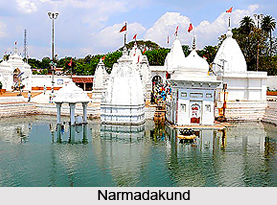 Amarkantak, situated in the Maikal Hill is an important pilgrimage centre for Hindus. It is situated at the confluence of two holy rivers, Narmada River and Sone River. Narmada is considered one of the most sacred rivers of India all with her strong asset as the daughter of Lord Shiva. It is also the meeting point of the Vindhyas Mountain Range and the Satpura Mountain Range in Central India. Amarkantak being a unique natural heritage comprises of a number of places of scenic beauty. Amarkantak is also famous for its temples that are visited by thousands of devotees from all the corners. Some of the famous temples in Amarkantak are:
Narmadakund and Temples : At the place of origin of Narmada River there is an open pool known as Narmadakund. There are number of temples around this kund such as Narmada and Shiva temple, Kartikey temple, Shri Ram Janki temple, Annapurna temple, Guru Gorakhnath temple, Sri Shuryanarayan temple, Vangeshwar Mahadev temple, Durga temple, Shiv Pariwar, Siddheswar Mahadev temple, Sri Radha Krishna temple, Eleven Rudra temple and others.
Ancient Temples of Kalachuri Period
The ancient temples of Kalachuri period are located in the south of Narmadakund just behind it. These were built by Kalachuri Maharaja Karnadeva (1042-1072 AD). The Machhendranath and Pataleshwar temples are excellent examples of architecture. There is also Keshav Narayan temple built by the Bhonsle ruler of Nagpur in the 18th century.
Kabir Chabutra : Kabir Chabutra is a holy place where Saint Kabir believed to have spent many years in meditation to attain new heights of spiritual power. This place near Amarkantak is a holy place for Sant Kabir Panth sect.
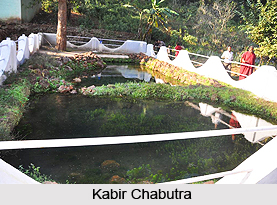 The local people, the Panikas, consider Kabir Chabutara as one of the holiest places of the Kabir Panthis because Saint Kabir spent many years here in meditation. This place is the meeting point of Kabir and Guru Nanak who discussed about various spiritual matters and introduced the way of better living for human being. It is also the meeting point of three districts, Anuppur and Dindori districts of Madhya Pradesh and Bilaspur district of Chhattisgarh. There is also a waterfall here known as Kabir waterfall.
Shri Jwaleshwar Mahadev : The Jwaleshwar Mahadev temple and the source of origin of the third river Juhila River is located at Amarkantak at a distance of 8 km. The temple is located on the Shahdol road. According to `Vindhya Vaibhav` Lord Shiva himself established a Shivling here. He is also said to have established many other Shivlings over Maikal Mountain. According to puranic traditions a rectangular area containing crores of Shivlings is known as `Maha Rudra Meru` and is the abode of lord Shiva himself. There are only two `Maha Rudra Meru` places Varanasi and Amarkantak.
Shri Sarvodaya Digamber Jain Temple : Shri Sarvodaya Digamber Jain Temple is considered as one of the world`s biggest ashtadathu Jain idol of Bhagawan Adinatha. The temple at Amarkantak resembles the Aksharadhama temple of Gujarat. The temple has been designed and built under the supervision of Sri C.B.Somapura the Chief architect of the Akshardham Temple.
Tourism in Amarkantak
Tourism in Amarkantak refers to the fact that it is basically regarded as a pilgrim city plus a municipal area within Anuppur District which again falls within the ambit of Madhya Pradesh, India.
Also referred to as "Teerthraj" (the California king of pilgrimages), Amarkantak region can be a one of a kind natural customs area which thrives to be the meeting place of the Vindhyas and the Satpuras, using the Maikal Slopes becoming the very fulcrum. This really is the location where the Narmada Water, the Son River in addition to Johila Water comes up. Amarkantak pays homage to the concept of purity and traditions and is quite abundant with biodiversity. The region not only houses a number of locations associated with picturesque splendour but even is a wonderful pilgrim centre intended for the devout religious practitioners of Hinduism. Also attached to it is the crown of a great-unexplored vacation spot.
Amarkantak positioned on the developed side regarding historic Empire regarding Kalinga and the meeting abode of Gods in addition to Gandharvas (Celestial beings), Asuras (demons), New Orleans saints in addition to Sages include most accomplished fantastic faith based capabilities below. It really is presumed in which that ever before dead at Amarkantak is guaranteed of a put in place bliss.
As soon as Head of the family Lord Shiva ruined Tripura (The a few cities) by flame, this ashes of one dropped after support Kailash, this ashes regarding an additional dropped after Amarkantak, along with the ashes from the third have been ended up saving by Head of the family Shiva in addition to kept within bliss. Amarkantak can be a Sanskrit concept this literal this means which is immortal (amar) obstruction (kantak). The Sanskrit laureate Kalidasa features talked about the item seeing that Amrakoot. Fantasy is which the thick woods with this area have been brimming with mango (amra) trees and shrubs. Kapildhara waterfall is located at six km northwest of Narmadakund. It is with a fall of about hundred feet. According to history Kapila Muni resided here. Kapil Muni performed severe austerities here and also received divine light. He even wrote `samkhya philosophy` at this place. The Kapileshwar temple is also located in the vicinity.
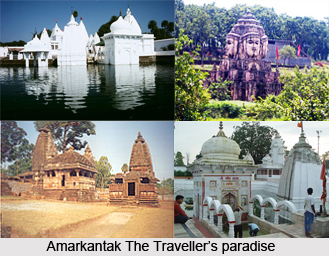 Narmada Kund and Temples : At the place of origin of Narmada River there is an open pool known as Narmadakund. There are number of temples around this Kund such as Narmada and Shiva temple, Kartikey temple, Shri Ram Janki temple, Annapurna temple, Guru Gorakhnath temple, Sri Shuryanarayan temple, Vangeshwar Mahadev temple, Durga temple, Shiv Pariwar, Siddheswar Mahadev temple, Sri Radha Krishna temple, Eleven Rudra temple and others.
Sonemuda : Sonemuda is a source of Son River. This holy place is situated at a distance of 1.5 km from Narmadakund at the very edge of Maikal Hill. The Son River flows from the mountain in a waterfall that is hundreds of feet long. The waterfall is surrounded by thick forests and valleys. According to Megasthanes and other Aryan writers the river Son got its name from gold as gold dust is found in the water of Son.
Mai ki Bagiya : Mai ki Bagiya is one of the prettiest locations in Amarkantak that have been setup in honour of the goddess Narmada. Legend has it that mother Narmada used to pluck flowers from this garden. In this natural garden there are Mango, Banana and other fruit trees along with Gulbakavli, roses and other flower plants. The grove of woods with dense woodlands located well away of one kilometres coming from Narmadakund is named "Mai ki Bagiya" with honour from the goddess Narmada. Within this organic backyard one would discover Mango, Banana along with other berries woods in addition to Gulbakavli, tulips along with other flower plant life.
Ancient temples of Kalachuri Period : The particular old temples of Kalachuri time usually are situated in this southern of Narmadakund which were developed by simply Kalachuri Maharaja Karnadeva (1042-1072 AD). The particular Machhendranath and Pataleshwar temples usually are fantastic types of structure. There is also the presence of Keshav Narayan in forehead developed with the Bhonsle leader of Nagpur within the eighteenth hundred years.
Kapildhara (Kapil waterfall) : Kapildhara waterfall lies at a distance of 6-8 km northwest involving Narmada kund is the Kapildhara waterfall with a slip of about hundred or so foot. According to scriptures, Kapila or Kapil Muni performed severe austerities and had acquired divine mind. This individual furthermore published `Sankhya Philosophy` (a sophisticated treatise about mathematics) with this place. The particular Kapileshwar temple is usually based nearby. The encompassing piles are filled with caves exactly where saints happen to be performing the faith based techniques.
Kabir Chabutra (The Platform of Saint Kabir) : It`s a classic idea that this good saint Kabir performed austerities the following along with reached faith based power. Therefore, it is a holy place for the Kabir panth sect. The neighbourhood men and women, the particular Panikas, think about Kabir Chabutara as one of the holiest sites with the Kabirpanthis simply because Sant Kabir used several years within introspection. As of this incredibly place Kabir along with Guru Nanak fulfilled along with reviewed faith based matters along with released how involving far better dwelling intended for person. It is additionally the particular getting together with place involving three zones, Anuppur along with Dindori zones involving Madhya Pradesh along with Bilaspur centre involving Chhattisgarh.
Shri Jwaleshwar Mahadev (The Temple of Lord Shiva) : The particular Jwaleshwar temple and the method to obtain beginning with the next river Juhila Riv is situated far away involving 8 km from Amarkantak about Shahdol highway. According to `Vindhya Vaibhav` Lord Shiva him or her self founded a Shivlinga the following as well as dotted crores involving additional Shivlingas more than Maikal Pile. According to Puranic culture that contains corers involving Shivlingas is referred to as `Maha Rudra Meru` and is particularly the particular abode involving lord Shiva him or her self. There are solely a couple of `Maha Rudra Meru` sites Varanasi along with Amarkantak. Lord Shiva along with Parvati stay the following due to this unique faith based quality.
Holy ponds, lofty hills, forested surroundings, breathtakingly beautiful waterfalls and an ever-pervading air of serenity make Amarkantak a much sought-after destination for the religious-minded as well as for the nature-lover.