Introduction
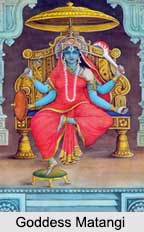 Goddess Matangi is the Hindu Goddess of inner thought and wisdom. Goddess Matangi is the ninth Goddess among the Ten Mahavidyas. She is a primary form of the all-powerful Goddess. The Goddess is Siddha Vidya or Tantra personified, thus commanding occult power. Goddess Matangi is associated with the full moon, the "night of intoxication". The Mahavidyas represent some or other manifestation of the Divine Mother. She grants control over poetry and music in particular. She is the Goddess of beauty, marriage, happy married life and son, and material gains.
Iconography of Goddess Matangi
Goddess Matangi has dark emerald complexion and has three eyes. She is depicted in various forms. She is depicted as green or blue holding a Veena, Knife and a Skull. At times she is seen seated on a corpse, holding a skull and a bowl of blood, with untidy hair. Matangi is surrounded by nature especially birds, green and red parrots which represent a Guru.
Origin of Goddess Matangi
Goddess Matangi is one of the Ten Mahavidyas. Matangi is a primary form of the all-powerful Goddess. The goddess is Siddha Vidya or Tantra personified, thus commanding occult power. On the mundane level, she is the daughter of the sage Matanga, who is said to have been the preceptor of Shabari of the Ramayana fame.
Legends of Origin of Goddess Matangi : The first myth associated with Matangi`s origin finds its mention in the Shakti-Samgama-Tantra. It is related to the appearance of Ucchista Matangini that is one of Matangini most common form. According to a legend, once Lord Vishnu and Goddess Lakshmi visited Lord Shiva and Goddess Parvati where the former presented the later with food items. While eating few pieces dropped on the floor and from those leftovers a maiden arose who was endowed with good attributes. She asked from the gods for their leftover foods who offered the maiden their Prasad. Shiva then blessed the maiden and said that those who would repeat her mantras and worship her would be able to fruitfully carry out their work. From that moment the maiden came to be known as Uccista Matangini, the bestower of all boons.
The second myth associated with the origin of Matangini has been derived from the Pranatosini- Tantra. Once Parvati wished to visit her father`s home hence she asked for the consent of Lord Shiva. He granted her wish on the pretext that she would return soon. When Parvati did not return for some days Shiva disguised himself as an ornament maker and went to her house. There he sold shell ornaments to her and to test her faithfulness he asked her for lovemaking as his payment. Parvati became furious and was about to curse him but stopped when she realized about the identity of his husband. Ceiling about the knowledge she accepted his request but asked him to come later.
Later Parvati disguised herself as a huntress and approached to Shiva. She danced in front him and addressed herself as the daughter of Chandala. She told Shiva that she had come here to practice penance. Lord Shiva was so impressed with her that he even made love with her. While making love Shiva was himself turned into Chandala and realized that the Chandala was his wife Parvati. The goddess requested to Shiva that as they made love in the form of a Chandalini, this form would last forever and will be named as Uccista- Chandalini.
The third myth that relates the origin of Matangi has been derived from the Svatantra- Tantra. According to legend once Matanga assumed austerities to achieve the power to suppress all creatures. He practiced his asceticism for thousands of years. Finally goddess Tripura Sundari appeared and emitted rays from her eyes from which Goddess Kali emerged. Kali put on a greenish complexion and took the form of Raja-Matangini. With the help of the goddess Matanga fulfilled his desire to control all creatures.
Goddess Matangi in Buddhism
Goddess Matangi has been associated in Buddhism and also finds mention in the Divyavadana which is a Buddhist collection of stories concerning previous lives of the Buddha that was probably written around 250-300 C.E. these texts relates Matangi as the daughter of elephant hunter king Matang.
Once upon a time, Ananda who was Lord Buddha`s disciple went out begging for food. While roaming he became very thirsty and saw a girl drawing water from a well. He immediately approached her and requested her for some water and asked for water. The girl refused as she was a daughter of Candala or low caste. Inspite of knowing the fact Ananda was ready to drink water from her hands. As he drank water, the young girl named Prakrti admired his youthful body and became fascinated by him. She desired to have him as her husband.
After Ananda had returned to the monastery, Prakrti requested her mother Mahavidyadhari to use her magical powers and attract Ananda to her. Her mother initially hesitated and refused but when Prakriti threatened suicide her mother agreed to help her. Prakrti mother cleaned an area and built an altar. She then offered flowers in the fire on the altar and began reciting mantras to attract Ananda for her daughter.
Mahavidyadhari`s magic spells compelled Ananda`s heat to crave for Prakrti. She remembered her charm and hence left his monastery to find her. On arriving there, Ananda realized his mistake and prayed to the Buddha to rescue him. Lord Buddha being aware of his predicament nullified the power of the candela woman`s mantras. Ananda thus became calm and returned to the monastery.
When Prakrti came to know that Buddha had overcome his mother`s magic she went to the Buddha. She told him that she desired Ananda and wanted to have him as her husband. The Buddha told her that the only way to execute her desire was to become a nun herself. Prakrti impressed by the teachings of Buddha agreed to be initiated as a nun. She cut off her hair and wore the simple dress of a Buddhist nun.
After Prakrti`s was initiated into the Buddhist order, the Lord narrated her story that put the company between her and Ananda in perspective. He said that in the past there was king named Trisanku who ruled over the elephant hunters. He had a son named Sardulakarna, for whom he wished to have a suitable bride. Trisanku wanted to marry his son with a Brahmin`s daughter named Prakrti. He thought her to be suitable for his son. He thus set out to arrange for a wedding and travelled with an entourage of his ministers. When the Brahman saw that Trishanku was an elephant hunter of low caste he rejected his proposal for a marriage. However Trisanku impressed him with his vast knowledge of spiritual matters and the arts and the sciences. The Brahman thus surrendered and allowed the marriage to take place.
The Brahmin`s daughter was the same Prakrti who in her next life desired Ananda and Trisanku`s son Sardulakarna was Ananda in that life. This explained the mutual attraction of the pair in this life. The elephant-hunter king, the Buddha said, was he himself.