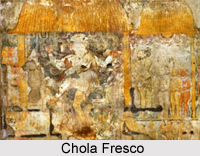
 Chola frescos bear an ardent spirit of Shaivism. There is a probability that it synchronized with the completion of the temple by Rajaraja Chola I the Great. He reflected in his frescoes different paintings of Lord Shiva and famous saint Sundara who was ardent devotee of Lord Shiva. Chola frescos are found in Brihadeeswara temple.
The paintings of Sundara have now been damaged but few of them that still remain reveal his life`s astonishing details. They have been divided into 3 horizontal sections. The bottom section depicts his early life, his wedding that was cancelled and the sudden disappearance of the old man. The frescoes are the fine examples of the perfect blend of colour, movements and details. The preparation of the marriage along with the banquet, the approaching of the old man with the manuscripts, the morose expression of Sundara, the anxiety of the guests and the temple where the old man disappeared have been perfectly displayed. Other damaged panels, reflect some of the miracles that Sundara had performed. The second sections show Sundara riding a white elephant and Cheraman bearing a fierce moustache and a detailed knot of hair riding his steed swiftly to catch up with the elephant. The speed is indicated by the swaying necklaces of the king and the flowing mane of the horse. The top most section depicts Lord Shiva in Kailasa giving his blessings to both Sundarar and Cheraman. This section portrays a group of `apsaras` playing various types of instruments. Horizontal lines specify movement and vertical lines denote performance.
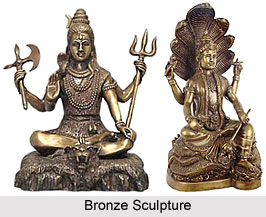
On the southern side of the frescoes a full area is devoted to the huge panel that depicts Lord Shiva as a supreme yogi and a teacher by the name Dakshinamurthy. He is seated under a banyan tree and many Sanakadi munis are seen surrounding him. These sages are the disciples of Lord Shiva and the child of Lord Brahma who are born out of his mind. Another aspect of Lord Shiva i.e. the Bhairava has also been represented here. Bhairava is the terrible aspect of Lord Shiva when he had cut off Lord Brahma`s head. He has been even cursed for inflicting such violence on a Brahmin. These stories have been said in Satarudra Samhita.
In another panel a huge figure of Nataraja is seen dancing in the golden hall at Chidambaram. It is being worshiped by Rajaraja Chola 1 and his three queens on one side and other devotees on the other side. On the opposite wall another image of Raja Raja 1 offering his worship to the lingam in the Brihadeeswara is depicted. The differentiation in the skin tones of the two images has well illustrated. The king has been represented with radiant youthfulness while the sage has been given touches of maturity by highlighting his age and wrinkled skin.
In the temple the northern walls boasts of the most outstanding mural. It narrates about Lord Shiva in Tripuranthaka. In the paintings Tripuranthaka has been given much importance. In this image the artist has moved the dancing image of Shiva to a corner so as that the spaces in the total panel attract the view of the spectator towards the image. Most of the Chola paintings resist the use of white and black.