Introduction
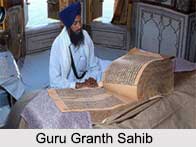 Guru Granth Sahib is the Holy Scripture of the Sikh religion. It contains the works of its own religious founders and also the writings of people from other faiths. The book is held in great reverence by Sikhs and is treated as the living Guru of theSikhs. Guru Granth Sahib is a collection of devotional hymns and poetry which proclaims God, lays stress on meditation on the True Guru (God), and lays down moral and ethical rules for development of the soul, spiritual salvation and unity with God.
Etymology of Guru Granth Sahib
Earlier, the Holy Book was known as the "Adi Granth", later it was changed to "Guru Granth Sahib". The term "Adi" means "first" and "Granth" refers to "book". Hence "Adi Granth" literally stands for "the first book". It was in 1708, prior to his death, Guru Gobind Singh, the 10th Sikh Guru pronounced the Holy Scripture as his successor and the "Adi Granth" came to be known as the "Guru Granth Sahib".
Composition of Guru Granth Sahib
Guru Granth Sahib was composed in 1604 by Guru Arjan Dev with assistance of one of the great devotees by the name Bhai Gurdas. It was written in Gurmukhi Script so that the Sikhs may remain Guru-centred.
The compositions of the Guru Granth Sahib, is of inestimable significance. It is all composed in mystic poetry. It is cast into 31 musical measures (Ragas). It is a natural flow of the divine ecstasy of Lovers of God.
Contents of Guru Granth Sahib
Guru Granth Sahib, the sacred book of the Sikhs contains four poems of Trilochan, 62 of Namadeva and 240 Sakhis and 227 padas of Kabir. It is subdivided into 1400 parts composed of hymnical verses. These compiled verses are often referred to as "Gurbani" or the "word of the Guru".
A considerable contribution to the Holy Scriptures was made by the devotees or `Bhagats`. These couplets were known as `Bhagat Bani` or `Word of the Disciples`. No distinction is made by the Sikhs between the verses composed by the devotees and the Gurus and they are honoured with equal respect.
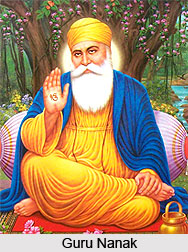
Most of the characteristic teachings of Sikhism like monotheism, crusade against idolatry and caste, externalism and ritualism; could be easily traced to these saint poets, especially Kabir. Kabir appears to be a contemporary of Guru Nanak. Guru Nanak himself had composed a number of songs. The best among them are named Japji, Asa-di-var, Rahi-rasa Patti, Dakani Omkara, Siddha Gosthi and Bara Mah.
Guru Granth Sahib includes not only the compositions of Gurus but also of many Saint Poets. It includes verses of Ramanand, Jaideva, Namadeva, Trilochan, Veni, Dhanna, Pipa, Sain, Kabir, Rai Das, Shaikh Bhikhaji, Sadhna, Surdas, and Poona Nane and also some of Muslim Sufis.
Hymns on Creation in Guru Granth Sahib
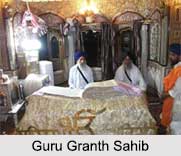 Hymns on Creation are a major part of Guru Granth Sahib as the concept of creation is one of the basic teachings of Sikhism. The Hymns on Creation have been emphasized on three things and they are Dhundukara, Sunnu and Andaja.
Dhundukara, Hymns on Creation : The Dhundukara Hymns on Creation are as follows:
"Arabada narabada dhundhukara.
Dharni na gagana hukamu apard.
Na dinu mini na candu na suraju suna
samadi lagaida ,
Brahamd Bisanu Mahesu na kol.
Avaru na diasal iko soi. .
Na Koi akhi vakhdnai dujd.
Ape dpi upai vigasai ape kimati pdidd . . .
Na tadi Gorakhu na macchindo . . .
Bada Kateba na simmriti sasata. . . .
Kahatd bakata ape agocaru ape alakhu Iakhaida. .
Ja tisu bhdnd ta jagatu updia.
Bdjhu Kald dddnu rahdid.
Brahama Bisanu Mahesa upae maid mohu vadhdida.
Virale ku guri sabadu sunaia kari kari dekhai hukamu sabdid.
Khand Brahamand patdl arambhe gupatahu
paragatl aidd".
The translation is as follows:
It has been said that Millions of years ago there was only Dhundhukara, undetectable Transcendence. There was no earth or sky. There was Infinite will. There was no time, space or movement. He was there in absolute state of stillness. Neither there was any Brahma, Vishnu or Shiva. No one else was seen except one. There was no mention of the second thing. Lord rejoiced by giving expression to Himself as well as evaluated Himself. There was no Gorakh or Machhindra. There were neither Vedas or Semetic Books or Smritis or Oriental Shastras. Lord Himself was speaker and preacher. The supreme, the Imperceptible and unseen, Himself saw everything. He made the world out of his will and without any support stretched the vast expanse. He created Brahma, Vishnu and Shiva.
He created Maya. He imparted word to a rare one. He made the creation and watches it and his Order ran throughout the Universe. The universe was divided into continents and under worlds.
Sunnu, Hymns on Creation : The Sunnu Hymns on Creation are as follows:
"Sunna Kala aparampari dhari.
Api niralamu apara apart Ape Kudarati Kan Kari dekhu sunnhu sunnu upaidd.
Paunu pdnl sunnai te sdje.
Sirasathi updi Kdid gara raje . . .
Sunnhu Brahama Bisanu Mahesu upde.
Sunne Varate juga sabde ...
Sunnhu candu suraju gainare.
Tis Kljoti tirahhavan sdre.
Sunne alakha apara niralamu sunne tarl Idida.
Sunnhu dharati akasu upde.
Binu thammd rakhe sacu Kalapde.
Tirabhavan sdji mekhull maid api upde Khapdida . . .
Sunnhu upajl sunni samarii.
Utabhuju calatu Kid siri Karatai hisamadu sahadi dekhdidd ...
Ape Karanu Kia aparampari sabhu tew Kid Kamdida".
The translation is as follows:
Infinite Lord in an attribution less state is in perfect stillness. He assumed his might assumed and remained unattached. He brings about the creation. He created air and water from an attribute less state. From this same state he raised Brahma, Vishnu and Shiva. Raising creation, in citadel of the body is He situated as Monarch. From the Sunnu state appeared the Sun, moon and the sky. His light pervades the three worlds. Three worlds were created from the string of Maya. He himself creates and destroys.
Everything arose from Sunnu and is absorbed into Sunnu. Creator has exhibited a creation; and through his word made the miracle manifest. All occurrences are bound by his will.
Andaja, Hymns on Creation : The Andaja Hymns on Creation are as follows:
"Ape sacu Kia Kara Jori.
Andaja phori jori vichori Dharati akasu Kle baisana Ku thaw, Rati dinantu Kle bhau bhau.
Jini Kle Kari Vekhanhare . . .
Avaru na diijd sirajanahara".
The translation is as follows:
The lord has made the creation by joining all. He joined and disjoined them by breaking the Egg. In order to live he made the earth and sky. He created night and day, and love and fear. As he is the creator he takes utmost care of it. He is the creator.
He made the creation, also takes care of it.
Hymns in Guru Granth Sahib
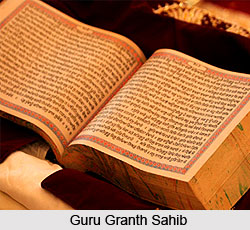 The hymns in Guru Granth Sahib gives out a message that all castes should be treated equally, women should be a given a high status. It also spreads holistic message as well as believes in the concept of Universal Human hood. Jaidev who was a Hindu Brahmin has written some hymns. He denounces wealth and beauty and lay emphasis on meditation of God. He says:
Ramu simaru pachutahiga mana.
Pdpl jlard lobhu karatu hai dju kali uthi jdhiga.
Lalaca Idge janamu gavdld bharam bhulahiga.
Dhana jobana kd garabu na kljai kdgada jiu gall jdhiga.
Jaujamu di kesa gahi patakai ta kina kchu na basdhiga.
Simaranu bhajanu daid nahl k`inl tau mukhi cotd khdhigd.
Baba Farid who practiced Islam has also penned some hymns. Some of his verses are given below and it emphasizes on forgiveness and God can help us out in every situation.
He says:
Pharldu jo toi mdrni mukldn tinhan na mare ghunmi.
Adpanarai ghara jalai pdira tinan di cumin.
Phardd jdn tau khatan vel ran tu ratd dunl siu.
Mdrag svdl nlhi jan bharid tan ladid.
Dekhu pharldu jo thla ddrl hoi bhura Agahu nerd did picha rahia duri.
Dekhu pharidu ji thla sakara hoi visit.
Sanl bdjhhu apani vedan kahlai kisu.
In the opening of Guru Granth Sahib Guru Nanak has made a basic statement of his faith which has become the fundamental statement in relation to creed for the Sikhs known as Mool Mantra, which is:
Ik Orhkdr Satinamu Karta purakhu Nirbhau Nirvlru Akdl-murati Ajuni Saibhang Gurprasddl.
Guru Nanak has prescribed some ways to achieve salvation:
Adi sacu Jugddi sacu
Hai bhi sacu
Nanak hosl bhi sacu
Socai soci na hovai je soci lakh vdr.
Cupai cup na hovai e lal rahd liv tar.
Bhukhid bhukh na utrlje bannd puna bhdr.
Sahas sidnpd lakh hohi ta ik na calai ndli
Kabir who was a weaver, Ravidas who was a cobbler and Namdev who was a dyer by profession has also penned down some Hymns. Namdev condemns the treatment meted out to him on his first visit to a Hindu temple. He narrated this experience thus:
Hasata khelata tere dehure aid.
Bhagati karata ndmd pakare uthaid.
Hlnarjdti men jddama raid.
Chipe ke janami kdhe ku aid.
Lai Kamall caleo palatal.
Dehurai pdchai baithd jdi.
Jiu jo ndmd hari gun ucarai.
Bhagata janan kau dehura phirai.
One of the well known verses of Kabir in Guru Granth Sahib is as follows:
Gagan Damama Baajooh pariho nishaan-e-ghao,
khet jo maandyo surma aab jujhan ka tao,
Sura so pahchaniye jo lare deen ke het,
purja purja kate marhe kabho na chhade khet.
Message of Guru Granth Sahib
It is a Divine Treasure of synthetic embrace of the whole global community. The Holy book of the Sikhs is a paradise of spiritual harmony. True integration, harmony and unity can only usher in, on a solid foundation of Love. This Love stands out beautifully, harmoniously, synthetically in its pristine purity and glory in Sri Guru Granth Sahib. Guru Granth Sahib serves as a living Guru for the Sikhs and helps them to walk in the right direction.
Significance of Guru Granth Sahib
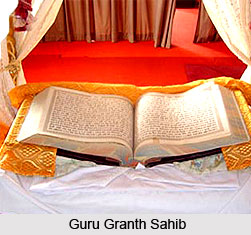 The status of women and caste equality and few other major aspects can be attributed to the Significance of Guru Granth Sahib. One finds an ecumenical aspect attached to it as its authors included six Gurus, fifteen Bhagats or Hindus and Muslims saints, eleven Hindu Brahmin musicians and three Muslims and one Hindu. The Bhagats came from different regional backgrounds as well as belonged to different castes.
The holistic message adds to the rare uniqueness of Sri Guru Granth Sahib. This religious text covers all aspects of human life that also includes man`s relationship with God, the ultimate Reality and the salvation of human beings. The basic contextual issues of their times, the evils of the caste system and the status of women have also been mentioned in the text.
Social equality among human beings has been maintained. It rejects caste-based distinctions, rituals based on karma. Solidarity among all castes was one of the main teachings. It is believed that the foundation of all Human beings have been universal. In the eyes of the Gurus, outcastes were welcome to receive religious support as well as offered the pride of place of a teacher.
Therefore it can be considered that Sri Guru Granth Sahib completely rejects caste-based distinctions and laid the foundation of an alternative social order that was based upon the principles of truth, good actions, and prayer. The basis of the three fundamental concepts, kin karo (work with own hands), namjapo (meditate on God`s name) and vand chako (share food with others). The authors of Sri Guru Granth Sahib laid down the foundation of Sikh praxis as it demanded actual action with the reflection.
The integrity and holiness of the whole creation has been upheld in this text. In several parts the religious leaders of different religions of Guruji`s time have been mentioned who had lost their integrity. Women`s status in society has also been a major concern. Guru Nanak bestowed upon them the premier status.
Thus Guru Granth Sahib is a unique text that is cosmopolitan in nature, gives a holistic universal message. It also deals with doctrinal clarity, caste issues, integrity of creation, status of women, suttee and many more. These issues are even relevant in today`s context too.