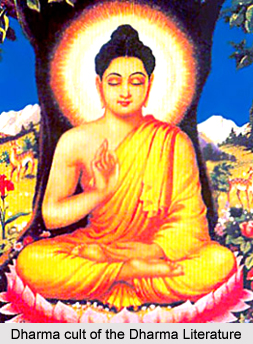
 Dharma Literature constituted of the literary works that was dedicated to Lord Dharma who was worshipped by the Laukik cults. Dharma is also called Niranjan or Sunya Niranjan and explores the genres of science o righteousness, the studies of the same. Lord Dharma was a native deity who was worshipped by the lower strata of society. Ramai Pandit is believed to be the original exponent of the Dharma cult. Dharma represented the idea of Lord Buddha in a perverted form. The Dharma cult was a hotchpotch of the scholar beliefs and practices like Tantric Sahajiya and Saiva Nathism. References to the Dharma cult are there in Bengali compositions like Vipradas Piplai`s Manasa-mangal and Manik Datta`s Chandi-mangal. However none of these seem to be older than the seventeenth or the sixteenth century.
The Dharma literature can be divided into two categories: a) manuals of Dharma theology and ritual and b) Dharma-mangal poems. Well known of the Varamati manuals is the Sunya-puran. Some parts of it have been ascribed to Ramai Pandit. It is an assorted collection of works by different authors of different times. A poem on the sun, a poem on Siva as a ploughman, and a poem entitled `Niranjaner Usma` (Wrath of Niranjan) are most interesting. The last work belongs to mid-eighteenth-century: the Anil-puran by Sahadev Chakroborty.
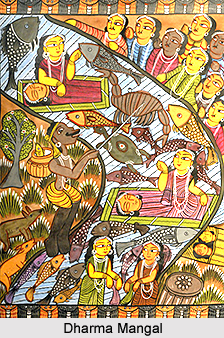 The Dharma-mangal poems elevate Dharma by narrating about his devotee the exploits being superhuman and miraculous. A brief summary of the Dharma fable have also been given here. The Dharma fable has several incidents however the uniting force is the personality of Lausen. The poets exhibit a common characteristic which is pleasing. Almost all characters talk at length about themselves and their circumstances. The personal accounts given by Rupram and Manikram Ganguli are the best.
Khelaram and Mayur Bhatta were the earliest Dharma poets. Their works have perished. Mayur Bhatta is mentioned as the original poet of this cult. The earliest extant Dharma-mangals are by Sitaram Das and Syam Pandit which have been written towards the end of the seventeenth century. Rupram`s poem belongs to the same date. The other ten Dharma poets belong to the eighteenth century. Among them the greatest is Ghanaram Chakravartti, a native of Krishnapur which is near Bardhaman district.
The Dharma poets do not strike a high level. However Ghanaram was vivid and clear and he is fond of alliteration. Manikram Ganguli is another poet who has not been as popular as Ghanaram. His special features include a sense of humour which was uncommon in other poets. The Anil-puran by Sahadev Chakroborty though cannot be regarded as a proper Dharma-mangal piece. Another piece entitled `Niranjaner Usma` describes how in the Jajpur area of south Rarh fanatical Muham-madan fakirs oppressed Hindu villagers with the assistance of Dharma-worshippers. The Anil-puran contains matters regarding Nath and Siva cults.
Three Mangal poems on Jagnnath of Puri have also been composed by Gadadhar, Viswambhar Das, and Dwija Madhukantha respectively. The first poet belonged to the seventeenth century and the other two belong to the eighteenth century.