About Krishna Temples
 Krishna temples in India are scattered throughout the country. Lord Krishna is integrally associated with love, friendship, benevolence and mischief. Hence whether, it is north, south, west or east India, this deity is worshipped by all. While some devotees are fond of the `bal gopal` (Krishna in his childhood), others are in awe of Krishna who delivered the messages inscribed in Bhagawad Gita to Arjuna. Yet he stands for power as well. He is powerful because the universe starts and ends with him; he is the one who stands up in the face of injustice to deliver justice. Steeped in mythological tales, Lord Krishna is one of the Hindu gods who are widely worshipped. Hence a number of temples dedicated to this deity can be found all over the sub-continent.
Krishna is hailed as the eighth avatar of Lord Vishnu. Lord Krishna gave the highest form of teaching on the battlegrounds of Kurukshetra to its disciple Arjuna and this teaching later came to be known as the Bhagwad Gita which is recited by some people on a daily basis and also on auspicious occasions. The Bhagwad Gita is also regarded as the holy book of the Hindus. He is known for his bravery in destroying evil powers throughout his life and some of the Krishna Temples in India portray his leelas or deeds. The Lord is usually depicted as playing the flute or murali, an indication of the spread of the melody of love to people.
Krishna Janmashtami, the day on which the Lord Krishna was born, is regarded as one of the most auspicious occasions and it is celebrated all over India with much enthusiasm. Lord Krishna is also shown with his childhood devotee Radha. The Lord is usually remembered and worshipped as Radha-Krishna. The pair symbolizes the eternal love between people and god. Lord Krishna is also shown with his pet white cow. He performed many divine sports or leela as a child.
A majority of the Indian classical music collection in almost all the languages have their subject as the celebration of the childhood of Lord Krishna. Several Krishna Temples is India are found where the Lord is worshipped a large number of devotees. Some of the temples are Iskcon Temples in Delhi, West Bengal, Bengaluru and Tirupati, Dwarkadhish Temple in Dwarka, Guruvayoor Temple, Vrindavan Temples, Mathura Temples, Ashvakranta Temple in Guwahati, Shri Govindji Temple in Imphal, Gopinath Temple In Balasore, Govind Devji Temple in Jaipur, Lalji Temple in Haldia, Aranmula Temple in Tiruvalla, Radha Shyama Temple in Kolkata, Nathdwara Temple in Udaipur, temple of Shreenathji in Nathdwara, etc.
Krishna Temple in Udupi
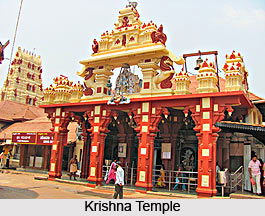 Udupi is a small coastal town of the Dakshina Kannada district in Karnataka. This town is well known for the famous Sri Krishna temple, which is one of the well-regarded Krishna temples in India.
The Udupi town and the Krishna temple are closely connected with a Vaishnavite philosopher and saint, Sri Madhvacharya (1238-1317AD), whose school of philosophy is known as `Dvaita`. It is believed that the idol of Krishna in Udupi was installed by Sri Aladhvacharya and from that day to till today the worship has continued without any break.
There is an interesting story regarding the existence of the temple in Udupi. It is said that the saint Madhva had a divine calling when he was waiting for the arrival of a ship at the coast called Vadabandesvar in Karnataka. This ship started from Dwarka and had bumped into a brutal storm. And, it was turned quiet by Madhva and the ship reached its destination safely. After reaching in the coast, the captain of the ship offered Madhva all the precious items contained in it to show his gratitude. But Madhva refused them and just asked for a huge boulder like thing lying on board. It was taken by the captain at Dwarka to counterbalance the ship. The captain then gifted him that boulder. When Madva broke the boulder, he found the idol of Krishna inside and he was overjoyed. On seeing this, Madhva got delighted so much that he ran all the way to Udupi by carrying the idol, which was 5 kms away from the coast singing the praise of his beloved Lord Krishna. These hymns, which were uttered by him, are known as the `Dvadasa Stotra`.
Later, this Krishna idol was installed at the northeastern side of the Ananteshwar temple in Udupi. It is believed that this idol was created by none other than Visvakarma, the architect of the gods himself. This temple is not very huge in size but many structures are added in recent days. There is an aperture named the `Navagraha window` through which the deity in the chamber is watched. This aperture of the temple has nine square holes.
There is another story related to this Krishna temple in Udupi. It is said that once a lower caste devote named Kanakadasa was not allowed to enter the temple and then the Lord Krishna turned around to enable the devotee to worship him. A unique system is practiced in the temple for management of it. There were eight disciples of Madhva, who founded monasteries in the surrounding areas. These priests of the monasteries take the responsibility of taking care of the temple one at a time. In Udupi, almost all activities and festivities are connected with this Krishna temple. The main festival of the Udupi is `Paryaya`, which takes place on 17th or 18th of January on every alternate year. It occurs to mark the change of the temple head and when the successor takes over. A huge festival environment is created in Udupi town during that time and hundreds of people were fed in a public fest.
There are two other temples in Udupi town named the Chandramaulishwar temple and the Ananteshwar temple. The main source of entertainment for the people of Udupi is the popular costumed musical dance-drama called `Yakshagana`. Few other ways of entertainment include the buffalo race; which is common among the farming community.
Sri Krishna Temple in Hampi
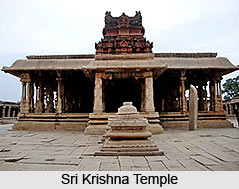 The Sri Krishna Temple was built by Krishnadevaraya in 1513 A.D. to commemorate his victory over Prataparudra Gajapati, the ruler of Orissa. During the battle he seized an image of child Krishna and brought it to Vijayanagara as war trophy. He then built this temple to consecrate the image. This temple is situated to the north of the image of Lakshmi-Narasimha in Hampi.
An inscription describing the conquest and the consecration of this temple on 16 February 1515 by Krishnadevaraya is found on a slab in front of this temple. Built in the centre of a courtyard, the temple possesses a sanctum, an antechamber, an ardhamandapa, a circumambulatory passage, a pillared hall with three entrances and an open pillared mandap, in addition to a number of other shrines for the attendant deities. The sanctum is at present empty. One of the pillars in the ardhamandapa is noteworthy as all the ten incarnations of Vishnu, including the rare one of Kalki, are carved on it. Kalki is depicted as a seated figure with a horse`s head. A large open prakara with high walls contains the Swami and Amman shrines as well as several sub-shrines.
Only a part of the superstructure of the east gopuram exists, but its west face contains fine stucco figures of warriors with shields, spirited horses and elephants. This perhaps represents a war scene connected with Krishnadeva Raya`s Orissa campaign.
The inner sides of the entrance exhibit beautifully sculptured Apsaras standing on mythical animals and holding scrolls filled with panels showing the ten incarnations of the lord. Like all major temple complexes, Krishnapura, a suburb, is developed around this temple. The bazaar in front is now a lush paddy field.
The nearest railhead to Hampi is Hospet. It is also accessible from Aihole, Badami, Bangalore, Bellary, Guntakal, Hubli, Hassan, Hyderabad and Mysore.
Sri Krishna Temple of Dwarka
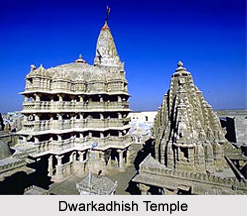
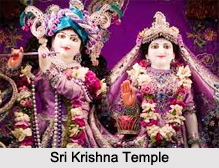 Sri Krishna Temple is a popular temple in Dwarka, Gujarat. This temple is popular as Lord Krishna was the king of Dwarka in Treta Yuga.
Location of Sri Krishna Temple : Sri Krishna Temple is located just behind the Gomti Temple. While walking from Samudra Narayan Temple along Gomti River Ghat, this temple is located at the opposite end.
History of Sri Krishna Temple : Satyabhama is one of Lord Krishna`s queens. She is also one of the most beautiful women. Like most beautiful people, she is also very conscious about her beauty and vain about it. She is constantly jealous of Goddess Rukmini, the incarnation of Goddess Lakshmi and the first wife of Lord Krishna. Though Lord Krishna pampers her, she thinks Lord Krishna is partial towards Goddess Rukmini. She finds out that Krishna has given Parijata Tree, the celestial flower, to Rukmini. She is jealous of Krishna having deep love towards Rukmini. She thinks of a plan to test Krishna`s love for her. Krishna enters Satyabhama`s chambers. She is sitting on her bed, sad, and forlorn. When Lord Krishna wanted to know the reason for her grievance, Satyabhama said, "Oh Lord! I want the Parijata tree." Lord Krishna was shocked to hear about the Parijat tree. He said, “This does not grow anywhere on Earth! It is a celestial tree that grows only in Heaven." Satyabhama was adamant. She repeated her request, "You have given a Parijata flower to Rukmini, so why not to me?" Krishna laughed, "I have given her just the flower. I can give you the Parijata flower as well. However, I am afraid I can`t get you the tree, since it belongs to Heaven." Satyabhama is adamant and sticks to her demand. Lord Krishna says, "Ask me for anything that is feasible and I will get it. I can get you the most precious gems from the deepest oceans. I can get you fruits or flowers that grow on the tallest mountains. The Parijata is something I have no access to." Satyabhama says, "I want to perform a special puja that will make You love me more than ever. I need the Parijata tree to perform this puja." Krishna says, "The Parijata tree grows only in Heaven. It is under the custody of Lord Indra, the king of Heaven." Satyabhama says, "Please wage a war against Lord Indra. Once you defeat Him, you should be able to bring the celestial tree for me." Krishna realises the moment has now come to make Satyabhama feel humble. Lord Krishna requested Lord Indra to give the Parijat tree and after that Lord Indra waged a war against Krishna. There He defeated Lord Indra, and planted the Parijat Tree for Satyabhama.
Architecture of Sri Krishna Temple : The building of Sri Krishna Temple is white and the altar has a black idol of Lord Krishna. An orange idol of Lord Ganesha adorns the door of the altar. As in most temples of Dwarka, here too, the Lord is four-armed, sans the flute. Behind Sri Krishna Temple is the Hari Kund where Lord Krishna and Goddess Rukmini had a bath. In front of the idol, there is a huge weighing scale fixed from the ceiling. For a first time visitor, this may appear odd. Though it is quite common to see weighing scales in temples, they are generally kept in the back courtyard or at one end of the temple premises. Generally, in most temples, the weighing scales are for the tulabhara of the devotees. Tulabhara means the devotee gets weighed against items of his/her choice (this could be bananas, coconuts, jaggery, etc). After the tulabhara, the items weighed are given away. However, here, in this temple, the weighing scales commemorate an episode that happened 5000 years ago. That`s the reason why they take centre stage here.
Devaki Krishna Temple
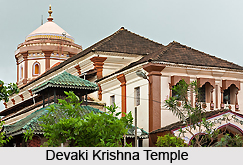 Devaki Krishna Temple is located in Marcel, Goa. The temple houses other deities like Bhumika Devi, Laxmi Ravalnath, Mallinath, Katyayani, Chodaneshwar and Dhada Shankar other than Devaki and Krishna. Originally the temple was located at Chorao Island. Later it was moved to Mayem in Bicholim and thereafter it was finally reconstructed in its present place beside the Banastari Bridge.
Lord Krishna is depicted as a small child sitting in between Devaki`s legs. This temple is also called the Pisso Ravalnath temple to the locals. The major festival celebrated is the
Malin Purnima from Paush Vadya. It is celebrated during January and February. Other festivals celebrated in the temple are Navaratri festival, Gokulastami, Ramanabami, Shri Chandika Yaina and the anniversary of the temple.