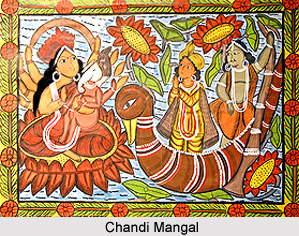
 Chandi Literature constitutes the compositions that focus on Goddess Chandi. Chandimangalkavya is an important sub-genre of mangal kavya. The Nadiya period saw the flowering of the Chandi cult. Goddess Chandi is an indigenous deity. The poems on her consist of two separate fables. They lack the essential unity of the Mahakavya. The first fable narrates the interesting anecdote about how Chandi conferred her grace on a male devotee. The second fable narrates how she conferred it on a female devotee. Both the fables are indigenous and are not inspired from Sanskrit literature. The first fable speaks of Kalketu who is a hunter and belongs to low caste and about his wife Phullara.
Khullana is the heroine of the second fable who was a young and beautiful daughter of a rich merchant of Ichhaninagar. Her life is the focus in the second fable.
The world of the Chandi fables is large and varied as compared to that of Manas fable. It is less dark, violent and primitive. There is no conflict between god and man. There are images of benign Chandi rewarding men and women who follow her willingly. There is a beautiful lizard of a golden hue. The Lady on the Lotus is the focus in the fables and the Chandi poets describe her in the best possible manner.
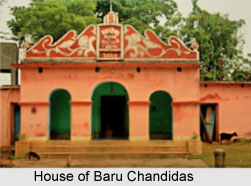
Poet Baru Chandidas and the hymn he addresses to Chandi in the Sri-Krishnakirttan make it evident that the Chandi cult was current in Bengal in the fifteenth century. The first poet to write a full-size Chandi-mangal was the contemporary of Baru Chandidas. However there is no trace of his work. However it is believed that Mukundaram speaks of this poet in his Chandi-mangal when he talks of the Adi Kavikankan who was the initiator of Chandi poem.
 Mukundaram`s poem is encumbered with mystical, mythical and supernatural stuff. It is like a fantastic fairy-land. The main impression is that of reality, humanity, and modernity. Mukundaram was up to date and topical, objective and concrete and interested in the social and economic side of life. He is a writer in the true classical tradition that is knowledgeable, observant, and specific.
Post Mukundaram there was a bend in Chandi literature as his successors were neither many nor notable. The seventeenth century witnessed the composition of Dwija Janarddan, whose small poem is of the Vrata-katha type and is devoid of Kalketu fable. The poems of Jaynarayan Sen, Muktaram Sen, Bhavanisankar Das and others of the eighteenth century belong to Mangal-kavya.
She received the homage of many poets like Bhavaniprasad Ray, Dwija Kamal-lochan, Rupnarayan Ghosh and Govinda Das of the seventeenth century; and Sivchandra Sen, Ramsankar Dev, Harischandra Vasu, Harinarayan Das, Jagatram Vandya and Ramprasad Vandya of the eighteenth century.
The Chandimangalkavya`s earliest poet was Manik Datta who hailed from Maldaha. Other poets include Dvija Madhab and Kabikankan Mukundaram both belong to the 16th century. Dvija Madhab`s work, dated 1501 Saka era gave shape to the narratives of Chandimangal. Dvija Ramdeb`s Abhayamangal is another work that belongs to the sub-genre of Chandimangalkavya.