About Classical Assamese Drama
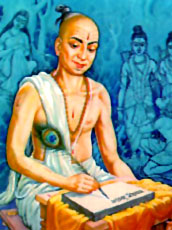
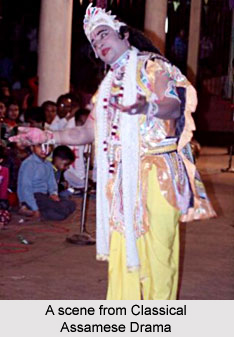 Classical Assamese drama is usually associated with Sankaradeva. Although Sankardeva (1449-1569) is the originator of dramatic tradition in Assamese, he is free from the imperfections that are usually associated with the first in any field. Even though Assamese drama started with him, he could not be equaled, much less excelled by his followers.
Sankardeva has six dramas, apart from Chinhayatra that is lost, to his credit. They are Kaliya-damana, Patni-prasada, Keli-Gopala, Rukmini Harana, Parijata-Harana and Rama Vijaya. It is established by scholars that all these dramas were written after Sankardeva`s twelve-year stay in different cultural centres of northern India. In Bihar and Orissa particularly, during those days, the theatre on Vaishnava theme was greatly popular. It reached a high level of attainments also. Power of kaleidoscopic appraisal and psychological assessment, grasp and understanding of the theme and, above all, the depth of poetry- these qualities are all evident in Sankardeva`s dramas.
Sanskrit plays are noted for their lyrical stanzas and prose passages, the latter being used mostly for dialogue. A similar technique is followed by Assamese playwrights also, particularly Sankardeva and Madhavdeva. The prose is simple and rhythmic with elegance. The lyrical stanzas are characterised by a sweep of metre that aptly expresses the wide range of feelings and sentiments. Generally perplexing in idea, Bhatimas constitute the grand theme of the play. The prose-passages are popular expositions of the high sentiment of the former.
Assamese Drama in Jayanti Era
 Assamese Drama in the Jayanti era is essentially divided into three broad categories: mythological, the historical, and the social. The structure of drama saw a major change in that it moved away from the rigidity of the classical five-act form. This flexibility allowed the later introduction of the one-act play. One of the major factors in the development of drama during this era was the radio. The ability to perform and broadcast a play without any visuals or costumes on radio shows freed drama from mere stage effects. The message and dialogue became important and thus more efficient. The influence of Shaw and Ibsen`s message-oriented drama can be seen in the social drama of this period.
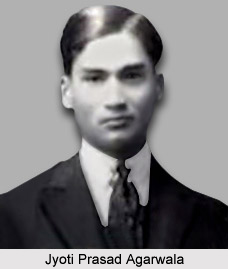
The historical dramas dealt with famous Assamese figures of recent history as their subjects. There was a particular emphasis on figures who symbolized resistance to British rule. The Nagaon Natya Samiti`s Piyoli Phookan (1948), Prabin Phookan`s (1912-85) Lachit Bor phookan (1946) and Maniram Dewan (1948), and Surendranath Saikia`s Kushal Konwar (1949) dramatized the historical and personal events surrounding these well-known personalities of Assam`s history. Surendranath Saikia also wrote a number of mythological plays, such as Kama (1947) and Lakshman (1949). But such plays were fewer in number. It was the social drama that gained popularity and importance, and Jyoti Prasad Agarwala being the dramatist popularized this drama. In his Lobhita (1942), though the play is set within two political events, World War II and the 1942 independence movement, the social message is most relevant. Its heroine, Lobhita`s, reaction to events around her, her courage and determination amid intense struggles, her ultimate sacrifice characterize a pride and essence of patriotism that allowed this young Assamese woman to face modern problems unafraid. Agarwala`s message thrived in inspiring young Assamese men and women worthy enough to encounter the complexities of the modern world with self- confidence and pride in their heritage and reject earlier tendencies to marginalize themselves. His Karengor Ligiri (The Palace Maid, 1936), too, dramatizes the dehumanizing effects of traditional class structures. Among his other plays are the symbolic dramas Nimati Kanya, Rupalim, and Sonit Kunwori. They are all notable for experimenting not only with form but with technique, including the incorporation of songs and music in what can be termed poetic dramas. Other social dramas of this period are Satya Prasad Barua`s (1919) Sakoi Sokuwat (1940), Susibrata Raichoudhuri`s Kon Bate (1948), and Dandiram Kalita`s Po-rasit (1946). We do find a number of comedies written during this period, but the comic vision was not predominant in the 1940s.
Thus it can be seen that Assamese drama in the Jayanti period developed a certain refinement in terms of dialogue, message and content.
classical_assamese_drama
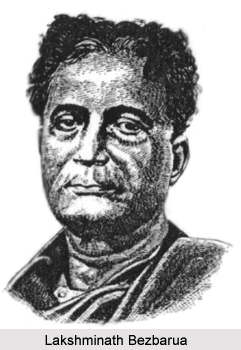 Assamese drama in the Jonaki era had more literary value than theatrical value. Much of the drama of this period was read rather than performed, and the following generation would put this drama on stage or at least borrow from their themes to do so. The first dramatic work of this period was Lakshminath Bezbarua`s `Litikai` (The Pages, or Lackeys), a farce serialized in 12 parts from the first issue of Jonaki. His other dramas were historical ones such as Chakradhwaj Singha and Joymati Kunwari, both taking up Ahom royalty as their primary characters. It was Benudhar Rajkhowa who was a more prolific playwright and whose plays contain strong satirical and often farcical characteristics. His plays, such as Kali Yuga (written in collaboration with another noteworthy litterateur, Durga Prasad Majindar Barua), Tint Ghaini (Three Wives), Asikshit Ghaini (The Uneducated Wife), and Sorar Sristi (The Thief`s Invention), depict various aspects of Assamese society of his day. With these plays, too, performance was not the primary concern.
Though the drama in the Jonaki era was more read than performed, it is remarkable to note that, though early-modern Assamese literature, with a few exceptions, does not yield great dramas, Assamese society has always been a theatre-going one. Drama developed in Assam contemporaneously with English drama in the fifteenth century. Alongwith the English church performances, mysteries and morality plays, the neo-Vaishnavite movement established religious drama and, with it, a classical dance form, the Satriya (of the salras or monasteries). But Assamese drama did not develop in the manner of English drama, and the classical, devotional, and historical strains were still strong into the twentieth century.
Modern Assamese drama was established in the 1940s by Jyoti Prasad Agarwala and continues to flourish. But even today, perhaps fittingly, successful dramatists are defined by performances at large, rather than by publications. Masses of people flock to the touring theatre companies that move through the Assamese countryside and towns performing popular plays that are not to be found in published form. The establishment of All India Radio in 1948 saw the rise of another form of non-literary drama.
Romantic Plays in Assamese Drama
Romantic plays in Assamese drama provide the required nourishment to the playwrights who are selective and poetically passionate. The poetic dramas are: K. Ghaliha`s Dhuli, Kirti and Mukti Bardoloi`s Sur vijay, Luit Konwar, Meghavali, Ananda Barua`s Kapau Konwari, Badan Sarma`s Kavitar janma, Heimantika and Parvati Barua`s Lakhimi and Sonar soleng (1929). The intrinsic characters of these dramas are musical and operatic. Some of the romantic plays of pre independence era include Benudhar`s Rajkhaowa`s as for example Seutikiran (1894) is a romantic love tragedy.
One-act plays and radio-dramas are among the modern experiments in Assamese literature. L. N. Bezbaroa`s light comedies like Nomal, Pachani, and some more are one-act plays. However the real leader of the modern one-act play is Lakshmi Sharma with her Prajapatir bhul. Tafazul Ali, H. C. Bhattacharjya, Bina Barua, S. P. Barua, Mahendra Bora, Homen Bargohain, Jogen Chetia, Satish Das, Bhaben Saikia, D. K. Saikia and Kiran Sarma have made a mark in this field of drama.
Bina Barua`s Abelar nat, a psychological study of two fuelling cross-currents and Pravin Phukan`s Tritaranga, an anthology of three social plays, have stabilised this experiment into an ennobling experience. The radio drama in Assamese literature made its debut with the establishment of the Guwahati station of All India Radio in 1948. Radio dramas like Bhogjara, Jonakir biya, Adha aka chhabi, Jinti, Malati, Era batar sur, Ghatoal have added to the compass of our dramatic literature.