The cult of Devi, the Goddess, who is believed to be the joyous creative principle of nature, includes the "Five Essentials" (Panchatattva) by which man enjoys his existence, preserves his life and obtains issue. These are- Intoxicating drink (Madya) which is defined as " the great medicine for humanity, helping it to forget deep sorrows, and is the cause of joy "; meat (Mamsa) of the beasts bred in villages, in the air, or forest, which is nourishing, and increases intelligence, energy and strength; fish (Matsya) which is "pleasing and of good taste, and increases the generative power of man "; delicacies of patched food (Mudra) which is "easily obtainable, grown in the earth, and is the root of the life of the three worlds "; and fifthly sexual union (Maithuna) which is " the cause of intense pleasure to all living things, is the origin of all creatures, and the root of the world which is without either beginning or end."
However, these five essentials may only be used in the circle (Chakra) of the initiated and even then only after they have been purified by sacred formulas and ceremonies. In these circles of initiated men and women, there are no distinctions of caste, but evil and unbelieving persons cannot be admitted into the circle. Neither is there to be any abuse of the five essentials. He who drinks immoderately, is no true devotee of the Devi. In the sinful Kali age, a man is to enjoy only his own wife as a "Sakti." If a householder is unable to control his senses, sweet things (milk, sugar, honey) shall be used instead of intoxicating drink, and the worship of the lotus feet of the goddess shall take the place of sexual union.
It is however true that the `hero` (Vira), i.e., he who has secret powers and is suited to be a Sadhaka or sorcerer is entitled to unite himself in the circle to a Sakti who is not his wife. He has only to make her his wife by a ceremony prescribed especially for this purpose. It is only in the highest heavenly state (Divyabhava), i.e., in the case of the saint who has completely overcome earthly things, that purely symbolical acts take the place of the five essentials.
Practice of Cult of Devi
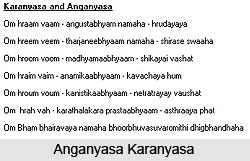
The cult of the Devi attaches especial importance to Mantras, i.e., prayers and formulas, and Bijas, i.e., syllables of mysterious significance, such as `aum,` `klim,` `brim` etc.;as well as Yantras, i.e., diagrams of mysterious significance, drawn on metal, paper or other material. Equally important are the Mudras, i.e., especial positions of the fingers and movements of the hands and Nyasas. The last-named consist of placing the fingertips and the palm of the right hand on the various parts of the body, whilst reciting certain mantras, in order to imbue one`s body with the life of the Devi. By using all these means, the worshipper causes the deity to show goodwill towards him and compels the deity into his service. He thus becomes a Sadhaka a sorcerer, as Sadhana, sorcery, is one of the principal aims, though not the final goal of the worship of the Devi.
Goal of Sakti cult
This final goal of the Sakti cult is Moksha or salvation, becoming one with the deity in Mahanirvana, the `great extinction.` The perfect saint, the Kaula, who sees everything in the Brahman and the Brahman in everything, whether he fulfils the rites laid down in the Tantras or not, attains this state even in this life. He is released though living (Jivanmnkta). However, the path of salvation can only be found through the Tantras. This is because the Veda, the Smriti, the Puranas and the Itihasas, all these were the sacred books of bygone periods of the world`s existence whereas the Tantras were revealed by Shiva for the welfare of humanity. In this way the Tantras describe themselves as comparatively modern works. In this age Vedic and other rites and prayers are of no avail, but only the mantras and ceremonies taught in the Tantras are of value.
Thus, just as the cult of the Devi leads to the grossest material gains by means of sorcery, as well as to the loftiest ideal of Nirvana, even so the sensual and spiritual elements are well mixed in the cult itself.
Cult of Devi in India
Cult of Devi focuses on the worship of the Devi, the Goddess, who is said to be the source and the creative element of nature. It prescribes certain essential practices by which man can achieve his final aim- that of Moksha or salvation.