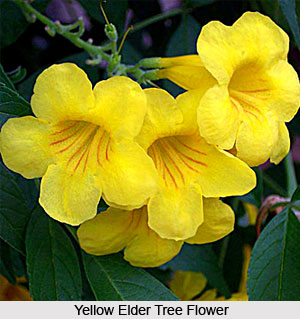
 The popular garden shrub that has some nice yellow flowers and elegant foliage is well known as the `Yellow Elder`. The scientific name of this shrub is `Tecoma Stans`. The word `Tecoma` derived from the Mexican name and `Stans` means, "erect". Being a member of the family named `Bignoniaceae`, the shrub is also called as `Trumpet Flower` and `Yellow Bells` in English. Its origin is South America, but at present it has been naturalised in a large number of tropical countries. The shrub practically has the capability to retain its attractive appearance throughout the year.
The shrub can grow nearly to the size of a small tree and has some low branches. The bright green foliage of this shrub can come down almost to the ground. Its bark is corky and light brown in colour. The leaves of the `Yellow Elder` are large in size and have a long stalk. They are usually divided into five to eleven leaflets. These leaflets grow in pairs. Each pair remains in opposite direction to the previous pair. Each of the leaflets is from 5 to 7.5 cm in length and has a base that is wedge -shaped. It has a long, narrowing point and indent edge. The leaflets are soft but not glossy and a bright pale-green in colour that becomes paler underneath. The last one of the leaflets is usually the longest. The leaves are of a beautiful fresh colour at the young age, but after the dry season they become boring and tired.
The flowers of the shrub are clear yellow in colour. They appear in close, floppy clusters from the ends of the branchlets. They do not top the foliage like the flowers of many other trees. Instead, they hide themselves amongst the branches, in and around the shrub. Each of the flowers of the `Yellow Elder` is a 5 cm long trumpet that emerges from the pale-green calyx. After emerging, it suddenly bellies out and opens into five wavy lobes.Three of these lobes lie down straight and the upper two fold back. In this formation, the whole flower measures some 3.8 cm across. The throat is delicately etched with orange inside the flower. The Winter and the Rainy season are the principal flowering seasons. However, most of the shrubs produce a few clusters all through the year. You may often find the ground below the `Yellow Elder` scattered with blossoms that lie amongst a number of little sprouting shrubs as the flowers fall before they wither and the shrub has the capacity of seeding itself. The fruits normally appear in bunches of long, slim capsules. They are of green colour at the beginning and by the course of time, they turn into brownish in colour. The shrub can propagate by cutting or seeds.