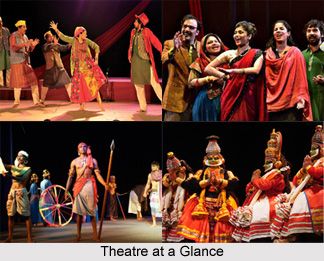
 Theatre which was primarily just a means of entertainment during medieval India later gained a concrete shape during the British rule. Why only drama almost every literary expression then became the weapon to illustrate the effects and impacts of the British Raj. Quite ideally therefore Indian theatre during the British rule became lot more contemporary. It can be therefore easily said that the 200 years of British Imperialism brought Indian art and artistry into close contact with the European fervour and hence in India, developed a new artistic form. Although the eminent personalities in Indian theatre (under British rule) did illustrate the British colonialism and exploitation amidst Indian Natya and drama yet it is certainly not an overstatement to say that the very kernel of contemporaneousness in Indian drama was first sown during that era. Theatre Later the story line changed, change was even noticed in the development of drama pattern and also in the dramatization. Gone are the days of celebrating the historical characters or embossing those celestial personas, drama during British rule In India became lot more structured and was steeped into the aura of modernism. Renowned personalities in Indian theatre (under British rule) thus aided in taking Indian theatre to the next level of maturity whilst offering it a spherical contour. With the direct contact with western philosophy, drama, art, literature, music and above all life style all gained an articulate diction in India. It is during this two hundred years of British reign Indian drama gradually became a much naturalistic and at the same time a realistic way of manifesting the realities of life.
Dinabandhu Mitra, Michael Madhusudan Dutta, Rabindranath Tagore, Horasim Lebedev are some of the names of the personalities in Indian theatre (under British rule). With their creativity, originality and most importantly with their colossal intensity in changing the very socio economic pattern of India they actually supported in adorning the rich history of Indian theatre.
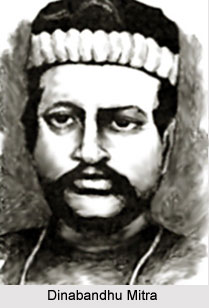
Dinabandhu Mitra:
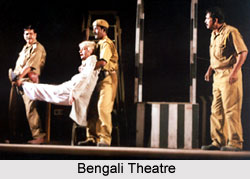
Indian drama, especially Bengali theatre gained that chic feel in the hands of this eminent dramatist Dinabandhu Mitra. The true aura of the commercial theatre was first time felt in his creations which were not only infused into the agony and pain of the farmer, cultivator and of the common man but also carried a rich social statement which later did act as the greatest force in India`s independence. His dramas were not only the blueprints of the weak socio political status of India under British rule but were at times extremely satiric. One of his greatest comedies, "Sadhaber Ekadasi", still echoes the social sentiment and discrimination of India during British rule. His "Nil Darpan" bears the social portrayal of the indigo cultivators whilst bringing out their ache, agony, pain and sufferings in the most lyrical way. Another of his remarkable play "Lilabati" added another landmark to the chronicle of Indian theatre.
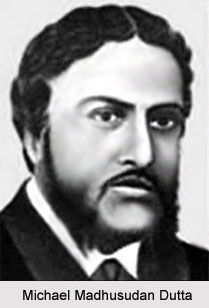 Michael Madhusudhan Dutta
Michael Madhusudhan Dutta "Where man in all his truest glory lives, and nature`s face is exquisitely sweet; For those fair climes I heave impatient sigh, There let me live and there let me die"
Indeed! Who else can actually illustrate the exquisite beauty of mother land in such an eloquent way? Who else can feel the pain of the sufferer and portray it so very coherently than that of the eminent dramatist, poet and thinker Michael Madhusudhan Dutta. He was the one who has further restructured the growth of Indian drama to befit the social requirement during that era. His creations had all the elements of "Nine Rasas" that later formed the elementary base of Indian Natya. His plays like Sermista, Ratnavali and translations like Nil Darpan bespeaks a high level of cerebral sophism and social commitments whilst establishing him as one of the eminent personalities in Indian theatre (under British rule)
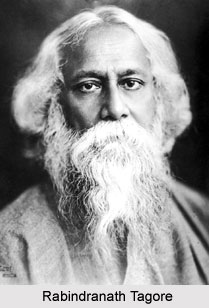 Rabindranath Tagore
Rabindranath Tagore as a dramatist as contributed greatly to the functioning of development of Bengali theatre in particular and Indian theatre in general. Tagore was an accomplished musician, lyricist, painter, artist, dramatist and the unique story teller of his own rank. Through his creative write ups, amidst his satires and humours, Rabindranath Tagore from that remote past tried to alter the socio, economic and political strategies of British colonialism. At the age of 20 Tagore composed "Valmiki Pratibha" where with his artistry and dramatic development Tagore portrayed the transition of "Valmiki". His "Dak Ghar" deals with the theme of death which according to him is the "spiritual freedom" from "the world of hoarded wealth and certified creeds". Later his dramas became lot more philosophical and were mainly based on allegory and metaphors. His political views were best described in his short stories, assorted letters and in his different poetries. Although he criticised European colonialism yet at the same time he did not support the typical swadeshi movement.
Theatre in India during British rule therefore gradually became a logical expression of democratic ideas and traditions. It was then a form of illustrating the views of life amidst pictorial artistry and creativity. The well accepted personalities in Indian theatre (Under British rule) with their brilliance and majesty thus added that maturity in Indian theatre.