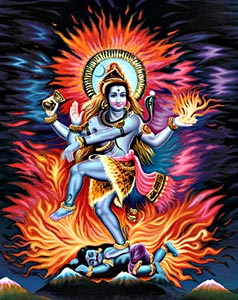
Tankara was a town in Gujrat. There lived a wealthy Brahmin named Karshanji Lalji Tiwari. This good and just man had faith in religious practices. In 1824 a son was born to the couple Karshanji and his wife Amrithbai. The son was named Moolashankar. According to the custom of the place, he was also called Dayaram. This child was to become famous as Maharshi Dayananda. As a child Dayanand was brought up under the strictest Brahmin rule, and at the age of eight was invested with the Sacred Thread (Upanayna). When he was fourteen his father took him to the temple on the occasion of Shivaratri. Dayanand had to fast and keep awake the whole night in obedience to Lord Shiva. In the night he saw a rat nibbling the offerings to the God and running over Shiva`s body. He tried to find out from elders why this "God Almighty" could not defend himself against the menace of petty mice, for which he was admonished. This incident shattered Daya Nand Saraswati`s faith in the idol worship and Dayananda starting questioning traditional beliefs of Hinduism and inquiring about God in early childhood. Thereafter he refused to participate in the religious rites for the rest of his life.
 The desire to give up family ties grew slowly in Moolashankar. He wanted to learn the answers to the questions about life and death from a perfect sage. With this end in view, Mopolashankar was determined to leave home in search of a worthy guru (a teacher). His parents decided to marry him off in his early teens which was very common in 19th century India, but he decided marriage was not for him and ran away from home.
Dayanand Saraswati was disillusioned with classical Hinduism and became a wandering monk. He learned Panini`s Grammar to understand the Sanskrit texts. At this juncture, Moolashankar came across Swami Poornananda, a profound scholar and sanyasi. The Swamiji initiated the young man into the holy orders. Moolashankar became Swami Dayananda Saraswathi. For the next fifteen years he wandered all over the country in the search of a guru. On the heights of the Himalayan regions, his life was in danger again and again. He had to stroll day and night in forests where wild beasts roamed. And in the midst of his wanderings his devotion to his goal was tested, too. Then he came to know that perfect yogis lived in the dense forest near the source of the river Narmada. Without caring for the distance Dayananda walked hundreds of miles towards the south.
Dayananda had the `darshan` of a monk, Poornashrama Swamy by name while he was approaching the river Narmada. He was happy to hear the story of Dayananda`s wanderings. After hearing his story he said, "Dayanandaji, there is only one man on this earth who can fulfil your desire, and that man is Virajananda Dandeesha. He lives in Mathura."
In 1860, he found his guru and mentor Swami Virjanand Saraswati at Mathura. He was blind. But he was the living form of enlightenment and could clear all the doubts of his disciples, quoting passages from all the scriptures. Dayananda felt that this meeting with the great genius had fully rewarded all his hardships for fifteen years. He gladly surrendered himself at the feet of the great master. Dayanand Saraswati underwent rigorous training under Swami Virjanand Saraswati. Virjanand Saraswati gave him the name Dayanand and as gurudakshina extracted promise from Dayanand that he would devote his life for revival of Hinduism. With his extraordinary devotion and sense of service Dayananda soon became the most beloved disciple of Virjanand Saraswati.
Dayanand Saraswati believed that Hinduism has been corrupted by divergence from the founding principles of the Vedas and misled by the priesthood for the priests` self-aggrandisement. He extensively traveled the country challenging the religious scholars and priests to discussions and won repeatedly on the strength of his arguments. He made fiery speeches condemning the caste system, idolatry, and child marriages. Dayanand Saraswati being the first leader in the field of theology welcomed the advances of sciences and technology. To him, the Vedas as the source book contain the seed of science, and to him, the Vedas advocate the philosophy of dynamic realism. He pointed out the shortcomings of every one of them without Supporting or opposing any particular religion. He told the people "Idol worship is not mentioned in the Vedas. The rational mind cannot accept idol worship. God is everywhere God has no shape or form." He bitterly criticized the harmful and wicked customs that have come down through the centuries. He explained the greatness of the religion preached in the Vedas. He advocated the ideal age for a girl to be between 16 and 24, and for men between 25 and 40.
In the course of his travels he came to Kashi (Benares) on 22nd October 1869 to take part in debates with the greatest scholars in Kashi. It was Swamy Dayananda who won a great victory in a true sense, in the debates about the correct explanation of scriptural texts from the point of view of both scholarship and morality. He always worked hard for his ken desire to unite all people under the banner of a single religion. The Maharaja of Kashi with great respect invited Swamy Dayananda to his palace.
Dayanand Saraswati founded Arya Samaj in Mumbai in 1875 to promote social service. Swami Dayananda`s creation, the Arya Samaj, is a unique component in Hinduism. Arya Samaj, postulates in principle equal justice for all men and all nations, together with equality of the sexes. The Arya Samaj condemns idol-worship, animal sacrifices, ancestor worship, pilgrimages, priestcraft, offerings made in temples, the caste system, untouchability, child marriages. It repudiates a hereditary caste system, and only recognizes professions or guilds, suitable to the complementary aptitudes of men in society. To many people, the Arya Samaj aims to be a "universal church" based on the authority of the Vedas.He gave new interpretations to reform the stagnant Hindu thought through his book "Satyaprakash" (The Light of Truth). He profusely quoted the Vedas and other religious texts to insist that salvation was not the only motto of a Hindu or Arya, as it was believed to be. Working for a noble cause was important to lead a fruitful worldly life. Thus salvation according to him was possible through social service.
Dayananda Saraswati immensely contributed to establish equal rights of women and their right to education, reading of Indian scriptures. Swami Dayananda was convinced that a common language is a good means of unifying the members of a society. He, therefore, was of the opinion that Hindi should be given the place of the national language. He translated the Vedas to Hindi from Sanskrit so that common man can easily read the Vedas. The Arya Samaj is rare in Hinduism in its acceptance of women as leaders in prayer meetings and preaching. Arya Samaj is a rare stream in Hinduism that allows and encourages converts to Hinduism.
Dayanand`s concept of Dharma is compressed in a certain area in his "Beliefs and Disbeliefs". He said, "I accept as Dharma whatever is in full conformity with impartial justice, truthfulness and the like; that which is not opposed to the teachings of God as embodied in the Vedas. Whatever is not free from partiality and is unjust, partaking of untruth and the like, and opposed to the teachings of God as embodied in the Vedas - that I hold as adharma." Again he says "He, who after careful thinking, is ever ready to accept truth and reject falsehood; who counts the happiness of others as he does that of his own self, him I call just."
He was among the first great Indian resolute who popularised the concept of "Swaraj", the right to self-determination vested in an individual, when India was ruled by the British. His Vedic message supported by the Vedic notion of the divine nature of the individual, was to emphasize respect and reverence for other human beings. The nature is divine because the body was the temple where the human essence, soul or "Atma" could possibly interact with the creator "ParamAtma". In the 10 priniciples of the Arya Samaj, he enshrined the idea that "All actions should be performed with the prime objective of benefitting mankind" as opposed to following dogmatic rituals or revering idols and symbols. Dayananda and the Arya Samaj provide the ideological strength of the Hindutva movement of the 20th century.