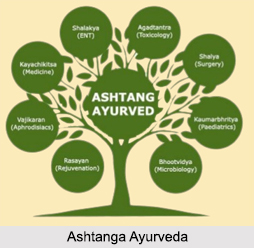
According to Ashtang Ayurveda there are three vital principles, which regulate and control the biological functions of the body. They are known as the dosha which are of three types --- Vata, Pitta and Kapha. They are the subtle forms of the three bhutas -air, fire and water. It is seen that the dead body and other lifeless objects do not have any of the three doshas. This proves that all the three doshas are invariably connected with life. Each of them has it`s own significance and qualities, which are contrary to each other so as to maintain the state of equilibrium, known as Sama Dosha.
Doshas play a vital role in the basic foundation of Ayurveda. They are responsible for synchronizing and maintaining all the substances and structures of the body, leading to the physical condition of Sama Dosha.
Vata doshas are analogous with kinetic energy as they initiate all forms of activity and motion in the body. It acts as a network of communication from tissue to tissue and from cell to cell. It is responsible for perception, integration and response. Vata doshas control all motions, transportation and electromagnetic activities within the body. In short it is the basis of all communication process of the body.
Disruption in vata functions leads to diseases of the nervous system and even angina. These diseases are more pronounced in the old age. Pitta dosha is responsible for all types of transformations in the body. Pitta controls hunger, appetite, thirst as well as digestion of food and is also responsible for the conversion of light rays that fall on the retina into electric impulses.
This humour is the source of emotions like anger, fear and boldness. Abnormalities in pitta make a person prone to diseases of the digestive and the metabolic system. The diseases mostly affect the abdomen, that is, the area between the chest and the umbilicus. Kapah dosha is the third significant part of dosha. It is the cohesive energy in the body, that smoothes out problems, lubricates and provides support when needed. If Vata dosha is kinetic energy then kapha dosha is potential energy. Kapha abnormalities lead to respiratory disease, feeble mindedness, weakness and lethargy.
Doshas along with the other two components, dhatu and mala, help in maintaining the body in a stable condition. When the body is stable, the soul is clean and works in harmony with the mind, a condition known as Prasanna Atmendriyamana in Ayurvedic terminology. Thus dosha controls the physiological activities in the living body and is also responsible for pathological conditions. When the proportion or the composition of the doshas is disrupted, the body deteriorates from its condition of Sama Dosha to Visam Sthithi (improper proportion), which leads to disease and if not prevented at the right time, may ultimately cause death.
Thus we can conclude that the condition of Sama Dosha is needed to maintain a healthy life. The concentration of these three doshas determines the body type of a person. To achieve the state of Prasanna Atmendriyamana, the body must regulate the composition of the three doshas.