Rise Of Sikhism - Informative & researched article on Rise Of Sikhism
  Indianetzone: Largest Free Encyclopedia of India with thousand of articles Indian Religion


in  
Art & Culture | Entertainment | Health | Reference | Sports | Society | Travel
Forum  | RSS Feeds  | Free E-magazine
Indian Religion : Vastu Shastra l Indian Religions l Indian Myths l Indian Mythology l Gods of India l Goddesses Of India l Religious Thinkers of India l Types of Religion in India l History of Indian Religion l Indian Yogis l Ajivikas l Sacred Scriptures in Indian Religion l Tantra l Shaivism l Indian Communities l Sacred Animals in India l Roman Impact on South Indian Art and Society l Bhattacharyas l Indian Classical Terms
Home > Society > Indian Religion > Types of Religion in India > Sikhism > Rise Of Sikhism
Rise Of Sikhism
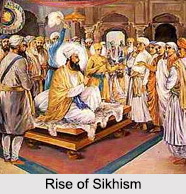
The Gurus of Sikhism Amar das, Arjun Singh, Teg Bahadur,Gobind Singh played a dominant role in the spread of Sikhism .
  Akali movement      

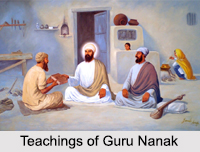
Guru Nanak JiGuru Nanak(1469-1538) sculpted Sikhism on the elevated ideology of Equality. His clarion call to the sea of humanity echoes in the modern-day dream of a global unity- "na ko hindu, na ko musulman", approximates to "There is no Hindu, there is no Muslim" . His keen interest in the unexplored mysteries of the world , enhanced his spiritual quest . He discovered the paramountcy of the Omnipotent . A true messenger of God, Guru Nanak , went ahead to distribute the precious "TRUTH" among the ignorant mass. His teachings generated a resurgence of reformation that precipitated into the growth of Sikhism .

Guru Angad Dev JiNanak found his follower Lahina as suitable for holding the candle to the heritage of Guruship.In 1538, Lahina was elected the Second Guru. He was renamed as Guru Angad Dev. Guru Angad Dev is merited for the presentation of the Gurumukhi script, sacred to the Sikhs.The entire 1430 pages of Guru Granth Sahib are written in this script.

Guru Amar Das ,hailing from the Bhalla clan, came to the limelight as the Third Sikh Guru. He , was that high priest of gender equality and humanity who abolished Guru Amar Das Jithe curse of "Purdah" and "Sati". He placed women on an equal status with men.He gave training to 146 of his able disciples to circulate the message of Sikhism.Among them, 52 were women. He motivated his people to keep alive the practice of Langar. It was his credit that in 1567, even the Mughal Emperor , Akbar, sat with the poor and commoners , to share a meal together in Langar.

After Guru Amar Das`s son, Guruship was assigned to his son ,Guru Ram Das in 1574 . He extended the sway of Sikhism to the city of Ramdaspur, which later came to be called Amritsar-the epicentre of Sikh pilgrimmage.

Arjun Dev JiIn 1581, Guru Arjun Dev , the youngest son of the fourth Guru followed the footsteps of his ascetic father. He supervised the construction of the Harimandir Sahib or the Golden Temple in Amritsar.He composed the Holy Book , "Adi Granth"which is a compilation of the valuable teachings of the first Five Gurus. However his denial to introduce changes in the "Adi Granth", and support provided to an unsuccessful contender to the throne, got him atrociously killed by the then Mughal Emperor, Jahanghir in 1606.

Guru Har Gobind JiGuru Har Gobind (1595-1644), turned out to be the Sixth Guru in 1606. He abided by the "miri and piri" norm in Sikhism by carrying two swords -one for the spiritual and the other for the temporal causes. The aftermarth was that Sikhs rose into an organied community , bearing a defence force for fortifying independence . Sikhs grew as an organised community and always had a trained fighting force to defend their independence.

Guru Har Rai(January 1630- October 1661) , the next and Seventh Guru was Guru Har Rai peace-loving and yet, continued preserving the army ,that his grandfather , Guru Har Gobind had standardized. Guru Har Krishnan, the boy Guru, (1656-1661) was nominated as the Eighth Guru.He was supposed to be invested with supernatural powers. It is said that once when smallpox broke out as epidemic in Delhi, the lake at Bangla Sahib became a panacea by his blessings. Hundreds got cured .After his death, at the age of about seven-eight years, the grateful followers built a Gurudwara at Bangla Sahib, the spot of his cremation.

Guru Teg Bahadur JiGuru Teg Bahadur, the granduncle of the previous Guru, remained the Ninth Guru from1665 till 1675. He extended his help to the tortured Kashmiri Pandits and the Hindus , threatened by death-sentences imposed on them by the fanatic ruler Aurangzeb on grounds of non-conversion to Islam. His role as the saviour , unfortunately snatched away the life of this martyr , heniously executed by the awful Aurangzeb. Guru Teg Bahadur`s son Gobind Rai (1666-1708), ascended to Guruship at the tender age of nine on November 11,1675. He inherited the indomitable and chaste spirit of his father.He soundly made his followers courageous warriors. He innovated the Khalsa Panth. He was baptised by Panj Piare, a chief apostle of Sikhism in 1699. The ceremony of baptism , made him the honorable Guru Gobind Singh. Khalsa assumed the dimension of the Sikh Nation/Community.Guru Gobind Singh made the proclamation: "Sab sikhan ko hukam hai guru manyo granth (All Sikhs are commanded to take the Granth as Guru").In fact, the Granth , is saluted as the Living Guru by the breed of Khalsa.

Dasamgranth or the Dasven Paatshah Ka GranthGuru Gobind Singh also prepared the Dasam Granth or the Dasven Paatshah Ka Granth (The Holy Book of the Tenth Emperor). He lost his dear family members to the sabotage led by the malicious Mughal ruler . He was a saint as wellas a soldier who formed the Khalsa army .

Banda Bahadur (1670-1716) became the commander of the Sikh army in the post-Guru Gobind Singh period. He cast many raids against the hostile Mughals , to stop their pernicious persecutions against the Sikhs. He died a martyr , being assassinated by the Mughal Emperor, Jahandhar Shah. He rejected the disgraceful mercy to change into Islam,which might have spared his life.

The absence of Banda Bahadur, spawned a loose knot of Sikh militants known as misls. The decline of the Mughal Empire was marked by the rise of the Sikhs under the outstanding leadership of Maharaja Ranjit Singh on April 12, 1801. Ranjit Singh architectured a pan-Sikh empire which earned for Sikhism, a national identity. However with the death of the monarch ,the empire crumbled into dust , owing to the turbulent Anglo-Sikh Wars. British overpowered their land of Punjab.

Sikhs joined the freedom-fighting of Indian National Congress. The resolute Sikhs cemented their Sikh foundation through the setting up of Shiromani Gurudwara Prabandhak Committee and the Shiromani Akali Dal. The weird Partition of 1947 witnessed a massacare of thousand Sikhs and forced immigration to West Punjab as destitute refugees.

Nevertheless , nothing can vanquish the invincible Sikhs.In1970`s the state of Punjab flourished with the boon of Green Revolution . Punjab tasted optimum progress and prosperity.Today, the Sikhs stand forthright as an educated and successful community all over the globe.

(Last Updated on : 27/01/2009)
  More on Sikhism...
 
Guru Grantha Sahib Khalsa Rise Of Sikhism
Dera Sacha Sauda History Of Sikhism Concept of Sikhism
Guru Granth Sahib Hari Rai Japji Morning Prayer of Sikhs
Akali Guru Gobind Singh Guru Arjan Dev
Guru Angad Dev Principles Of Sikhism Spread Of Sikhism
Holy Scriptures Of Sikhism Influences On Sikhism Sikh Gurus
Sikh Philosophy Sikh Festivals Guru Tegh Bahadur
Recently Updated Articles in Indian Religion
  • Hindu Gujjars in India
    Hindu Gujjars in India have their own culture and they do not possess any identity market. The livelihood of the Hindu Gujjars depends entirely on the availability of the cereals and milk products.
  •  
  • Religion of Gujjar Community
    Religion of Gujjar community is divided into two main parts - Hindu Gujjars and Muslim Gujjars. Each of the section is again sub-categorized into several gotras.
  •  
  • Van Gujjars in India
    Van Gujjars in India are entirely dependent on the forest produce for their livelihood. They follow Islam and they are more popularly known as Forest Gujjars.
  •  
  • Vastu of Temples
    Temple Vastu in Agni Purana specifically describes the construction pattern which should be followed by any divine mansion.
  •  
E-mail this Article | Post a Comment
Free E-magazine
Subscribe to Free
E-Magazine on Indian Religion

 
Rise Of Sikhism - Informative & researched article on Rise Of Sikhism
Sitemap
Contact Us   |   RSS Feeds
Copyright © 2008 Jupiter Infomedia Pvt. Ltd. All rights reserved including the right to reproduce the contents in whole or in part in any form or medium without the express written permission of Jupiter Infomedia Pvt. Ltd.