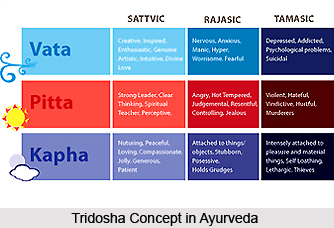
 According to Ashtang Ayurveda, health refers to that state in which the three doshas are perfectly balanced and the five senses as well as the soul are working in harmony. According to Ayurveda, the disparity in the doshas is manifested in the body in the form of disease.
The ancient sage, Charaka suggests that there can be three causative factors behind any ailment. These three are related to the mental, physical and environmental factors. As long as these factors remain balanced, the three doshas function properly and there are no signs of disease. The body becomes vulnerable to disease when the casual factors become unbalanced, which can take place due to three reasons: an excessive (atiyoga), deficient (hinayoga or ayoga) or incorrect (mithyayoga) action or situation. These three causal factors are the improper contact of the senses with their respective objects (asatmendriyartha samyoga), the improper use of the intellect (pradnyaparadha), and seasonal variations (kala or parinama).
Literally, the word Pradnya means "wisdom" or "intelligence", and apradha means "offence". So the meaning of pradnyaparadha becomes "an offence against wisdom". In other words, it signifies those thoughtless actions, which are undertaken without determining whether those actions will be detrimental to the proper functioning of the body. These actions may be verbal, mental or physical. The actions stimulated by pradnyaparadha worsen the tridosa system in the body and stimulates the gunas of rajas and tamas creating a pathway through which disease can enter the body. Excessive or atiyoga forms of this factor comprises talking too much, or excessive reading, thinking, mental work or physical activity.
A deficiency or hinayoga of these actions incorporates things such as not speaking at all or speaking very little, and not working or engaging in any academic or physical activity. Incorrect (mithya yoga) forms of pradnyaparadha include tittle-tattle, lying, instigating violence and irrelevant, illogical or unkind speech. Actions that are induced by ravenousness, fury, material attachment, envy, ego, fright, sorrow or delusion can also be included under mithyayoga. The physical manifestation of this condition includes activities like the suppression of natural urges or taking part in perverted activities such as excessive smoking of cigarettes inspite of health warnings on packets, drinking alcohol while being completely aware of its adverse effects, driving recklessly or indulging in dangerous sports. In brief all actions that have a negative impact on the body and mind can be categorised as mithyayoga.
In conclusion we can say that Pradnyaparadha refers to those actions, which are undertaken in spite of being aware of the potential dangers. This, along with the other two causative factors hampers the body`s normal physiological functions thus making the body home to various ailments.