


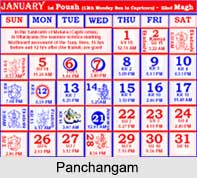
 Panchangam is a Hindu astrological calendar that is based on traditional aspects of the Indian cosmology, presenting essential astronomical data in a tabular format. These calendars forecast heavenly phenomenons such as eclipses, weather conditions like rain or dry-spells, and other regular happenings. Panchangams are produced by avid researches conducted by learned authors, universities, societies and academies. Panchangam is a Hindu astrological calendar that is based on traditional aspects of the Indian cosmology, presenting essential astronomical data in a tabular format. These calendars forecast heavenly phenomenons such as eclipses, weather conditions like rain or dry-spells, and other regular happenings. Panchangams are produced by avid researches conducted by learned authors, universities, societies and academies.
Etymology of Panchangam Panchangam is a Sanskrit word, which is also called ‘Panchanga’ meaning "having five limbs". Panchangam in Indian Astrology Indian astrology is concerned with the movements of the different celestial bodies which comprise the traditional belief system of the Hindus. It is also known as "Jyotish", which is an Indian term for Astrology. It forms a part of the branches of the Vedanga descending from the Vedas. Positions of Sun, Moon and other planets for every day of the year on a fixed place (longitude, latitude) and time of day (in 24-hour format IST) are the typical things mentioned in the Panchangam. Panchangam in Vedic Calendar Vedic calendar gives information about astrological factors, heavenly bodies like planets and stars. The Vedic Calendar can be called a modern panchangam which also include Western calendar information. Panchangams in Vedic calendar helps the individual to understand and supervise the predominating forces of each day, furnishing knowledge to understand things like auspicious moments or "muhurtas" for new ventures and avoiding the unlucky ones where energy will be wasted. Important Elements in Panchangam The important elements in Panchangam employ the Nirayana (sidereal) zodiacal system in the Panchangam which includes; Tithi: The Sun and the moon are at an angular distance, which can be measured from the earth. This distance is divided in 30 parts, and the moon spends a certain time in these parts, which is known as one ‘Tithi’. Tithis help in determining the bright fortnight, and dark fortnights, which are known by names like ‘Purnima’ and ‘Amavasya’ respectively. Tithi for a day is the time in which the moon is at the time of sunrise. These tithis are important for religious ceremonies, rituals, determining the "kundli" of a newborn and so on. Nakshatra: Nakshatras are lunar houses reflecting the moon's cycle against the fixed stars. One or many stars characterize them. Karana: Karana is again a technical term that is calculated as half of a tithi. Yog: Yog is another important part of the Panchangam, which involves a calculation of the longitudes of the sun and moon into 27 parts. Vara: Varas are the names of the seven days of the week involving the alternate names of the celestial bodies. Significance of Panchangam Different nuances of the Zodiac signs, their effects on individuals, good and bad phases in human lives are determined often by consulting the Panchangam. Auspicious dates suitable for weddings and other ceremonies are also fixed by consulting the Panchangam. Panchangams furnish astronomical information that is helpful for astrologers and for religious events. Panchangams are hence very integral to the system of Indian astrology and also an important component for day to day activities. They provide information based on different technical nuances in astrology and consulted by astrologers as well as the commoners. |
| |||



Panchangam
| Panchangam is a traditional Hindu almanac having close associations with Indian cosmology. |
| ||||||||||||||||||||||||||||

