 The office for the Indian Governor-General of the Presidency of Fort William was created in 1773 for administering the Indian subcontinent. These offices were initially supervised by the East India Company and later with the transfer of powers this office was administered by the British Raj. While discussing about the British Governor generals one cannot possibly miss out the French Governor-General, Dupleix. However the Battle of Plassey ensured the supremacy of the British East India Company in the subcontinent. The reign of the Indian Governor-Generals began with Robert Clive in 1765.
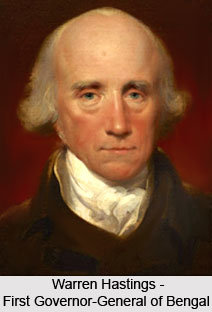
The first Governor-General of Bengal was Warren Hastings. His proficiency and abilities were undoubtedly the best that the Company ever had. He held the office of Indian Governor-General from 1772 to 1785. He introduced numerous administrative, revenue and judicial reforms. Hastings was also the commander in chief of the British army during the Anglo-Maratha and Mysore Wars. He was succeeded by Sir John MacPherson (1785-86) and then Lord Cornwallis (1786-93). The latter was responsible for further consolidating the British Empire in India. He introduced the Permanent Settlement Act in Bengal and several other administrative reforms. Sir John Shore stepped into his shoes in 1793 and held his office till 1798.
Lord Wellesley was appointed as the next Indian Governor-General in 1798. His tenure continued till 1805. Within this span Hastings introduced the Subsidiary Alliance system. After appointing Sir George Hilario Barlow (1805-07) as the provisional Indian Governor-General the British Raj delegated the charges to Lord Minto in 1807. He was succeeded by the Earl of Moira; then by John Adam and finally by Lord Amherst in 1823.
But it was William Bentinck (1828-35) who succeeded William Butterworth Bayley who made a huge impact on the socio-cultural scenario of India. He abolished the Sati act, suppressed child sacrifices, infanticides and adopted liberal policies towards the Press. Lord Dalhousie is another Indian Governor-General who created a lot of ripples during his tenure. He was appointed Governor General of India in 1848. His eight years of rule is considered one of the greatest periods of British rule. His policy of Annexation was a lethal weapon of conquest that raised the rule of the East India Company to the height of glory.
Other Indian Governor-Generals of the British Raj were Earl of Elgin, Sir Robert Napier, Sir William Denison, Sir John Lawrence, Lord Mayo, Sir John Strachey, Lord Napier and Lord Northbrook. After 1876 a transfer of powers took place. As a result the administration of India was directly taken up by Britain. The office was Indian Governor-General from then on came to be known as Indian Viceroys.