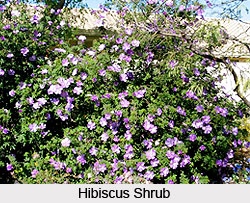
 Hibiscus shrub is rather large, containing numerous species which generally grow in warm temperate, subtropical and tropical regions in the country. These shrubs are the members of the Malvaceae family. They are called in many names in different languages in India. In Hindi, they are called as Lashand. In Bengali, they are named Joba. They are known as Sembaruthi and Sappartu Pu in Tamil language and in Malayalam, it is commonly known as Chemparathi. The flowers of the Hibiscus shrub appear throughout the year and the sunbirds and tailorbirds really are fond of them. All the varieties are scentless although there are some exceptions. Usually, the flowers open in the morning and are dried up after lasting about twelve hours. The Hibiscus shrub should be shortened frequently in order to ensure maximum number of blossoms.
Varieties of Hibiscus Shrub
There are four major types of the Hibiscus shrub. They are the H. Mutabtlis, H. Rosa Sinensis, H. Syhacus and the H. Schizopetalus. The first species is famous as the Changeable Rose. The vernacular names of this species are Gul-i-ujaib, Sthalpaddo and Oru. Though it is not a rose, it can be easily said that the names were given because of the appearance of its double varieties. The shrub blooms in the months of September and October. It can grow large or small, tending to be straggly and contains some unique leaves. If the shrub is pruned heavily after the flowering period, the shrub will produce another colour of flowers in the winter and again in a later period. The leaves of the shrub are large and like hearts in shape. They are almost as broad as they are long and they have five veins that radiate to the point of each hazy lobe. The edge of the leaves is indent and the whole leaf and stem remain covered with a fine down. The large flowers are in the typical variety and 7.5 to 10 cm. across. They are of pure white colour in the morning and slowly turn through pale pink to deep rose in the evening.
The other varieties of the Hibiscus shrub remain white, then change from pale to dark pink or remain pink. The flowers generally dry out before nightfall, but the flowers can be retained in its colourful appearance few hours after plucking by keeping them in a cool area. The fruit of the shrub is a little, hairy capsule.
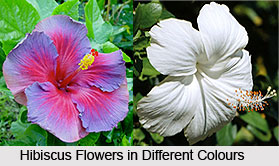 Except the scarlet Hibiscus, all other flowers lose their red colouring matter during the day. The species H. Rosa Sinensis is a big evergreen shrub. This is known as Jasud or Juwa in India. It can be stated as the most common and most beautiful amongst all of them. The Jasud can form a fine ornamental hedge.
There are some double varieties of the shrub at present and a lot of new colours like white, yellow, pink, orange, terra cotta, cerise etc. have been introduced. The leaves of the Hibiscus shrub are bright green in colour and shaped like ovals. They are pointed at the top and roughly toothed except round the base. They normally grow alternately on a short stalk. At the bottom of the stalk, there is a slim bract. The lovely flowers hang like open bells amongst the leaves. They have some long bunches of stamens. The calyx is unusual. It circles the five sepals and makes the appearance of a secondary calyx that is comprised of several narrow pointed leaves.
The species named H. Syriacus or Althea Frutex is called as Swet Joba in Bengali language. It also contains a very lovely name of Rose of Sharon. Shrubby Althea is another name of this species. It can thrive best in the hilly regions and also produces some lovely white, blue or mauve flowers. The flowers are either single or double and they grow to about 2.7 m. Just like the hollyhocks, they too spring from the axils of the leaves. Another species of the Hibiscus shrub is H. Micranthus. It is a strong and shrubby plant that is often seen in hedges in the hotter parts of India. The leaves of this species are deeply indent and the flowers are single, tiny and of pink coloured.
Uses of Hibiscus Shrub
Most of the species are grown for the purpose of decorating gardens for their exuberant beauty. Some species are also utilized to lure bees and butterflies. Hibiscus shrubs also form a key ingredient on some forms of herbal tea. Kenaf, another species, is used for making paper. Some people also use Hibiscus as a hair decoration on festive occasions and sometimes in funereal rites.